
Building democracy, one brick at a time
At the Brickworld Lego expo held in Grand Rapids during ArtPrize, a volunteer’s lesson on ranked choice voting using Legos captured hearts—and over 756,500 TikTok views.

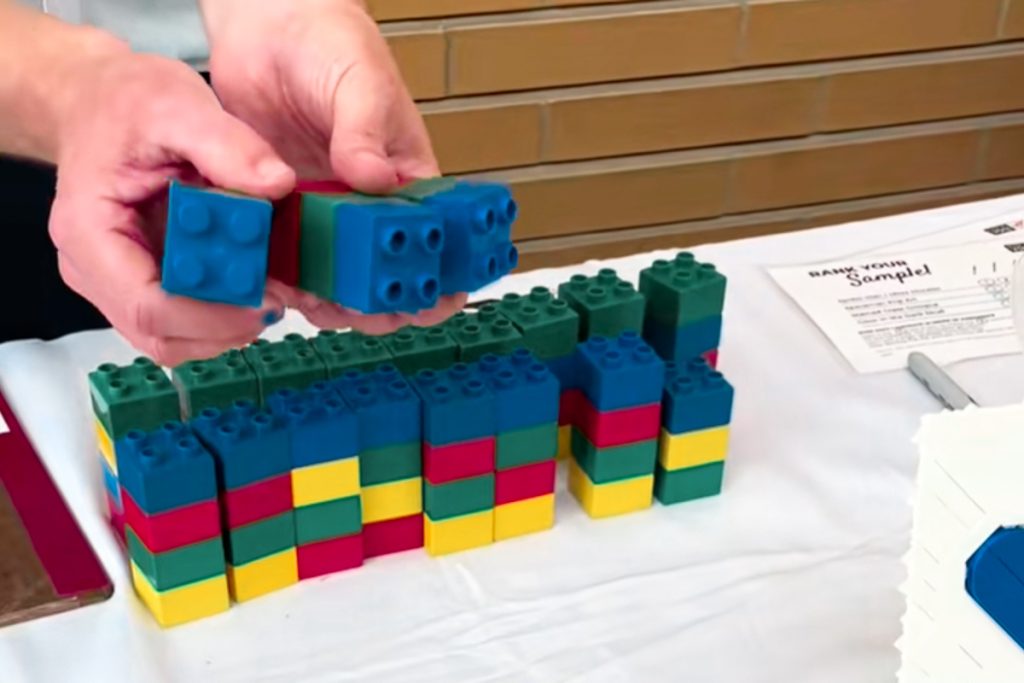
At Grand Rapids’ Brickworld, an expo devoted to Lego creations and displays held at DeVos Place during ArtPrize, a straightforward civics demonstration went viral online when a volunteer’s Lego demonstration of ranked choice voting, recorded by TikTok creator @sliqjonz, garnered over 756,500 views and continues to grow.
Grand Rapids resident Daniel Biber, a tech-sector professional and volunteer with Rank MI Vote, delivered the explainer and arranged the demonstration for those interested in voting on the winning mosaic at Brickworld.
“I’m just a normal Michigander,” Biber says. “While I work in the tech sector, I’m also a local volunteer who really likes how ranked choice voting works.”
Rank MI Vote is circulating petitions to put a Michigan constitutional amendment on the ballot in November 2026 that would bring ranked choice voting to the state.
In ranked-choice voting, voters rank candidates in order of preference rather than choosing just one. In single-winner elections, if a candidate does not receive more than 50% of the first-choice votes, the candidate with the fewest votes is eliminated, and their votes are redistributed to the voters’ next-ranked choice. This instant-runoff process continues until one candidate secures a majority.
Stacking the votes
Biber explained that the appeal of using Legos lies in their familiarity and tactile nature, which are fundamental elements in many educational approaches.
“Lego makes a perfect conduit for learning as it’s a toy everybody knows. It’s fun, actually,” Biber says. “And once the Legos are stacked in this example, it becomes really easy to illustrate how ranked voting works.”
While preparing to volunteer at Brickworld with his son, he suggested using a ranked-choice voting system for guests to select their favorite Lego mosaics.
Brickworld attendees scanned the code to cast their votes. When they had questions, he walked them through his Lego explainer, outlining what is shown in the TikTok video.
“It worked very smoothly because everyone was already attending ArtPrize and was familiar with voting for art, so the audience was already in the right mindset.”
And while the video was trending over the weekend, Biber didn’t see the TikTok until a colleague sent it to him later.
“I didn’t learn about it until Monday when someone wrote me to say that they had seen it shared to Facebook,” Biber says.
Explaining the concept
He offered a simple reason as to why it connected.
“I honestly think it connected with folks because it’s fun,” says Biber. “The fact that it’s colorful, fast, and easy to understand makes it approachable. In fact, it’s easy enough that somebody who’s 5 can easily understand it.”
Although he appreciates the attention his demonstration has gained, Biber credited the TikTok recorder for capturing the moment.
“We definitely owe the poster of the video a lot of credit,” he said of @sliqjonz, who filmed and edited the clip.
Biber not only appreciates how it could achieve excellent results in the civic sphere, but he also mentioned that he already observes this in action in people’s daily lives.
“As soon as we explained it to folks, we would often hear feedback like, ‘Oh, yeah, that’s just how I decide on dinner,'” says Biber. “There are just so many other examples where we rank our choices in order of preference. So if your first choice doesn’t have a chance to win, your vote still counts—just for your next-ranked choice.”
Civic significance
Ranked choice voting isn’t new in America.
“Alaska and Maine are the two other U.S. states that have accomplished this,” he noted, adding that several Michigan townships have already approved ranked choice voting. (Australia, Ireland, and Malta have had ranked choice voting for over a hundred years.)
Biber is hopeful that ranked choice voting can reduce polarization within the political process.
“In a ranked choice voting election, candidates need the support of more than 50% of the votes. You’re not going to be mean to people who like [another option], so you’re going to be trying to make friends,” he says. “When you are asking for second‑ or third‑choice support, it is far less likely to resort to name-calling or even mudslinging.”
Although he is a volunteer in this campaign, the importance of his role now extends beyond just collecting signatures and generating pageviews. This new teaching tool enhances the cause and helps reach an audience on TikTok, a platform popular among younger voters.
Biber’s favorite part of the weekend was repeating the demo dozens of times and watching “that aha moment” as a light bulb came on for both kids and parents.
“It could absolutely be game‑changing,” he says of the video and what it could mean for Michigan to welcome ranked choice voting.
To learn more about the Michigan effort, visit Rank MI Vote’s website at https://rankmivote.org/. To sign the petition or volunteer, use the resources on their site to find a nearby canvass or learn how to get involved.
Photos provided by Biber and Ranked MI Vote.
Related Articles

Shark Tank stars kick off Tech Week Grand Rapids
Daymond John and Robert Herjavec open a week that celebrates innovation, entrepreneurship, and West Michigan’s growing technology community.

Trinity Health and Michigan community groups will make fresh, local food a Medicaid benefit
A new Trinity Health initiative will allow people in the Ann Arbor, Detroit, and Grand Rapids areas to access fresh, affordable produce from local organizations through their Medicaid health plans.
Voices of Youth: Lessons learned from listening to young people
Over the past three years, Voices of Youth has shown us that by actively listening to what young people want, we often develop better ideas. Here, Publisher Tommy Allen reflects on the achievements and lessons learned over three years with Voices of Youth.


