
New toolkit helps Michigan communities design homes for everyone
A new statewide toolkit guides planners and developers to build accessible housing that supports aging residents and people with disabilities.
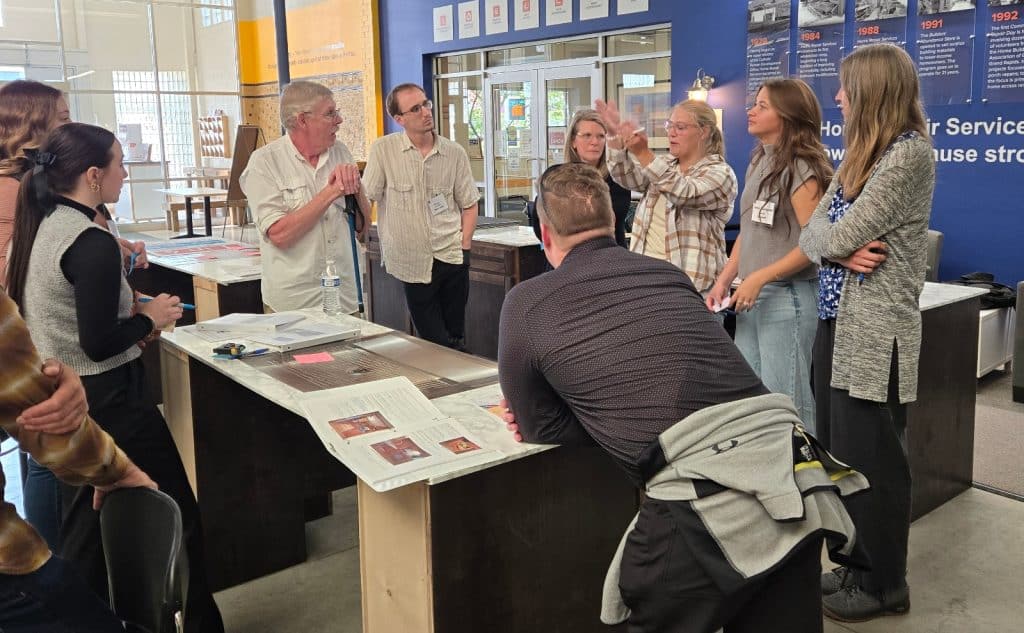
In many housing developments, accessibility shows up as a checklist: a ramp here, a wider doorway there.
While that satisfies the law in the limited places where this is required, it often fails to meet other needs of people with disabilities. A new statewide project in Michigan is working to change that.
The effort centers on a new toolkit created by Disability Advocates of Kent County, the Michigan Association of Planning, and the Michigan Disability Network. The project is funded by a grant of more than $100,000 from the Michigan State Housing Development Authority, or MSHDA.
Advocates say the toolkit will influence future development by helping planners, developers, and local leaders think about accessibility earlier in the process, rather than trying to fix problems after projects are built.
“At its core, inclusive design means that people with lived experience of disability are part of the design process,” says Megan Spitz, departmental manager of the Office of Housing Strategies at MSHDA. “It’s not just about meeting the bare minimum requirements of the Americans with Disabilities Act. It’s about designing spaces that truly work for everyone.”
A broader view
The ADA and the Fair Housing Act created essential protections. But many advocates argue that it also unintentionally narrowed how housing accessibility is approached.
“This shows that accessibility doesn’t have to mean a single, isolated ‘special’ unit,” Spitz says. You can design housing that’s accessible, attractive, and desirable for anyone – homes that allow people to age in place and live independently, with features so thoughtfully integrated you don’t notice them until you need them.”
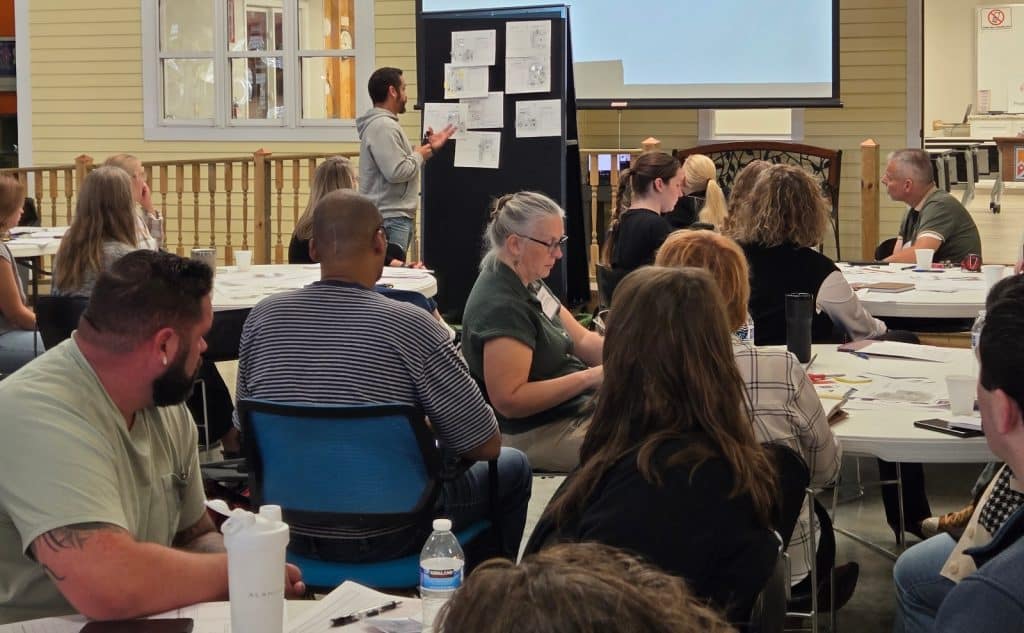
She says developers now can plug templates into their designs, whether the unit is attached or detached, for rental or ownership, that go beyond basic compliance and show greater possibilities.
The toolkit also looks beyond individual projects.
“It could be making planning notifications more accessible by using plain language,” Spitz says. “It could be looking at zoning ordinances or policies that unintentionally create barriers. It’s a larger document that gives many different ideas of how you can increase access in the community.”
Familiar collaboration
The project is led by Disability Advocates of Kent County. Its executive director, Dave Bulkowski, who has spent years working at the intersection of disability rights and housing policy, partnered with the Michigan Association of Planning (MAP) to bridge the gap between advocacy and municipal governance.
“This is exactly why we partnered with MAP. Their attention to detail and professionalism shine through,” says Bulkowski. “The tool kit will definitely be part of our work with area municipalities, builders and developers, and those around the state working with other Disability Network Michigan members.”
Part of the project consisted of first bringing together the design community to develop templates for inclusive kitchens and bathrooms.
“In the past, when we have said to architects, interior designers, and developers that the building code and the ADA are the minimal requirements and that they can do more, their typical response has been: ‘Tell us what you mean by more,’” says Bulkowski.
The templates designed through this process, led by Jolene DeJong of DeJong Design Consult LLC, answer that question in tangible ways.
“While the four templates of inclusively designed kitchens and the four examples of bathrooms are not construction documents, they give excellent suggestions for designers to incorporate into existing plans,” Bulkowski says.
The project also recorded Disability Advocates’ one-hour course, An Overview of Inclusive Design and Residential Construction, which the staff has been delivering in person for years.
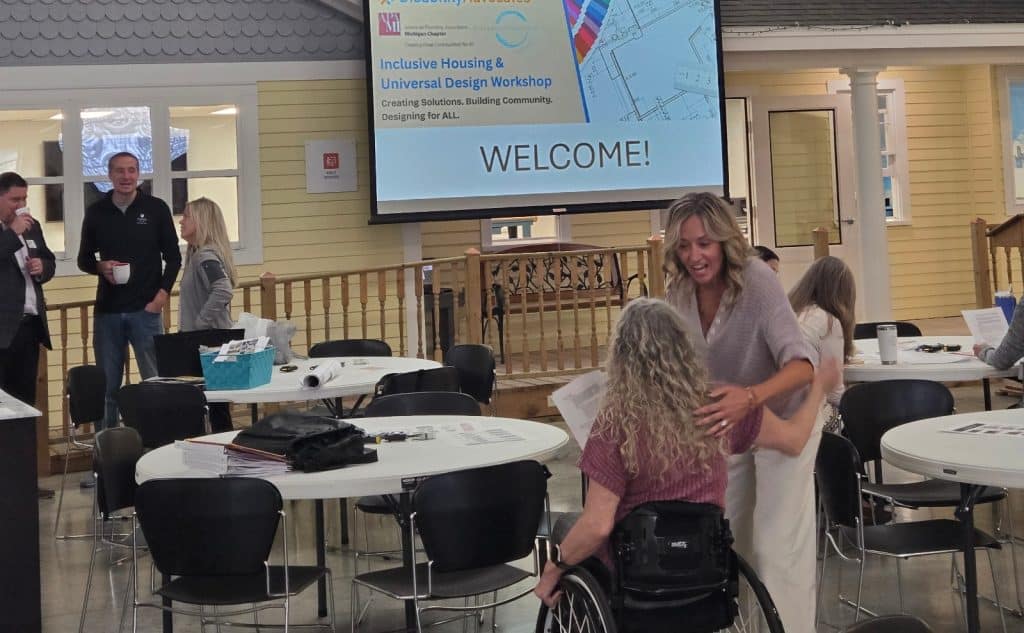
“Having seen the rough cuts of the video,” he says, “I’m really excited to release it along with the templates to folks who will be able to watch it when they have the time, as opposed to us needing to travel across the state or even across town. Of course, we will be willing to make such in-person presentations, because those really are second to none.”
The templates for inclusively designed kitchens and bathrooms will be presented via a webinar on Feb. 18 and 25, and then will be available, along with the presentation, on the Disability Advocates webpage.
Andrea Brown, executive director of the Michigan Association of Planning, says the collaboration was years in the making.
“I’ve been sitting at tables with Dave Bulkowski for 20 years,” Brown says. “When the voice of planning is needed at a table, I’m there, and when the voice for disability issues is needed, Dave is there.”
Together, they divided the project into two parts. Disability Advocates focused on physical space, while the Michigan Association of Planning concentrated on policy frameworks.
“Our piece is developing guidelines for local officials to adopt policy into their local comprehensive plans,” Brown says. “Then, secondarily, zoning and regulatory changes that will implement those visions.”
The idea was to combine physical design with policy reform, heightening the impact of both.
“We saw an opportunity to bring together the physical space and the policy space to really amplify the message,” Brown says.
Beyond building codes
Amy Vansen, project manager at the Michigan Association of Planning, says one of the most common misconceptions among planners is that accessibility is primarily a building code issue.
“Planners get accessibility, but I really felt like, well, this is a building code thing,” Vansen says. “But really, the plan lays out the vision, and that’s where these conversations need to happen.”
She adds that building officials are limited by code requirements. Planning officials, on the other hand, can influence projects long before blueprints are finalized.

This distinction becomes especially important for what planners call “missing middle housing” — duplexes, triplexes, and small multi-unit buildings that are increasingly seen as a solution to housing shortages.
“Missing-middle housing like duplexes is not something the ADA really has authority over,” Vansen says. “So if you want duplexes to be barrier-free, you need to do that at the planning stage. You can’t assume the code will do it.”
Without early intervention, accessibility often becomes optional, rather than integral.
Rather than relying on regulation alone, the toolkit emphasizes incentives and collaboration. Municipalities are encouraged to offer expedited review, reduced development fees, or streamlined permitting for projects that prioritize accessibility.
“A municipality has a lot to say,” Vansen says. “Whether it’s expedited review or reduced fees, there are incentives.”
From a market perspective, she says, accessible housing is also good business.
“You’re going to have a much more marketable product if it’s more accessible and beautiful,” Vansen says. “It can be both. It doesn’t have to remind you of a hospital.”
Facing an aging population
Population changes are a main reason for the program. Spitz says developers increasingly recognize the value of universal design as Michigan’s demographics shift. The state has one of the fastest-growing older populations in the country,
“People want to age in place,” Spitz says. “They want homes that work for them now and later.”

However, planners say, many homes are not ready to meet their needs.
“Michigan has an aging population that is really going to impact all of us in every way,” Brown says. “Our population pyramid is getting so old, and there’s not nearly enough accessible housing for this burgeoning group.”
Vansen frames it more personally.
“Eventually, the stairs are going to be hard if you live long enough,” she says. “So aging in place is about how can we get people thinking about this ahead of time.”
The toolkit encourages planners to think about the full spectrum of mobility, including families with young children, workers recovering from injuries, or residents dealing with temporary or permanent health changes.
“This isn’t just for people with disabilities,” Brown says. “It’s for the young mom with a stroller, for older adults, for anyone whose body changes over time.”
Filling a resource gap
While larger cities like Grand Rapids, Detroit, and Ann Arbor often have professional planning staff and access to technical resources, many Michigan communities do not.
“They don’t have the capacity or even awareness that this is an issue,” Brown says.
Those communities, she says, are a major target audience.
“The goal is really to deliver the message to those who may not be thinking about it yet,” Brown says. “An incremental increase in awareness is probably a better way to describe it.”
The Michigan Association of Planning has about 4,000 members, including professional planners, elected officials, zoning administrators, and building inspectors.
After the toolkit’s launch at the Feb. 18 webinar, it will be presented at the Building Michigan Communities Conference in Lansing and other statewide forums. Disability Advocates Kent County will take part in the events alongside planners and housing officials.
“The hope is that this toolkit will be used in local government everywhere,” Spitz says. “But also that advocates and developers use it to nudge communities toward better outcomes.”
Vansen says the question is not whether Michigan can afford to prioritize accessibility, but whether it can afford not to.
“This is the moment to have the conversation,” Vansen says. “Not after the concrete is poured.”
Photos courtesy of Disability Advocates Kent County
Rapid Growth’s Disability Inclusion original story series is made possible through a partnership with Centers for Independent Living organizations across Michigan.
Author

Related Articles
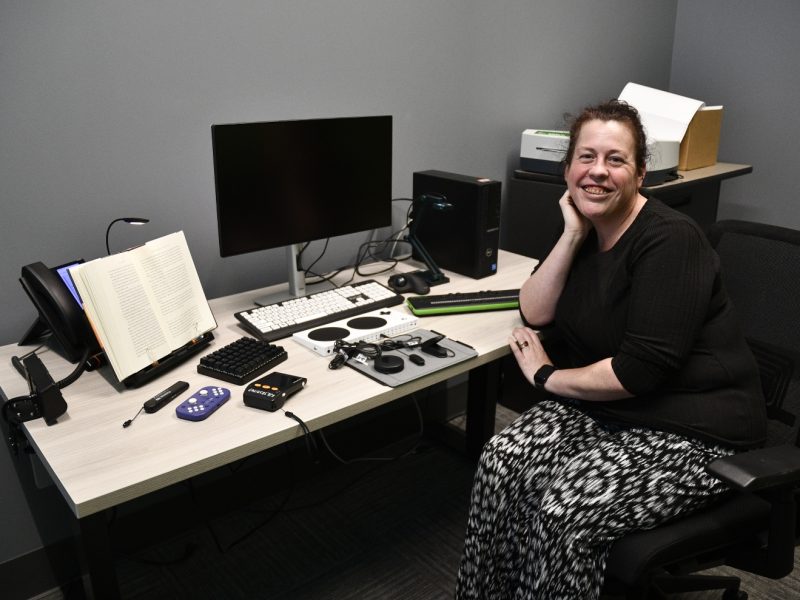
Kent District Library expands accessibility services through technology, training, community partnerships
Shelley Roossien leads Kent District Library efforts to improve accessibility through adaptive technology, staff training, and inclusive library services.

Ticket to Work helps people with disabilities return to work safely
The program offers guidance and support so people with disabilities can work without losing benefits, addressing fears, complexity, and financial instability.
Leadership program helps dental directors improve care in underserved communities
Program supports dental leaders in Ohio, Michigan, and Indiana with skills to manage clinics, improve care, and advocate for underserved patients.


