“You keep going”: Disability and first-generation support help nontraditional student navigate college
Kathleen Camp returned to Ferris State University at 39, using support for first-generation students and services from Disability Network West Michigan to overcome barriers.
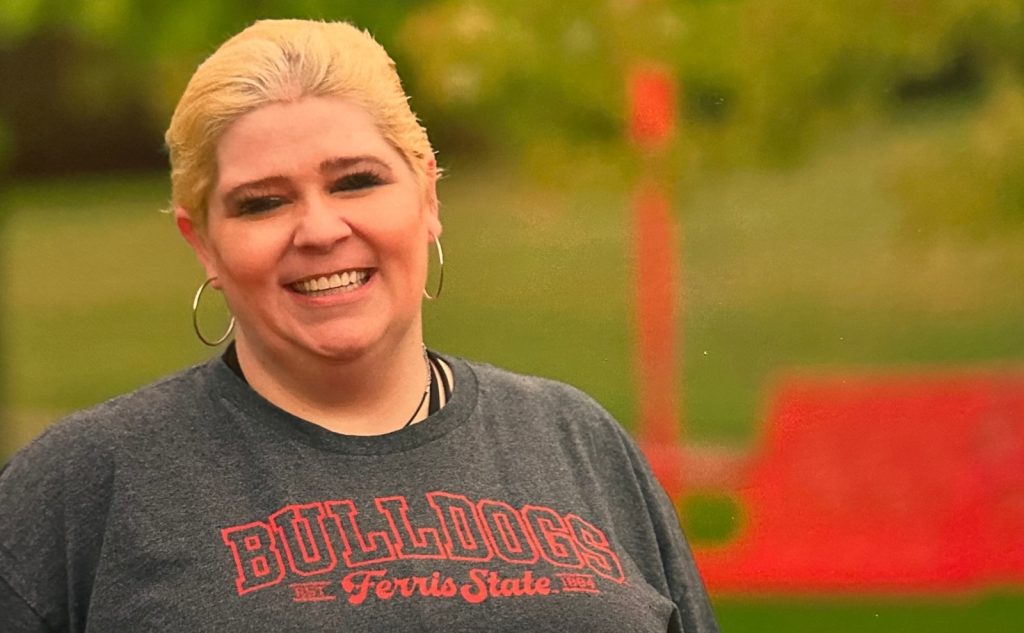
When Kathleen Camp returned to college at age 39 in 2023, she did not follow a traditional academic path. She was rebuilding her life while working toward stability, health, and a future her daughter could see and believe in.
Camp, a first-generation college student at Ferris State University in Big Rapids, completed her master’s in business administration in December 2025 and is now pursuing a second graduate degree in information security and intelligence.
Her academic journey includes long gaps in enrollment, disability-related barriers, and recovery from a violent assault. Her story also highlights how targeted support programs can help students stay in school when higher education systems are difficult to navigate.
“I wanted my daughter to see that even when things happen to you, you don’t stop,” Camp says. “You keep going.”
Challenging return to school
Camp previously earned an associate degree in social work from Mott Community College in Flint and was close to obtaining a bachelor’s degree in psychology. But her education stalled after a failed six-credit course cost her financial aid.
Without resources to recover academically or financially, she stepped away from college for more than a decade.
When she enrolled at Ferris in April 2023, she was navigating college as an older student, a first-generation graduate student, and a person with disabilities. In addition to her health issues, Camp, like so many adult learners, had to balance parenting and financial strain.
Camp credits the first-generation support program at Ferris with helping her regain confidence and momentum. The program helps students navigate advising, campus systems, and expectations that are often unstated.
“People assume you already know how everything works,” Camp says. “If you’re first-generation or you’ve been out of school a long time, that’s not true.”
‘Needed to do something different’
Camp’s return to school came after a traumatic event. In February 2023, someone broke into her Flint-area home and assaulted her, causing severe internal injuries that required a hysterectomy. She enrolled at Ferris shortly afterward while still recovering.
“I felt like my life flashed before my eyes,” Camp says. “I needed to do something different.”
At the same time, Camp was managing chronic health conditions, including brittle diabetes. Requesting accommodations was often a challenge.
“Sometimes you’re told something isn’t possible,” she says. “Then you learn who to talk to, and it turns out it actually is.”
Learning how to advocate for herself was a turning point. Disability services staff worked with dining services during her first semester to address meal access concerns related to her medical needs. The process was lengthy but successful.
“No one explains that you have to ask questions and push back,” Camp says. “That’s something you learn the hard way.”
While working on her undergraduate degree, Camp worked as a cultural reporter for the student newspaper, worked in campus dining services, was a support provider for students with disabilities, completed internships, and did seasonal tax work.
“I was doing three jobs at one point,” Camp says. “That’s not sustainable, but it’s what I had to do.”
Moving into career
Support from Disability Network West Michigan helped Camp translate her academic experience into employment planning. She worked with Leslie Zimmerman, an employment navigator specialist, on career development and job readiness.
“Leslie looked at the whole picture,” Camp says. “Not just what I was doing now, but where I wanted to go.”
Zimmerman showed Camp how to break down job applications into manageable steps. This process included creating a comprehensive skills list that could be adapted for different positions. Camp says the approach reduced stress during the application process.
Meresa Salisbury, a community inclusion specialist with Disability Network West Michigan, also worked with Camp to address challenges commonly faced by adult learners with disabilities.
“Students are expected to navigate education, employment, and benefits at the same time,” Camp says. “Those systems don’t always work together.”
Programs that focus on coordination rather than isolated services tend to improve outcomes, she says.
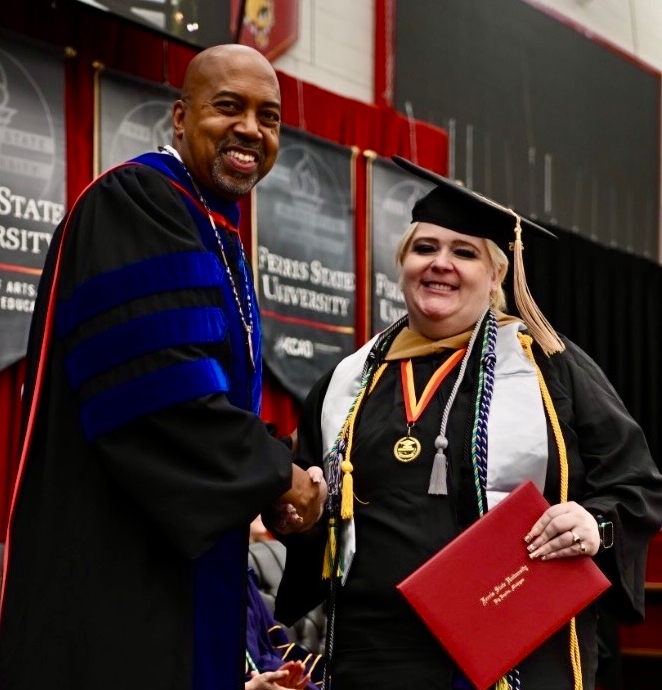
Camp’s persistence led to recognition on campus. She was nominated as Outstanding
Graduate and was invited to speak at a hooding ceremony.
During her speech, Camp spoke about disability access, self-advocacy, and navigating college later in life. The address was recorded and later shared by New Journey Clubhouse, a community mental health organization that supports employment and education.
“Everyone was emotional,” Camp says. “We were all talking about what it took to get there.”
Faculty and staff members attended the ceremony, including Zimmerman, whom Camp invited as a guest.
“Kathleen’s accomplishments are astounding and reflect her discipline and drive,” Zimmerman says. “While attending Ferris State University, she made the dean’s list, worked on campus, supported new students, balanced multiple jobs, earned tax preparation certification, received awards, and raised a daughter — all while completing her master’s degree.”
“I was honored to attend her hooding ceremony,” Zimmerman adds. “Many graduates spoke about balancing work, school, and family, and they all shared the same traits: discipline, dedication, and determination. It was an inspirational event.”
Looking ahead
Camp is studying for a second master’s degree in information security and intelligence. She says the coursework dovetails with the growing reliance on digital systems in nearly every profession, including her current remote tax work. She also has a paid fellowship for Handshake AI as an AI language model training generalist.
“Security and technology affect everything now,” she says. “It’s useful no matter where I end up.”
Her goal is to work in higher education and help students navigate academic processes, particularly those facing additional challenges, such as a first-generation student, a non-traditional student, or a student with disabilities.
“There were times when advisors didn’t have the full picture,” Camp says. “It took a dean stepping in to make graduation possible.”
She believes her experience overcoming struggles can help others.
“People give up because they feel overwhelmed,” she says. “They shouldn’t have to.”
Photos courtesy of Kathleen Camp/FSU
The multi-regional Disability Inclusion series is made possible through a partnership with Centers for Independent Living organizations across West Michigan.
Related Articles
#RG20LookBack: North Monroe’s focus on parks, people, and play is transforming this neighborhood.
For his sixth #RG20LookBack, Rapid Growth’s Tommy Allen revisits Monroe North’s transformation into a vibrant riverside neighborhood shaped by redevelopment.
#RG20LookBack: DACA — A personal view from here to Washington
For his fifth #RG20LookBack, Rapid Growth’s Tommy Allen reflects on thinking he understood DACA—until sudden federal changes forced him to learn faster, listen closer, and document how policy reshapes neighbors’ daily lives.
#RG20LookBack: How neighborhood identity factors into planning a socially productive park
As part of Rapid Growth’s 20th anniversary, we revisit a 2014 innovation story by Anya Zentmeyer, documenting a subtle but significant shift in Grand Rapids public planning sessions and citywide meetings.