Ancient giants and local legends: Public Museum’s new exhibit opens a portal in time
Visit the Grand Rapids Public Museum to explore deep time, where Tyrannosaurs – Meet the Family and the Klapp Family Mastodon showcase a worldwide tale of evolution and a local find that highlights how curiosity is universal.
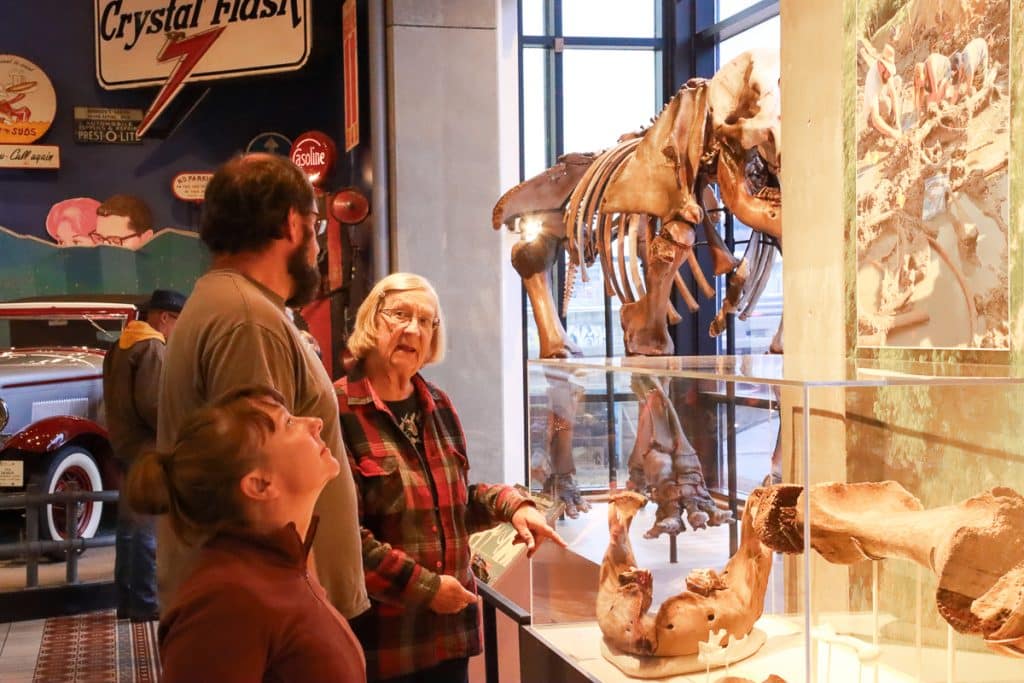
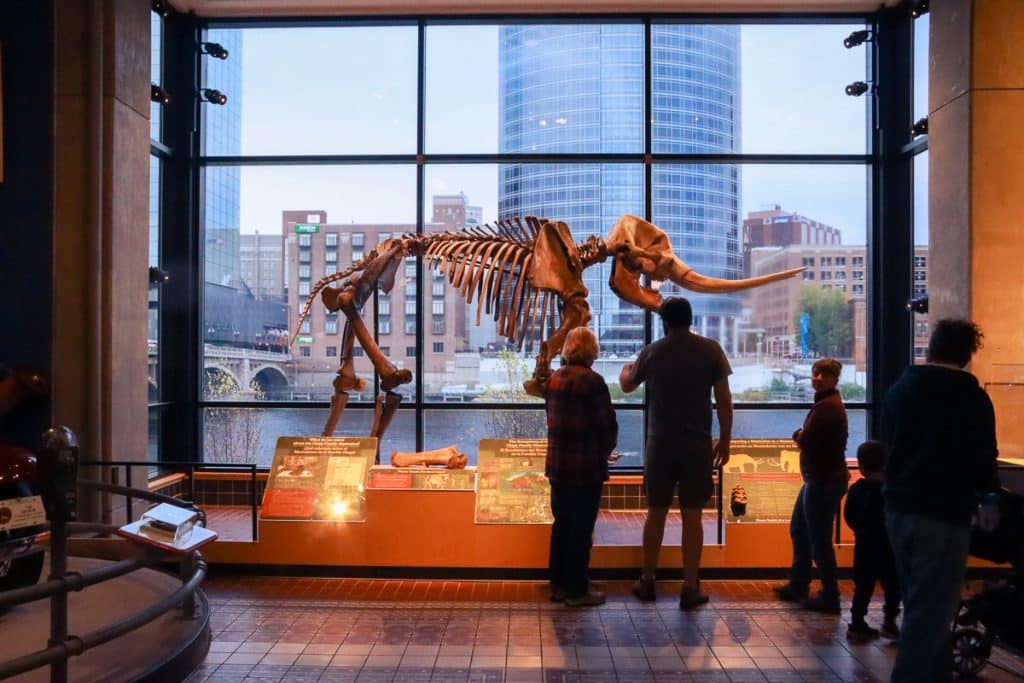
This fall, the Grand Rapids Public Museum (GRPM) unveiled a full 3D model of the Klapp Family Mastodon, constructed from bones found in 2022 north of Kent City. This discovery was not only a scientific milestone but also a captivating local tale of curiosity, generosity, and amazement.
The Klapp family’s donation of the Ice Age creature’s remains to the museum guarantees that future generations will be able to examine them and encounter an ancient inhabitant, preserved in time yet vividly alive. Today, this West Michigan discovery is standing alongside a global phenomenon.
Starting Oct. 11, Tyrannosaurs – Meet the Family invites visitors to travel over 100 million years into the past to see the most complete portrayal to date of the world’s most famous predator family.
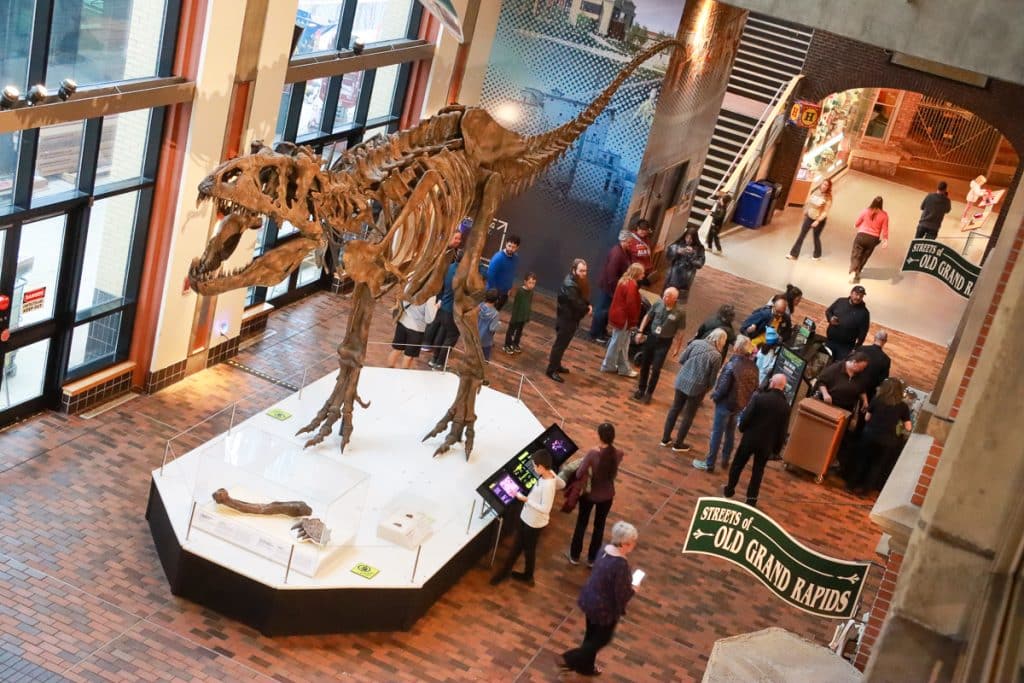
From feathered ancestors to the massive “Scotty,” one of the largest Tyrannosaurus rex specimens ever discovered, the exhibit combines advanced science with the awe that has long captivated our imagination about dinosaurs.
Cory Redman, science curator at GRPM, considers the pairing of the Tyrannosaurs and mastodon exhibits to be more than a mere coincidence—it represents the museum’s strengths.
“We’re always asking how we can take what’s global and connect it locally,” he says, noting that the Klapp Family Mastodon and Scotty illustrate how science carries us across time and place.
The art of awe and evidence
Redman acknowledges that, despite many years of studying fossils, he still experiences a sense of wonder.
“It’s hard not to be impressed when you stand in front of something like Scotty,” he says, referring to the 40-foot-long T. rex cast that welcomes visitors on the museum’s main floor. “Dinosaurs are inspiring. If they get people, even for a moment, thinking about science and the natural world, that’s a success.”
And Tyrannosaurs – Meet the Family goes far beyond spectacle. Created by the Australian Museum, it uses advanced technology to feature the newest paleontological discoveries.
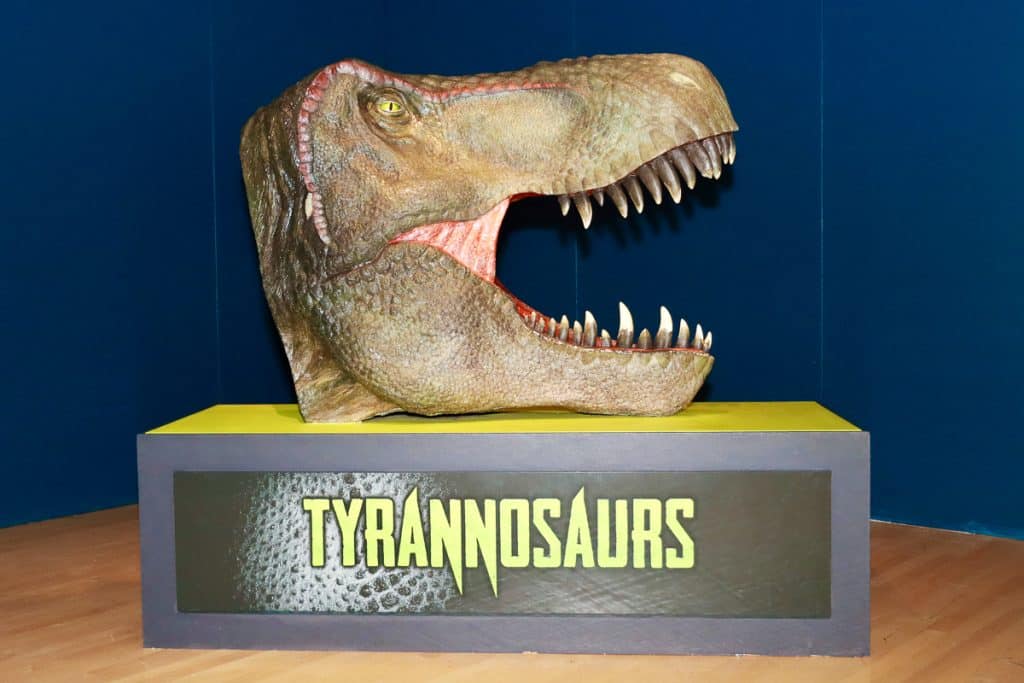
Interactive displays range from inventive video projections to hands-on applications that illustrate the movement of continents through tectonic shift graphics, all demonstrating the evolution of this species. Fossils and life-sized replicas follow the tyrannosaur lineage across millions of years, from smaller, feathered relatives like Guanlong to the formidable T. rex.
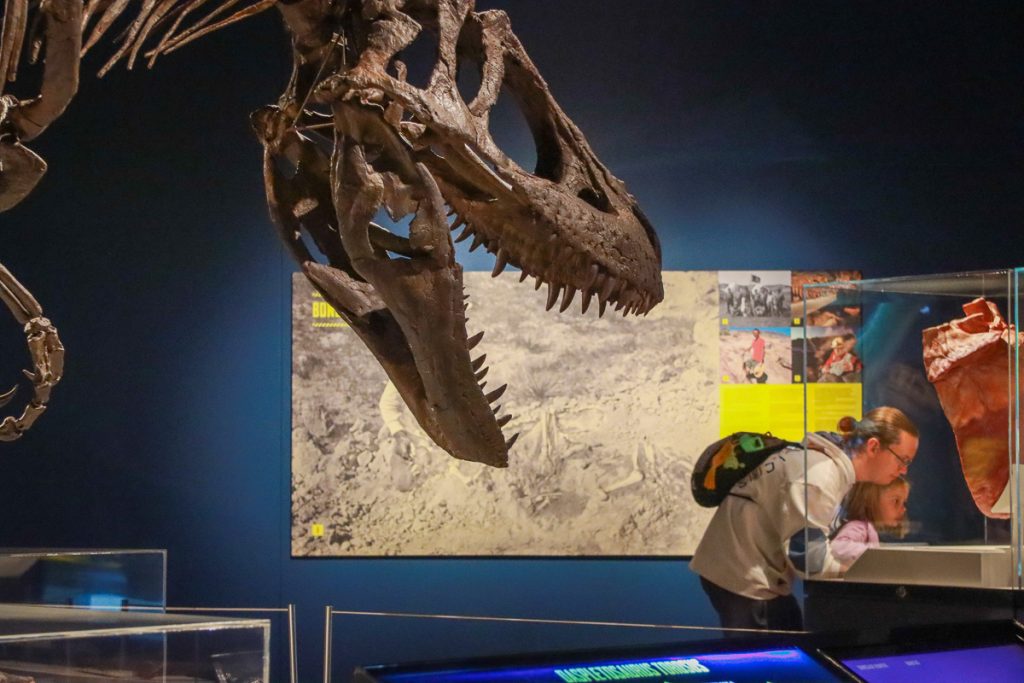
Among the insights he gained from the exhibition, Redman says he was especially impressed by the fused nasal bone that is unique to tyrannosaurs.
“It probably helped them withstand blunt force when tearing into carcasses,” he says, offering an illustration of how evolution solves problems.
He says adults often find a deep sense of humility when engaging with exhibits like this.
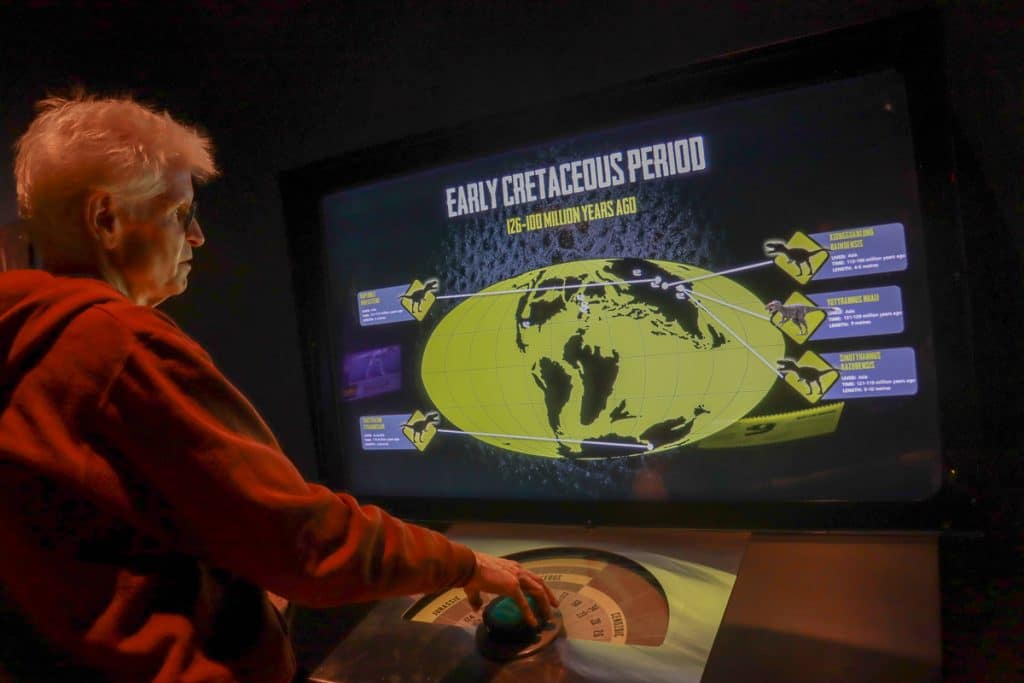
“When you look at geological time, our own species barely registers,” Redman says. “Humanity’s presence only appears in the final moments of Earth’s ‘calendar year’ history.”
Bringing science to life—for everyone
Redman says accessibility and inclusion are core guiding principles in the exhibition’s design.
“We want to engage all the senses,” he says. “Some interactives are digital, but others involve touch, sound, or physical movement. Not everyone learns the same way, and not everyone experiences the world the same way.”
GRPM collaborates with organizations like KultureCity and Grand Valley State University to assess exhibits for sensory inclusivity, helping adapt the experience so everyone can participate.
“We host sensory-inclusive days for individuals who might need quieter environments or tactile learning tools,” Redman says.
These small design choices—such as providing 3D-printed touch samples or modifying lighting and sound—transform what could be a purely visual experience into a more inclusive exploration.
“We always welcome feedback,” Redman says. “Positive, negative—it all helps us do better next time.”
From fossils to neighbors: The Klapp Family Mastodon
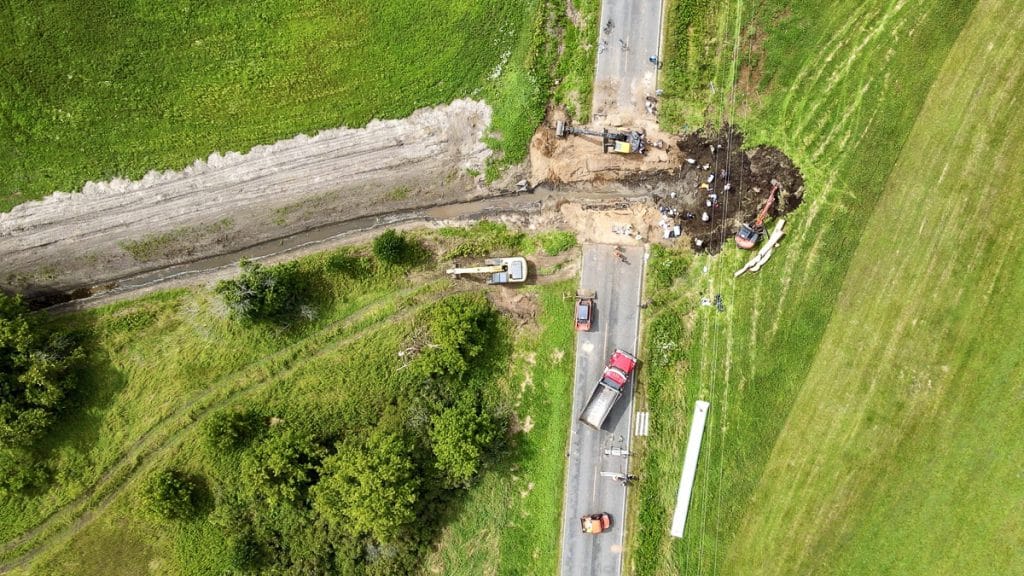
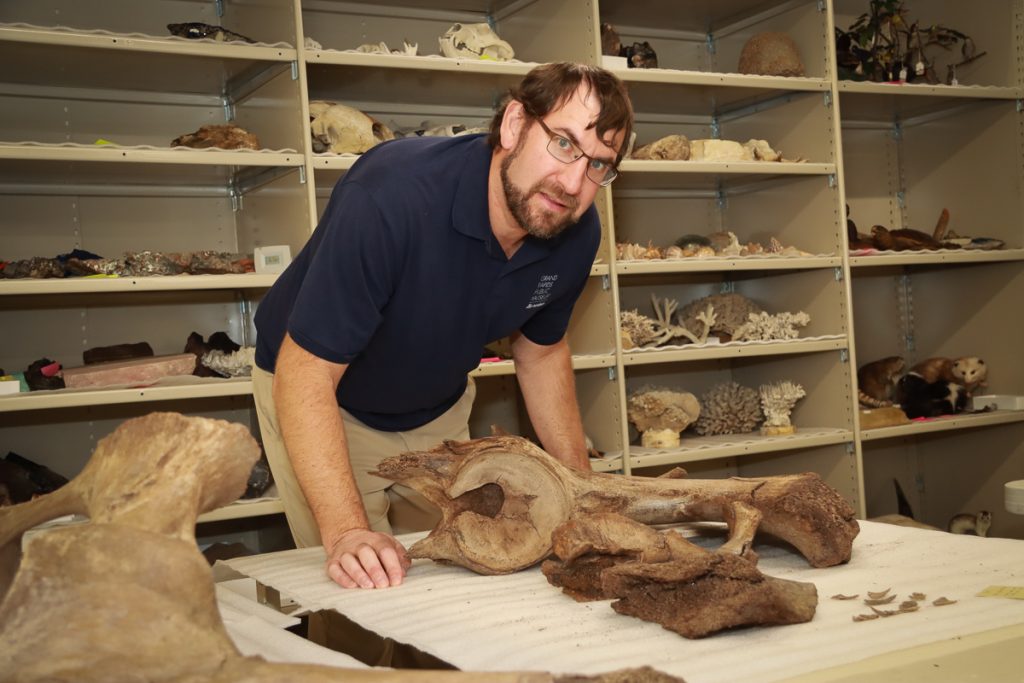
If the Tyrannosaurs exhibition’s Scotty connects West Michigan to a wider evolutionary story, then the Klapp Family Mastodon grounds that story locally. Discovered only 32 inches below the surface, it is one of the most complete mastodon skeletons ever found, with 70% of the skeleton preserved.
Redman remembers arriving at the site the morning following the discovery of the bones.
“We knew immediately it was something special,” he says. “It’s rare to find a specimen this complete, and even rarer that it’s so close to the surface.”
In collaboration with the University of Michigan and Research Casting International, the GRPM team 3D-scanned each bone in detail to produce a replica, now displayed prominently on the museum’s first floor, that accurately reflects its color and texture.
“What you see isn’t just a reconstruction,” Redman says. “It’s a one-to-one digital preservation of a real creature that once walked here.”
He says the Klapp family has remained deeply involved.
“They’re humble, generous people,” Redman says. “Their curiosity only grew through this process. They’ll still send me pictures from their land, asking, ‘Is this (item) something?’ I love that—they’ve caught the science bug.”
A dialogue across time
GRPM visitors standing between Scotty the T. rex and the Klapp Family Mastodon are surrounded by two giants spanning 60 million years and sharing a story of discovery. Redman views this as an invitation to contemplate how examining the past helps us understand change.
These exhibits highlight not just extinction but also adaptation, resilience, and survival. It encourages the community to connect with a story that feels more personal, inspired by the curiosity of a worker who stopped their construction to ask questions, which ultimately led to our local discovery.
This lesson extends beyond the exhibits, as the museum hosts special programs like the Oct. 16 Tyrannosaurs Trivia Night with Betka-Pope Productions and an Educator Night on Oct. 22, events that touch on themes of science, imagination, and community.
Redman considers these events integral to the museum’s broader mission.
“We want people to leave inspired to ask more questions,” he says. “That’s how discovery starts—with curiosity. And curiosity belongs to everyone.”
“Tyrannosaurs – Meet the Family” runs at the Grand Rapids Public Museum from Oct. 11 through April 26.
This story is part of the Bridge to Community Curiosity, underwritten by the Grand Rapids Public Museum. Through this partnership, we highlight GRPM’s mission to inspire curiosity, deepen understanding, and foster belonging by showcasing the transformative power of arts and education in West Michigan.
Photos by Tommy Allen, except drone shot of mastodon dig, courtesy of the GRPM.
Related Articles
Lovet expands affordable veterinary care model with fourth Grand Rapids clinic
Chicago-based Lovet Pet Health Care opens fourth Grand Rapids clinic, aiming to reduce costs, expand access, and ease stress for pet owners.
Equest Center highlighted as Bank of America boosts year-round community support
Bank of America’s Day of Giving showcases its ongoing volunteer partnership with Equest Center; Lakeshore Advantage selected as bank’s 2025 Neighborhood Builder.
Retailer Hank Meijer shows off his storytelling talents at Dutch American celebration
At Dutch-American Heritage Day, retailer leader and author Hank Meijer reflects on family stories, immigrant roots, and the legacy of Fred and Lena Meijer.