
From Super Green Market to the clinic: two sisters and lessons learned from a community care model
Awatef and Ayah Ayesh are training within a community-based medical school model that encourages future physicians to consider the whole person and to view listening as a vital form of care.
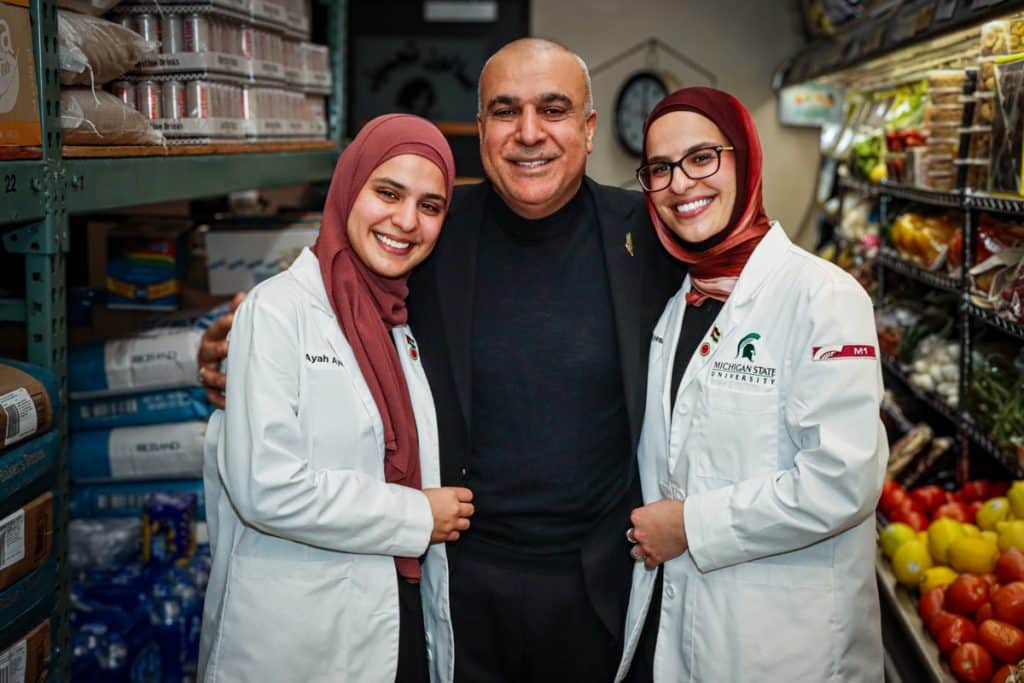
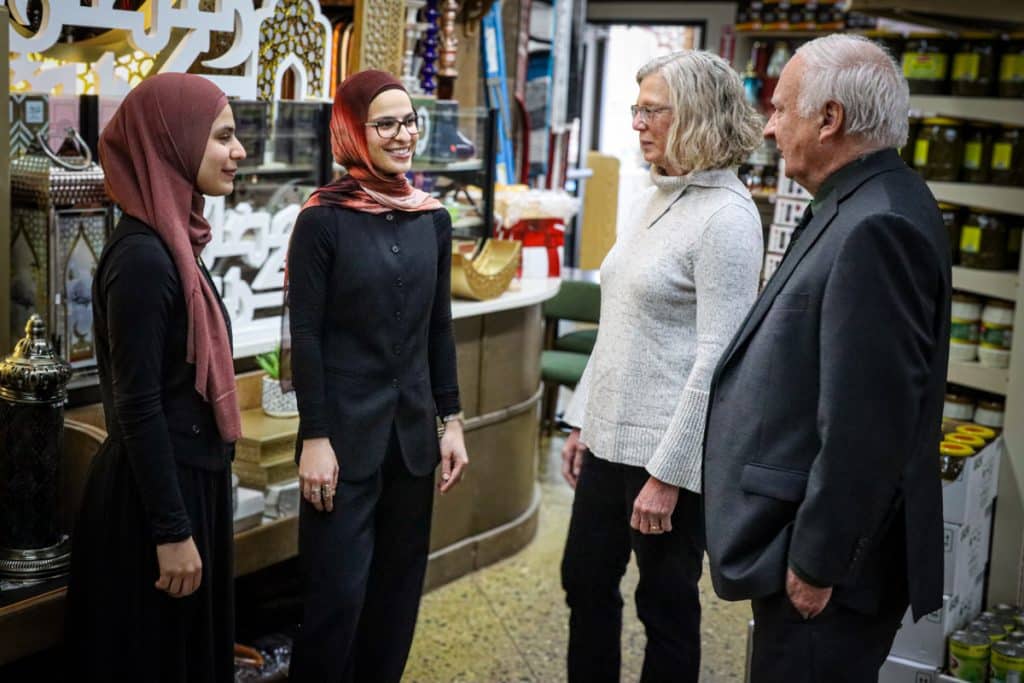
At Super Green Market in Kentwood, you can observe care in the smallest of gestures: greeting someone in their first language, providing a quick translation, or listening patiently as someone explains a product from their childhood.
For sisters Awatef Ayesh and Ayah Ayesh, these daily acts of service are intertwined with medicine. In fact, their history has fundamentally shaped their approach.
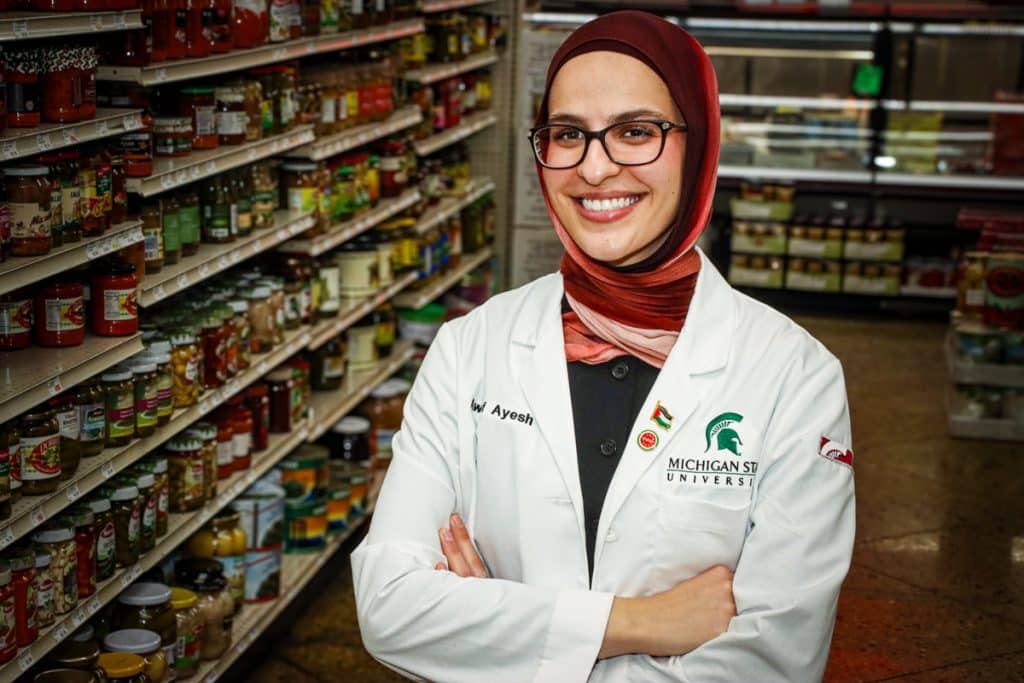
Awatef, a first-year student, and Ayah, a third-year student, are both medical students at Michigan State University’s College of Human Medicine (CHM) in Grand Rapids. The sisters describe a training experience focused on dignity, inclusion, and serving medically underserved communities.
A community-based medical school
CHM is a community-focused medical school with eight campuses across Michigan, including Grand Rapids. Students begin their training in Grand Rapids or East Lansing and then gain clinical experience in communities across the state. During the first two years, students are grouped into Learning Societies, which are led by clinical faculty fellows who guide case discussions, provide coaching, and offer valuable mentorship.
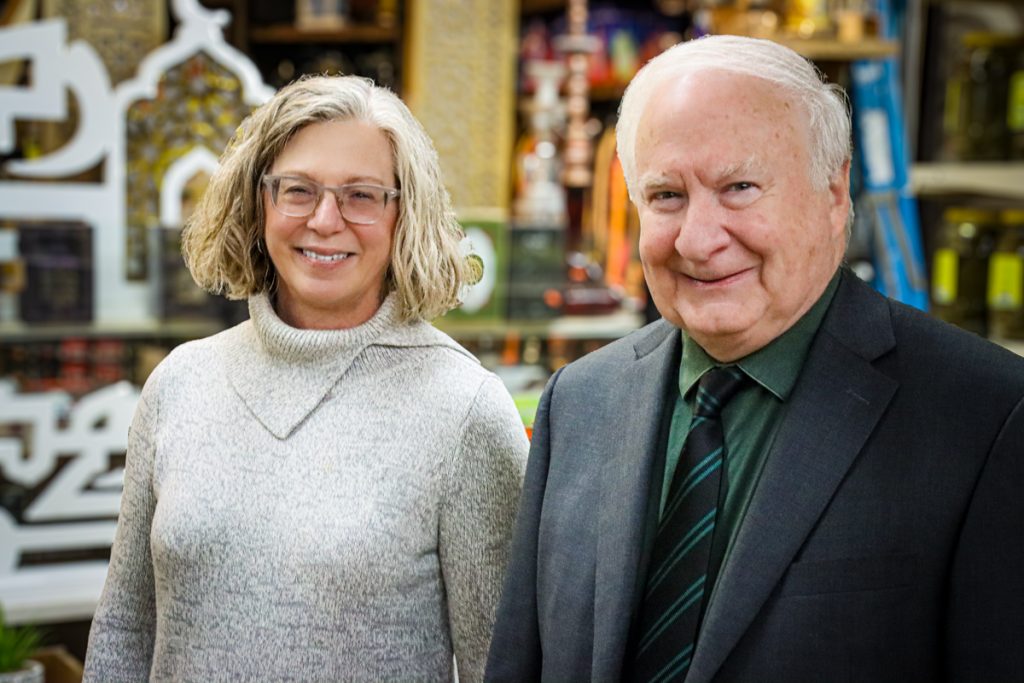
“As clinical faculty, what we do twice a week is we have real-life patient scenarios that we walk through with the students,” says Dr. Carole Montgomery, who is Awatef’s fellow. “It helps them learn to think like a doctor … and grow their critical thinking skills.”
Dr. John Maurer serves as Ayah’s fellow and is a steady point of contact for MSU students who seek to move from classroom learning to patient care.
Grocery store a training ground for empathy
Awatef was raised among her family’s market stalls, where patrons came for both cultural connection and groceries. She considers this experience good preparation for her clinical work.
“There are a lot of similarities between here, being in the grocery store and being in the clinical setting,” Awatef says. “You are seeing very similar populations.
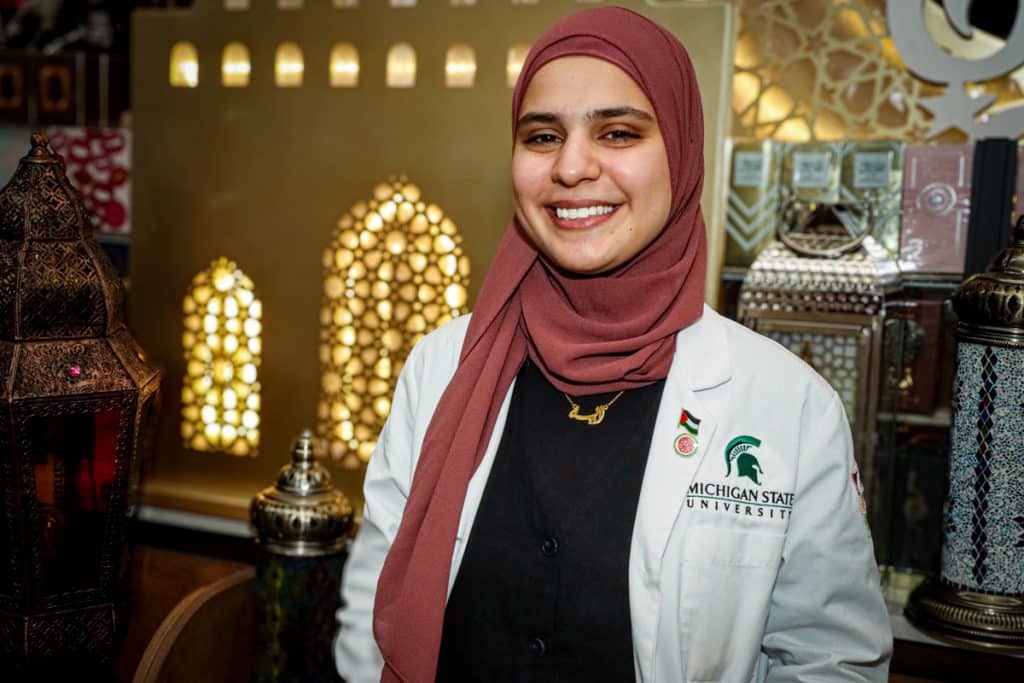
“Working here helped me develop more appreciation for different cultures and different people with different backgrounds … like immigrants or people who are struggling in life,” she says. “Taking that with me to the clinic helps me develop a more empathetic and more trusting relationship with the patient.”
CHM’s early clinical exposure strengthened that connection, she explains, by immersing first-year students in community clinics where they experience the pace, workflow, and the human aspect of care.
“Placing us in community clinics for our first-year rotations was a really nice opportunity as we were exposed to patients from different backgrounds, and as a result, we saw a variety of scenarios,” Awatef says.
Hearing the story underneath the symptom
Ayah notes that CHM’s emphasis on patient-centered interviewing taught her the importance of taking her time to truly understand why a person is there and see them as a whole person.
“Something that MSU CHM emphasizes a lot on is patient-centered care and patient-centered interviewing,” she says. “From our first year, we were taught skills on how to address and validate patients’ emotions and listen to their stories.”
“A lot of people don’t come just because their arm hurts,” Ayah says on this treatment’s approach. “Patients come for a lot of different reasons. You have to get to know the patient’s story.”
Maurer states that CHM’s comprehensive approach encourages students to examine practical obstacles affecting health outcomes, such as housing, transportation, food access, and affordability.
“We’re not just looking at Mr. Jones as somebody with hypertension and diabetes,” Maurer says. “We’re looking at Mr. Jones as a person… who has a place to live, access to food, access to transportation.”
Ayah and Awatef have committed time to Grand Rapids Street Medicine, a student-led project that seeks to reduce barriers for unhoused residents by interacting with them directly. In this setting, she says, building trust is typically the first step.
“It’s not as formal,” Ayah says about her work over the last three years with the project. “It’s more like a community, like helping a neighbor.”
Palestine, reframed through medicine: humility and listening
Both sisters went on a medical mission to Palestine in August 2024. They say the experience taught them the importance of approaching with humility, listening attentively, and keeping in mind that “doing no harm” involves the attitude you bring into others’ communities.
“The biggest thing I took away is the power of listening to others,” Ayah says. “We saw patients in vulnerable states, and listening and translating for the doctors was kind of the only thing we were able to give them, (as we are students). It was important to respect the people who were already working there and not come in and pretend that we are going to save what’s going on.”
For Awatef, the journey was a significant turning point. She pursued this mission trip despite not yet receiving an acceptance letter from medical school and admits she was almost ready to give up.
Her acceptance letter from MSU’s CHM arrived after she returned from Palestine.
“[The mission trip] made me more motivated and determined to go to med school,” Awatef says. “At that time, when I left for Palestine, I didn’t have any acceptances, and I was about to give up. But this trip made me more determined because I realized that a lot of people needed my help.”
She recalls patients feeling proud, frequently offering encouragement, expressing gratitude, and hoping that she would return as a physician.
“They were like, ‘We wish you the best of success, and we hope to see you again next time as a doctor,’” Awatef says.
Ayah says she aimed to assist members of visiting medical teams, composed of international physicians, by teaching them essential Arabic phrases to serve Arabic-speaking patients and to help them feel more at ease in clinical settings.
“I’m not expecting people to go and speak full-blown Arabic to their patients,” Ayah says, but she recognizes that empathy takes root with tiny movements. “Even one word of comfort (delivered in one’s native language) can help a patient feel like you’re here for them.”
‘Do no harm’ as a daily practice
Many believe the Hippocratic Oath states “first, do no harm,” but the precise wording is a paraphrase of an earlier ethical guideline from the Hippocratic era, often described as “help, or at least do no harm.” This idea aligns with the sisters’ experiences, as they describe learning that responsible care often involves humility, attentive listening, and safeguarding a patient’s dignity. Good days can turn into bad ones quickly, so it is vital to understand how to nurture the empathy needed when the unthinkable happens and medical service is required.
Montgomery shares that ethics is integrated into CHM’s curriculum, notably through standardized patient scenarios in which students make immediate decisions and then reflect on their actions and potential improvements.
“There are intentional parts that will raise ethical issues,” he says, “and then you can debrief afterward and, as a result, really have the most important learning from it.”
In a grocery store, you quickly realize that people have more than just a shopping list. The same holds true in medicine, only with higher stakes and fewer assurances. No two days are truly the same at the market or within the arena of human medicine.
The Ayesh sisters’ story is notable for its deep roots in community values: family, a strong work ethic, and an educational model that fosters close connections with people. Reflecting on the many topics one must consider in a day, maybe we, too, can learn to observe how empathy is cultivated… not just through emotions but also through thoughtful structures and dialogue.
Photos by Tommy Allen
Related Articles
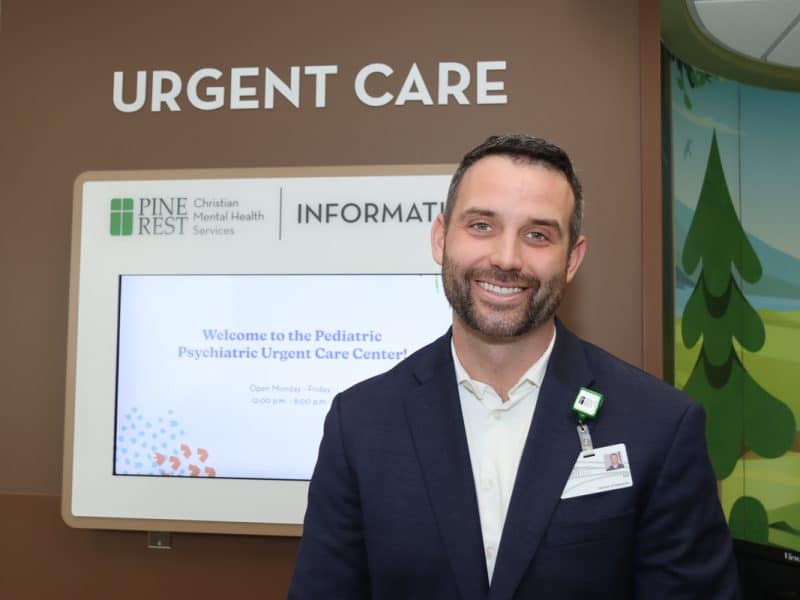
New Pine Rest urgent care center offers quicker psychiatric help for youths
As youth mental health needs strain Michigan families, Pine Rest opens its new Pediatric Center of Behavioral Health. The center offers expanded inpatient treatment, the state’s first pediatric psychiatric urgent care center, and new services for children and adolescents.
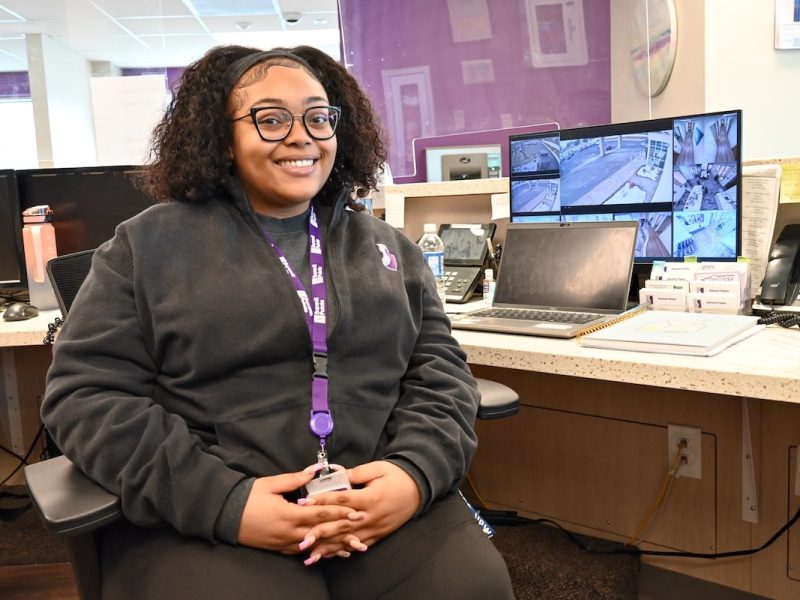
When everyone is welcome: How Michigan’s CCBHCs are changing care
CCBHCs have been improving access to quality mental health care for Michigan residents since 2021.
Grand Rapids consortium launches youth sexual health toolkit addressing care gaps
New online resource provides evidence-based sexual health guidance for youth, families, and clinicians, aiming to reduce misinformation and barriers.


