
Gina Bivins: Steward of local history shows how seeing others builds bridges of curiosity
GVSU’s Kutsche Office of Local History honors Gina Bivins with the Gordon Olson Award for a career that highlights how public history resonates more when diverse individuals see themselves reflected in it.
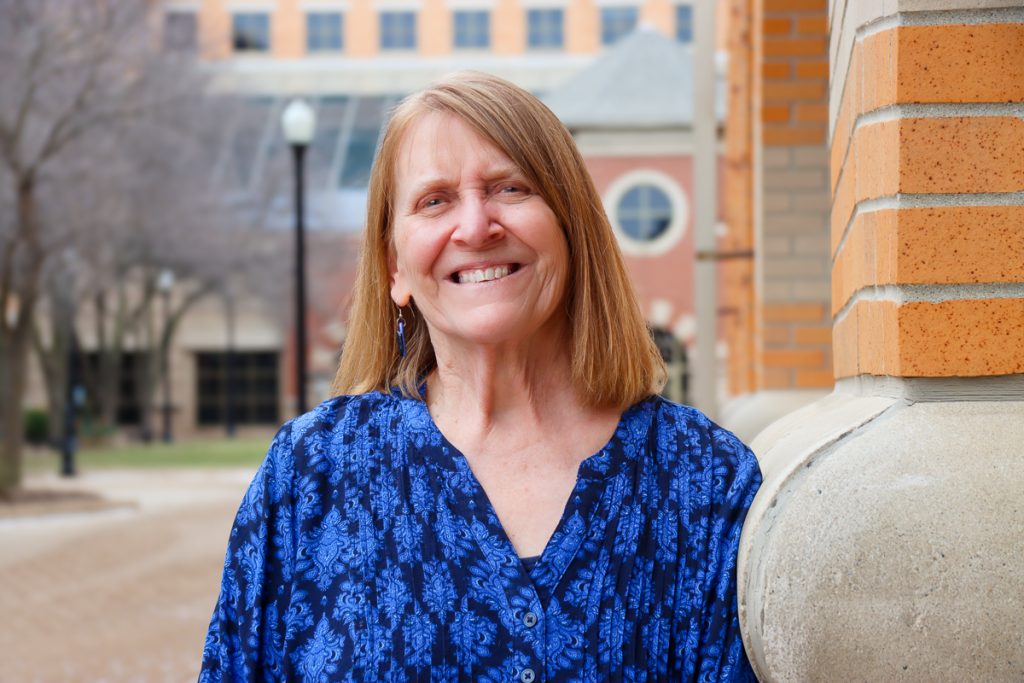
In her 37 years working at the Grand Rapids Public Museum, Gina Bivins demonstrated that history isn’t confined to displays and archives – it resides in the stories people carry, the questions they ask, and the choices a public institution makes to broaden its perspective.
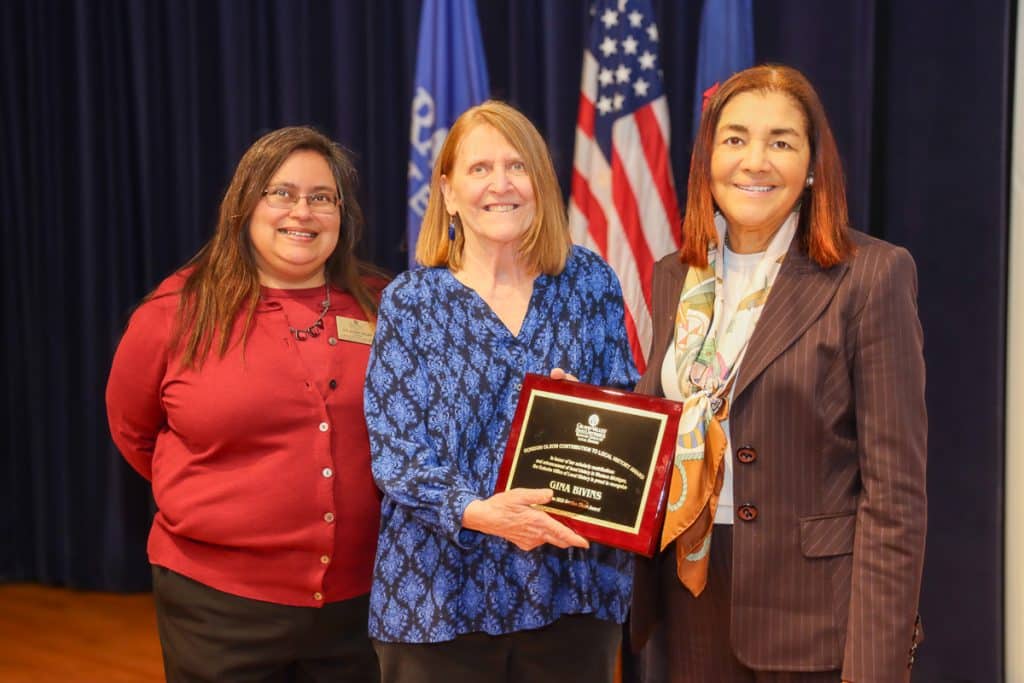
Bivins was recently honored by Grand Valley State University’s Kutsche Office of Local History, which presented her with its Gordon Olson Award. The presentation was part of the Kutsche Office’s 17th annual Local History Roundtable, held March 18 on the Robert C. Pew Campus in downtown Grand Rapids.
In honoring Bivins, the Kutsche Office not only celebrated a dedicated former museum staff member but highlighted a form of civic effort that often goes unnoticed yet significantly influences how a region perceives itself.
Over the years, Bivins worked in various roles at the museum, including education, collections, customer experience, public engagement, and exhibit development, helping shape not only the museum’s collections but also the way visitors experience them.
In presenting the award, Peg Padnos, chair of the Kutsche Office’s advisory council, described Bivins as a “pillar of the museum” and a “guardian angel of institutional knowledge.”
Bivins, now retired from GRPM and serving as president of the Grand Rapids Historical Society, remains a steadfast civic figure whose influence extends far beyond her official role.
History outside the book
Bivins says receiving the Gordon Olson Award is especially meaningful because she knows the legacy of fellow honorees.
“It’s humbling, because I know who’s received it in the past, and while I’m honored, I do hope it inspires others to look outside the pages of a book, and look at the people in history, not just the big picture,” she says.
At the ceremony, Bivins thanked the Kutsche Office for supporting work that remains “very near and dear” to her heart. Then she offered a line that explains much of her career.
“We honor the stories that aren’t always out there,” she says, referring to the role the GRPM and the Kutsche Office play in lifting up diverse voices in the community.
This instinct shaped Bivins’s approach to local history. She focuses on the names associated with streets, the family stories behind artifacts, and the small details that prompt further questions. She believes history is dynamic and accessible, not just something for experts.
“It’s paying attention to those little things that somebody will tell you … and then you want to know more,” Bivins says. “You’re not going to necessarily find it in a book. You have to either talk to people … and it’s just curiosity, I think, is probably the biggest word. You’ve got to be curious.”
That curiosity has real-world significance for a public museum. Often, history seems detached — a record controlled by institutions, featuring well-known names, admired from a distance. The approach Bivins helped develop is more relational: encourage engagement, listen more intently, and consider community memory as an integral part of the historical record rather than an afterthought.
Making room for the fuller story
A prime example of this approach is the museum’s Newcomers exhibit. Instead of focusing on a single group’s story, it explores arrival, settlement, work, worship, and daily life across various communities. This allows visitors to understand both the differences and commonalities in their experiences.
According to Bivins, the exhibit is important because it confronts difficult truths rather than avoiding them.
“There’s one other area of Newcomers that I think is important,” she says. “They don’t skirt the things that are a little uncomfortable.”
Bivins points to the story of Grand Rapids’ Auburn Hills, located in the North East Citizens Action Association neighborhood, which is entwined with the history of redlining, exclusionary housing policies that shaped who was welcomed and who was shut out. She says those realities should not be erased simply because they make us uneasy, reminding us of the James Baldwin quote, “Not everything that is faced can be changed, but nothing can be changed until it is faced.”
“I think it is important that we don’t lose the reality of it,” Bivins says. “Absolutely, we should be uncomfortable with a lot of our history.”
This lesson is crucial as institutions worldwide struggle with presenting more comprehensive stories. No museum can fix every omission immediately. Archives are inherently incomplete, and collections mirror the biases of their time. Bivins’ method offers a model for others: acknowledge the silences instead of ignoring them. Recognize them, confront them, and continue creating space for the overlooked or absent elements.
Welcoming begins with seeing people
Bivins’ legacy at the museum extends beyond exhibits and archives. It is also built through small, everyday actions that communicate to people that they belong there. When she explains the significance of welcoming, she does not start with official policies. Instead, she begins with something more organic: making eye contact.
“I believe that smiling and nodding acknowledges that I saw that person,” Bivins says. “I’ll do it for a homeless person. I’ll do it when talking with a CEO. I even smile and nod when I pass somebody, because that’s welcoming.”
Later, while managing the GRPM’s front desk, she used the same approach to enhance the visitor experience.
“If you’re not with a customer, you try to say, ‘Thank you for coming. And, of course, smile. It doesn’t hurt to give someone a smile.”
That simple instinct of Bivin’s, her “I see you” style, may sound small, but it carries weight in a public institution. It is one way that people decide whether a museum is truly for them.
Bivins also explains that providing access frequently involves understanding another person’s perspective. When she created a tour for young children in the Bird Hall, she tested it with her 4-year-old daughter and discovered that her daughter viewed the exhibit from a completely different perspective.
“I rewrote the tour,” Bivins says. “I wrote it while on my knees.”
That lesson stayed with her, growing to include careful consideration of visitors in wheelchairs, school groups with diverse needs, and the importance of addressing the person who might be struggling the most in a space, rather than applying a single explanation to everyone.
“I had to put myself in her place,” she says. “You have to put yourself in the place of … the one who’s struggling the most.”
This is one of the clearest lessons in Bivins’ career: inclusion is concrete, developed through practice, testing, listening, adjusting, and understanding that creating access often starts when someone within an institution is open to reexamining long-held perspectives.
A bridge through commonality
Bivins says when history is shared effectively, it does more than just preserve the past; it also fosters a sense of connection in the present. In explaining how a museum can enhance people’s connection to a place, she again refers to the Newcomers exhibit and emphasizes the importance of our collective and often shared experiences.
“It shows how we have so many commonalities,” Bivins says of the fact that, unless you are indigenous, your lineage most likely begins with an immigrant journey. “We all have a story of coming here. So the question begins with, how did we arrive in the West Michigan area?”
That question matters in a region where people often live side by side without realizing how deeply their stories are connected. A public museum can’t solve loneliness by itself, nor can it mend every division that our culture continues to widen. However, it can offer one increasingly rare thing: a place to experience shared civic space, and see that a city’s story is bigger — and more connected — than we sometimes think.
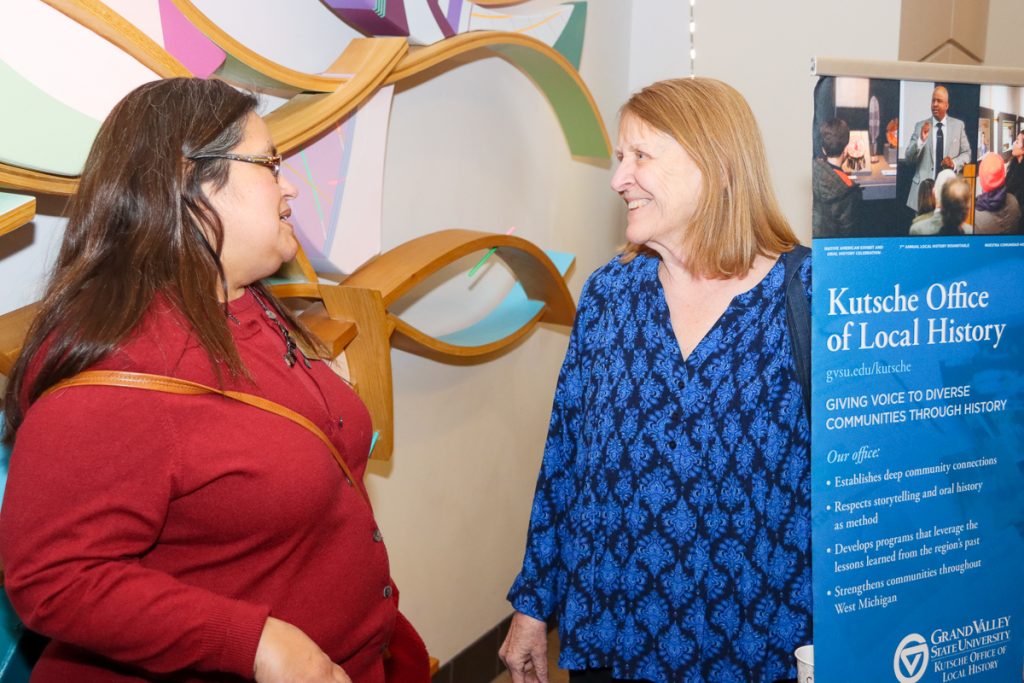
Bivins suggests that our personal growth in understanding history benefits tremendously when we develop better listening skills, especially toward histories that are not ours.
“Listen to comprehend, not to formulate your answer,” she says.
Public history isn’t just a one-way lecture; instead, Bivins sees it as the beginning of a deeper conversation, encouraging people to slow down, focus, and let someone else’s story deepen and expand their understanding of a place.
What the award recognizes
The Gordon Olson Award, named after the late, longtime Grand Rapids city historian, celebrates more than just years of service. It embodies an approach to history that is both rooted and generous — emphasizing artifacts, but also prioritizing conversation, discomfort, curiosity, and care.
Bivins says the urgency of that work has only grown.
“Right now, more than ever … it is so important that the real truth of our stories come out,” she says.
Even after retiring, she remains connected to the museum and city archives that initially sparked her curiosity.
“They let me come and play with the archives,” Bivins says, laughing.
Then she adds the line that perhaps best explains her lasting connection to this work and why she sees it as ongoing, even after all these years.
“There’s just so much to do.”
If the Grand Rapids Public Museum is to continue to inspire more people to explore city life, ask meaningful questions, and help us to see ourselves and our neighbors within a larger history, Gina Bivins offers a valuable example of how to achieve this welcoming stance.
Bivins suggests that staying curious, listening, and contributing to our collective stories are key. Most importantly, welcoming begins with a simple but meaningful act – acknowledging someone. And how wonderful that the Kutsche Office for Local History acknowledges Gina Bivins’ contribution to building a more complete account and welcoming city.
This story is part of the Bridge to Community Curiosity, underwritten by the Grand Rapids Public Museum. Through this partnership, we highlight GRPM’s mission to inspire curiosity, deepen understanding, and foster belonging by showcasing the transformative power of arts and education in West Michigan.
Photos by Tommy Allen
Related Articles
Parent feedback shaping literacy pilot for littles with special needs
How a Kent County alliance centers parents in developing literacy strategies for their kids.
Home-based providers call for flexibility as Michigan expands Pre-K for All
Home-based providers could be significant to making Pre-K for All available to more children.
From phone to big screen: Youth films spotlight food justice, identity, community
GR teen filmmakers share mobile-made stories on food justice and identity at Mosaic Film Experience screening, highlighting youth voices and community connections.


