
Grand Rapids sustainability leaders recognized for innovative environmental community impact
Three West Michigan fellowship winners advance zero-waste business, forest protection, and climate justice, inspiring communities to adopt sustainable and equitable solutions.
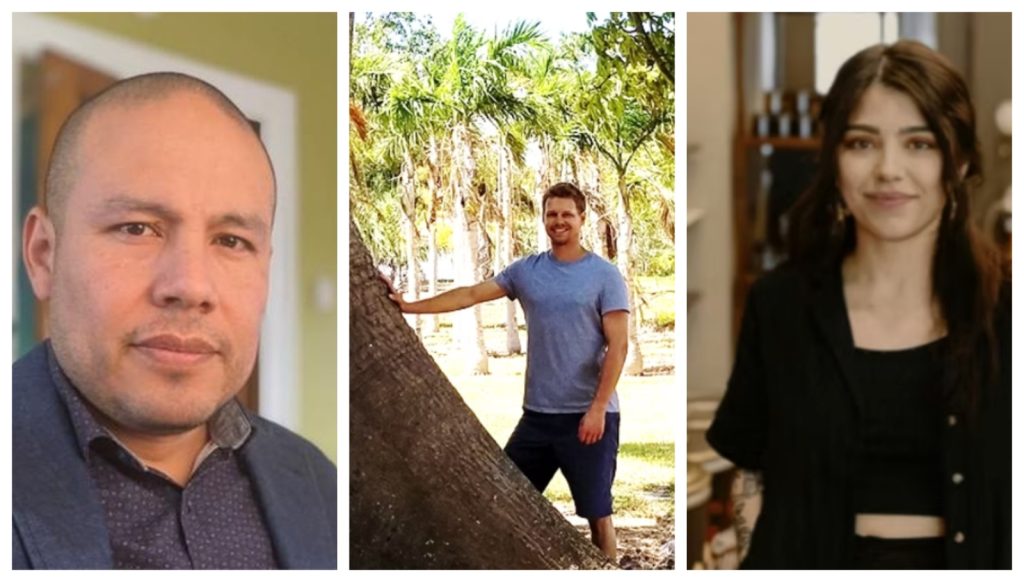
At Earthly Refillery, clear canisters of dry goods line the walls. There’s an assortment of nuts with large spoons for scooping. Whole coffee beans from around the world exude a rich aroma. Colorful seasonings fill glass jars. None of it is packaged individually. As a full-service refill shop, the establishment offers more than 150 bulk food items and over 100 personal and household products.
Anna Crooks, owner of Earthly Refillery, hopes to transform the way Grand Rapids residents think about consumption and waste. Her work in sustainability was cited when the Charles R. Evenson Foundation, in conjunction with the Michigan Sustainable Business Forum, recently recognized her as one of its three 2025 C.R. Evenson Foundation Fellows.
Other fellowships were awarded to David Fraker, for ecosystem protection, and Sergio Cira-Reyes, for climate justice organizing.
The Evenson Foundation was founded in 1970 to advance sustainability, equity, and collaboration in West Michigan. It created the fellowship in 2021 to recognize individuals who demonstrate leadership through transformative change and generate science-based and community-driven solutions in their daily work.
Moving away from plastics
Customers at Crook’s locations in Studio Park Plaza or Eastown select from a vast inventory of items priced by the ounce. They then choose a container, ranging from various sizes of glassware to simple paper bags, or use one they brought from home.
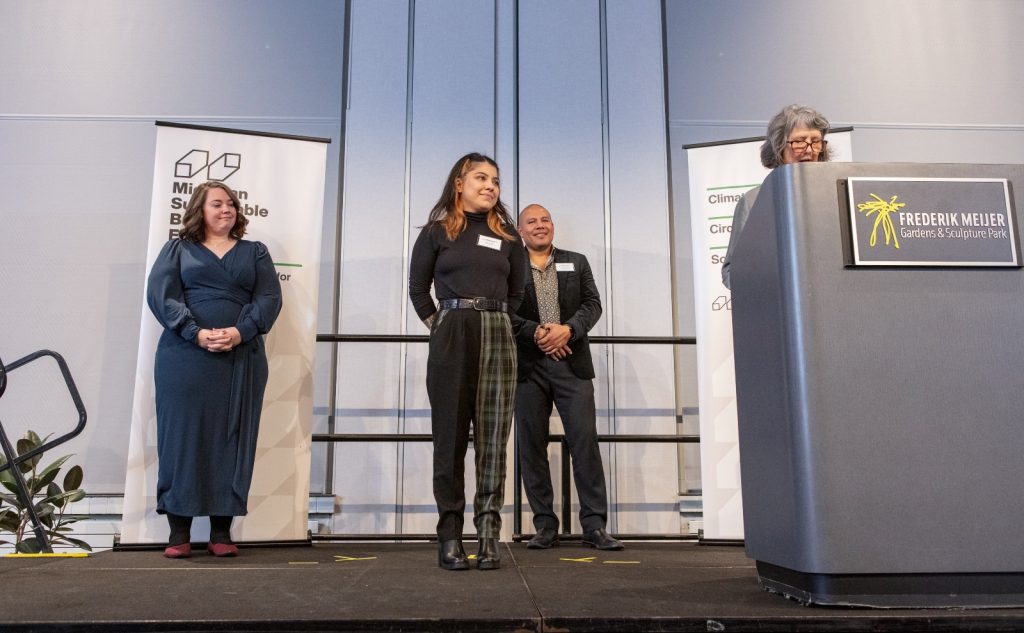
Anna Crooks, owner of Earthly Refillery, was named a 2025 C.R. Evenson Foundation Fellow at the Michigan Sustainable Business Forum for her work rethinking consumption and waste in Grand Rapids.
“I think it’s something that makes it easier for people to switch over to a plastic-free lifestyle,” Crooks said. “We do the research for people so they can go in and trust that these are good products. The response from the community that has stopped in is phenomenal.”
Crooks plans to expand Earthly Refillery’s offerings.
“Looking ahead, we actually just signed a contract to offer grab-and-go foods. We’re going to try to use as much local fruits and vegetables when they’re in season,” says Crooks.
“We are going to have a tasting event at the end of April to help customers have a hand in choosing the menu. And we’re trying to involve ourselves in the community more to help spread awareness about sustainable and reusable materials.”
Protecting forests
As an arborist and biologist, David Fraker has spent most of his career preserving biodiversity while protecting Michigan’s forests from the effects of climate change and invasive species.
Fraker focuses on the early-stage detection and prevention of ecological threats, specifically invasive fungi that threaten the vitality of national forests.
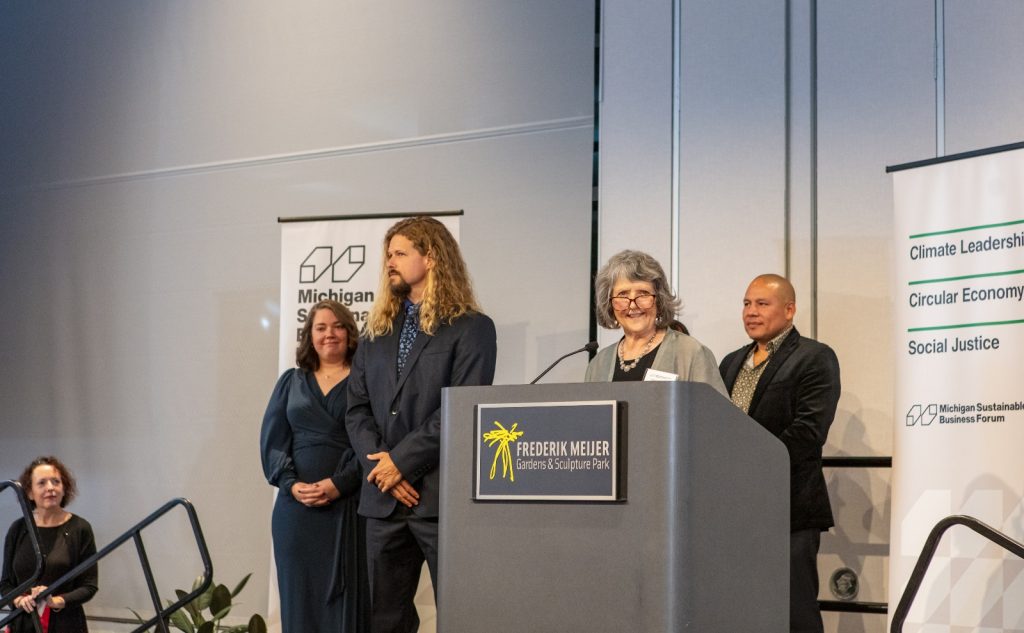
In addition, Fraker owns and operates Treeology, a tree removal company servicing residential and commercial properties in Grand Rapids. Fraker also teaches the arborist certification preparation course for the International Society of Arboriculture, lending his expertise to students entering the field.
“It can be frustrating seeing how unaware a lot of society is about the specifics of our environmental problems and sometimes the gravity of our environmental problems,” Fraker says, “although sometimes that can feel overwhelming and like too much. So there’s a balance there.
“There’s a lot of talk about issues that visibly have an impact on the average person’s daily life. But there are a lot of things all around us and in people’s direct environments, around their homes, their places of work, and recreation areas. Those ecosystems and the animals they support have a huge impact on us as humans. We need healthy trees and healthy ecosystems and living, vibrant green things around us in order to be physically healthy, but also physiologically and spiritually healthy.”
Environmental equity
Sergio Cira-Reyes is director of community engagement and climate justice catalyst with the Urban Core Collective, where he strives to promote BIPOC leadership and equity in environmental decision-making. Having grown up in Los Angeles as a Mexican immigrant, he draws on his formative cultural experiences to inform his leadership and advocacy within the Latino community.
In the early 2000s, Cira-Reyes relocated to West Michigan, where he attended Calvin University. The campus felt like a strange and insular bubble compared to LA’s vibrant and heavily Hispanic community.
It wasn’t until after leaving campus and settling in Grand Rapids that Cira-Reyes began his advocacy work, joining forces with the Latino Community Coalition, the West Michigan Latino Network, and Movimiento Cosecha.
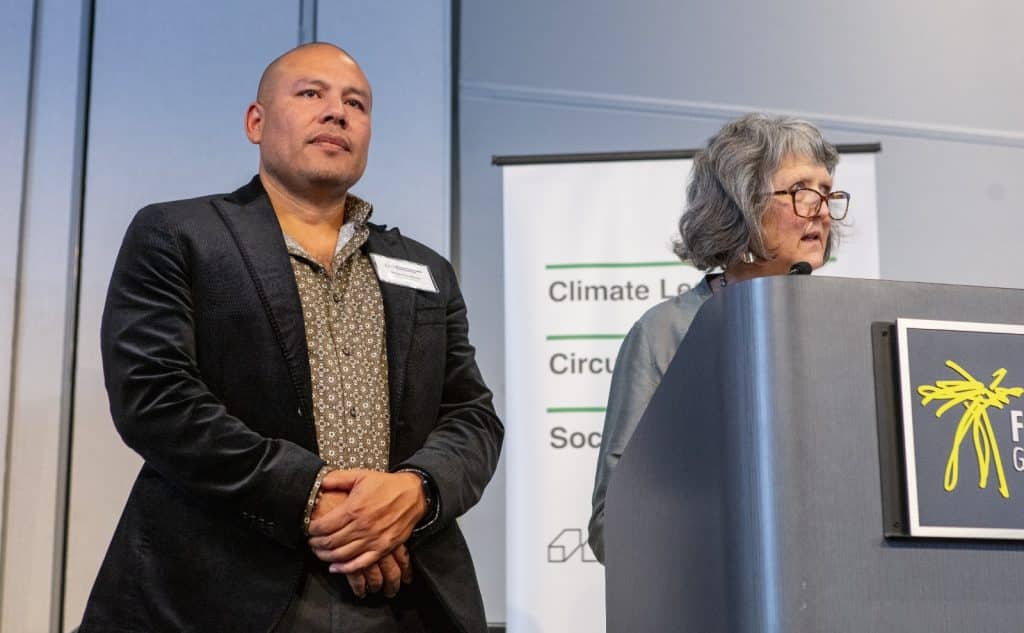
Sergio Cira-Reyes, director of community engagement and climate justice catalyst at Urban Core Collective, promotes BIPOC leadership in environmental decision-making.
He also created the Facebook group Latino Outdoors GR, a platform established to engage the Latino community in outdoor recreation. Working closely with West Michigan municipalities, grassroots organizations, and institutions, Cira-Reyes is determined to confront the systems and policies that have historically excluded BIPOC voices.
“To me, this is the future – having regular discussions about environmental impacts and sustainability,” says Cira-Reyes. “I started an environmental justice program at an organization that didn’t have one. We’re now a state-recognized program fighting utility companies from raising rates and urging them to transition to renewable sources of energy. That is an accomplishment in and of itself.
“We also recognize that the general public has no idea what the Michigan Public Service Commission is. People think that you get your bill, and it’s suddenly more expensive each year, and that it’s your own doing. So they turn down the thermostat, but that’s not the issue. The institutions that regulate this are very obscure. They continue raising rates.
“So we’re going to develop an engagement framework where we ask people to devise their own plan to reduce energy costs and push renewables. We’re going to facilitate a couple of sessions in Grand Rapids and then take it on the road to other cities and consumers within our coverage area.”
In 2025, the City of Grand Rapids approved a Climate Action and Adaptation Plan, developed with input from diverse community stakeholders, including neighborhood groups, businesses, and residents. Cira-Reyes, with team members from Urban Core Collective, participated in this collaborative effort and described the plan’s approval by city officials last year as “a significant milestone.”
The six-chapter plan provides a detailed roadmap for how the city will reduce greenhouse gas emissions and prepare for the impacts of climate change on public health, public spaces, local ecosystems, and infrastructure.
In their respective fields, the three 2025 Evanson Fellows have displayed a commitment to further sustainability and environmental change in West Michigan. As they look ahead, a common chord among them is the desire to educate and urge the community to advocate for change.
Photos courtesy of the Charles R. Evenson Foundation
Related Articles
Trails as talent magnet: Outdoor access is key part of West Michigan’s ‘why here’ conversation
Trails and greenways are no longer just for weekend leisure. Regional leaders say outdoor access has become a key factor in recruiting and a crucial “quality of life” indicator for the contemporary workforce that West Michigan aims to attract and retain.
5 things you may not know about Blandford School in Grand Rapids
Flora Duckworth-Guerra, a sixth-grader, uses five original illustrations to show what happens at Blandford. She highlights the songs, chores, doodles, “magic spots,” and confidence-building moments that make this year-long program unique compared to other school experiences in Grand Rapids.
The trail as a classroom: Indigenous knowledge, reciprocity, and the future of greenways in West Michigan
What began as a snow-day chat with Kaya DeerInWater soon evolved into a trail-side lesson in reciprocity, encouraging West Michigan to view greenways not merely as pathways to develop, but as relationships to respect.


