From a dying landmark to live music, the Crofoot rocks Downtown Pontiac
Both the building at 1 S. Saginaw in Pontiac and the McGowan family have deep ties to Michigan history. Through their redevelopment of the Crofoot building from abandoned office space to a ballroom, the family proved that the recipe for downtown revitalization is one part historic preservation, one part innovation, and a dash of rock 'n roll.
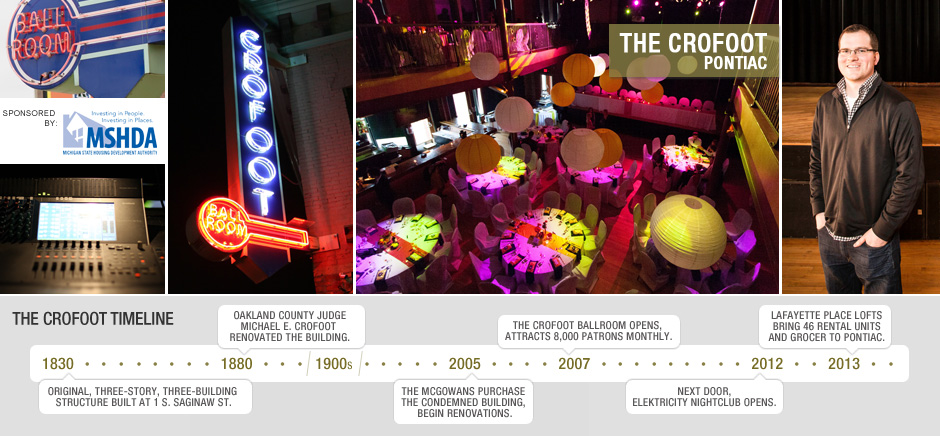
Both the building at 1 S. Saginaw in Pontiac and the McGowan family have deep ties to Michigan history. Through their redevelopment of the Crofoot building from abandoned office space to a ballroom, the family proved that the recipe for downtown revitalization is one part historic preservation, one part innovation, and a dash of rock ‘n roll.
Being historic is about much more than simply being old. Few commercial buildings in Michigan are better examples of both than 1 S. Saginaw St. in Downtown Pontiac. The oldest commercial building in Oakland County, the once three-story structure was constructed in 1830 and has since been home to retail shops, offices, saloons and more.
Today, it’s home to the one type of business is had never been before: a live performance and events venue known as the Crofoot Ballroom, which has not only transformed the historic building, but Pontiac itself.
“There have been countless businesses in here over the years,” says current owner Dan McGowan. “There’s been a hat shop, diner, drug store, shoe store and others. People still tell me all the time that this or that business used to be here.”
As surely as it sits on the corner of Saginaw and Pike Streets in Pontiac, the Croftoot Ballroom was also built on the intersection of the building’s past and the McGowan family history.
“My dad, Blair McGowan, came to Detroit to work for Cesar Chavez as a fundraiser for the United Farm Workers. Working with the UFW, he learned about halls,” McGowan says. “He realized the power in public assembly, and that kind of led him into the business.”
Over the years, the McGowans have been connected to such venues as St. Andrew’s Hall, Industry Nightclub and Clutch Cargo’s. It’s no coincidence that this family with such ties to Michigan’s cultural history finds themselves choosing historic locations to launch their ventures.
“We are preservationists,” McGowan says. “We believe in preserving history because there is so much we can learn from it. Places with that historical texture are so much nicer than being in a white box. Even buildings that are white boxes almost always try to emulate historic space, but they’re cheesy and they fall short.”
Such a commitment to preservation is no small undertaking. When the McGowans took on 1 S. Saginaw in 2005, it had been boarded up long enough to be slated for demotion, and therefore required significant investment to become the two-story performance venue it is today. Taking the historic building down to the studs meant coming into contact with an entirely different construction era. McGowan and his crew found artifacts such as old newspapers, candy wrappers and actual horsehair insulation.
“The whole place smelled like a stable,” says McGowan, who is clearly still enchanted by the renovation process. “It was fascinating.”
Finding a careful balance between historic preservation and forward-thinking development, McGowan was able to reuse the original 1830 staircase that used to lead to the third floor of the building (which was long ago destroyed by fire), all the while making several dramatic changes to the structure. Among these was cutting a sizable hole in the second floor to create a mezzanine overlooking the stage below, and connecting what was formerly three separate buildings to create one, 20,000 square foot space that now includes the Crofoot Ballroom, Pike Room, Vernor’s Room and Crofoot Café.
The combination of heart, investment and elbow grease had a powerful result. The Crofoot hosts about 350 concerts and 75 special events each year. The business has created a dozen full-time positions, as well as supporting 75 part-time jobs as needed for events. Attracting 8,000 patrons per month to Pontiac hasn’t been the business’ only economic impact on the downtown.
“When places opened up [for downtown apartment rentals], our staff wanted to take those spaces,” McGowen says. “One building had a dozen lofts in it, and nine of them were rented by our employees.”
That economic shot in the arm continues to trickle through the neighborhood. McGowan’s building next door, the former Eagle Theater, is now the Elektricity Nightclub, which employs nearly as many workers as the Crofoot, and brings even more visitors to the city – McGowan estimates up to 10,000 each month. Nearby, the new Lafayette Place Lofts recently became the largest development project in Downtown Pontiac in 30 years, bringing with it 46 upscale lofts and a grocer.
“It’s really wonderful,” says McGowan. “Pontiac has gone up and down. Now it’s starting to go back up.”
The restoration of the county’s oldest building into a new and thriving business has played no small role in Pontiac’s changing economic climate. And don’t expect the Crofoot to slow its growth now that the whole neighborhood is moving forward. McGowan is working on developing the Vernor’s Room, a smaller lounge area that was once a Vernor’s soda shop, into a more formal performance area, as well as opening a fully operational kitchen in the Crofoot Café.
“We’re moving into doing more banquets and special events outside the walls of the Crofoot, as well as some festivals,” McGowan says. “We’re growing at a good pace. We’re happy to be based in Pontiac, and are optimistic about the future of Michigan and Detroit proper.”

Related Articles
#RG20LookBack: DACA — A personal view from here to Washington
For his fifth #RG20LookBack, Rapid Growth’s Tommy Allen reflects on thinking he understood DACA—until sudden federal changes forced him to learn faster, listen closer, and document how policy reshapes neighbors’ daily lives.
#RG20LookBack: How neighborhood identity factors into planning a socially productive park
As part of Rapid Growth’s 20th anniversary, we revisit a 2014 innovation story by Anya Zentmeyer, documenting a subtle but significant shift in Grand Rapids public planning sessions and citywide meetings.
Two British influencers explore what makes Michigan ‘special’
Sometimes it takes outsiders to remind us how extraordinary our everyday really is. Thanks, Josh & Jase.