
On Ada library’s ‘golden’ birthday, Amy Van Andel reflects on its origins, possibilities
Amy Van Andel looks back on her role in building Ada’s library, inspired by family, community needs, and a lifelong love of reading.
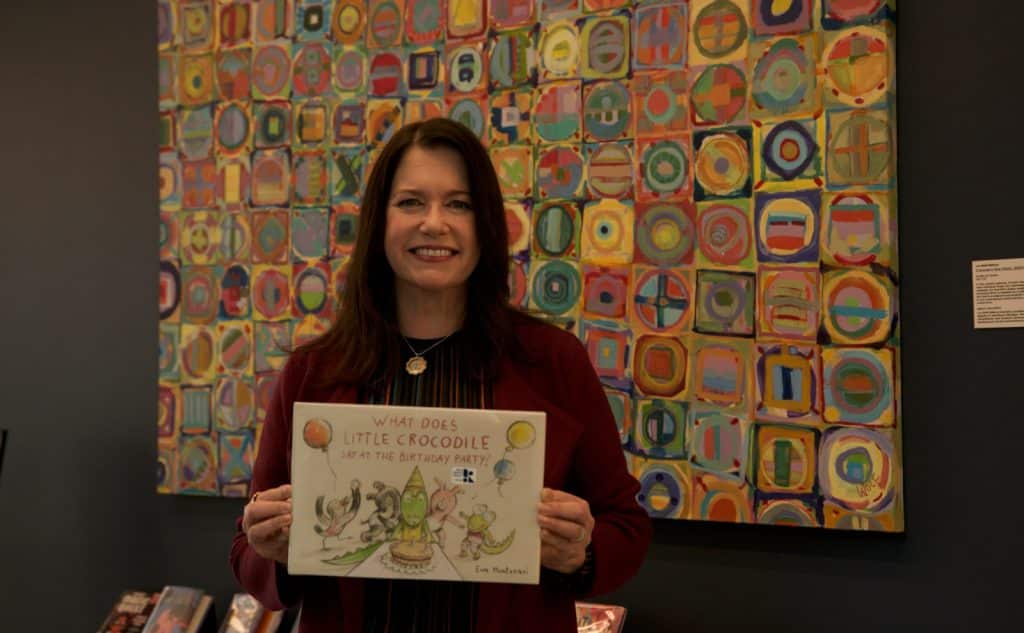
From her office in downtown Ada, Amy Van Andel has a bird’s-eye view of the library she has poured her heart and soul into.
She loves watching people walk through the front doors and leave with books and other items.
“I positioned my office so I could look directly at the library every time I look out my window,” she says. “I love that I can see the door and all the people coming and going.”
This week, the library turns 5. The building opened on Feb. 5, 2021 – the same day as Van Andel’s birthday.
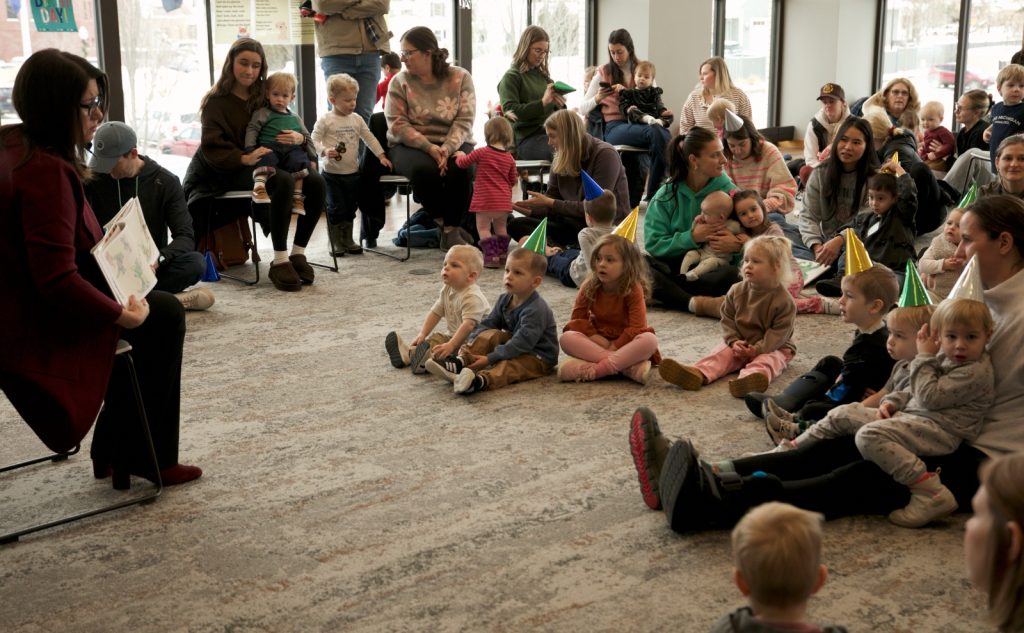
The library is marking the milestone with balloons, some surprise giveaways, and what Van Andel considers the best kind of ceremony: reading. Van Andel typically joins story time during birthday week, picking a book that nods to the occasion.
“We’re calling this the golden birthday,” she says. “It’s our fifth year, and it just feels really meaningful — not just for me, but for the whole community that helped bring this place to life.”
‘Definitely a gap’
When Van Andel moved to Ada after marrying Steve Van Andel, philanthropist and co-chairman of the board of directors of Amway, she noticed that the village didn’t have its own library. The closest library branches were in Lowell, Cascade, and Plainfield — all part of the Kent District Library system.
“There was definitely a gap here,” she says.
So when the village’s main street and riverfront were being redesigned as part of the ‘Envision Ada’ development campaign, she used the opportunity to advocate for including a library in the plans.
She worked closely with Kent District Library and the township to bring the dream to fruition, joining a community that had already been advocating for a library for years.
Van Andel understood the power a library can have on children’s lives and on a community.

She has fond memories of going to the library with her grandmother, Betty Horton, who grew up on a farm outside Rockford. Mrs. Horton loved reading and learning. She worked for years as a secretary at Rockford High School, and after retirement, she volunteered regularly at the library in downtown Rockford.
Horton created a weekly ritual that molded the family’s identity. When Van Andel and her sisters were young, their grandmother took them to the library every week during the summer.
“It was definitely a highlight. We took out the maximum number of books we could every single week,” Van Andel says.
She learned that libraries do more than build literacy. They create a place of belonging — where curiosity is nurtured, community is formed, and access to the world is limitless – all thanks to a simple library card.
Van Andel says her years working as a hospice nurse deepened that connection to people and stories. Sitting with patients at the end of life, she learned how powerful it can be simply to listen.
“It teaches you how important people’s stories are,” she says. “And what a privilege it is to be trusted with them.”
Community hub
The library became part of Ada’s broader effort to remake parts of its downtown. Development was initially focused on businesses and developing the riverfront as a focal point.
“We needed to have a place to gather year-round,” she says. “And the library community center was a natural fit.”
The library shares space with the Ada Community Center, which hosts a variety of functions.
Van Andel describes it as one building that seamlessly serves a dual purpose. There are technical distinctions behind the scenes because of funding and governance, but for patrons, she says, it is simply a shared civic space.
The role of Kent District Library has been important from the beginning. Van Andel says a group of KDL staff and librarians recognized the need for an Ada facility early, built local support, and provided the practical knowledge that does not always show up in architectural renderings — how patrons move, where bottlenecks form, what spaces are most popular.
“They knew how the building would be used,” she says, “where the pinch points were.”
The partnership with KDL is foundational. The system brings programming, greater access to materials, and an enhanced experience for patrons, giving Ada a branch that is connected rather than isolated.
“Partnering with KDL was really probably the most important part of the whole process,” Van Andel says.
Forward-thinking design
Van Andel says the Ada branch is designed to feel different — bright, flexible, and adaptable to changing community needs. The design was inspired by the light-filled space of the Grand Rapids Public Museum, which was championed by her late father-in-law, Jay Van Andel, one of Amway’s co-founders, whose philanthropy helped build the museum overlooking the Grand River.
The Amy Van Andel Library includes meeting rooms, areas for children, spaces that can be reconfigured, and a courtyard that functions like a safety valve for programming. The location is near a busy road, Van Andel says, and planners don’t want children streaming straight from story time toward traffic. The courtyard creates a contained outdoor zone where classes, readings, and events can happen safely.
Other design decisions turned out to be unexpectedly timely.
Before the building opened, librarians identified a common problem at other branches: too few study rooms and quiet places for students and adults. Also, tutors need places to meet clients; in some branches, Van Andel says, tutoring occupies study rooms all day. So Ada’s library was designed not only with study rooms but also a larger area where tutors can set up for longer stretches without impeding other users.
Then the pandemic hit.
When the library opened a year later, it did so in a world changed by COVID-19 and remote learning. Van Andel says no one anticipated how significant the need for tutoring would become.
“We had no idea,” she says. “No idea that the need to have extra tutoring to get students back on track after COVID was going to be so significant.”
The library also includes a podcast room — a small space that patrons can reserve to record audio. The equipment is intentionally simple, Van Andel says, and librarians help people learn how to use it.
Then there are the services that libraries quietly provide even as technology changes.
“One thing that never goes out of style is the printer,” Van Andel says.
As home printers disappear, she says, patrons still need to print school assignments, job applications, and legal documents. The library provides free printing for library card holders of up to 50 sheets each week.
Accessibility is another area where the library adapted based on observation.
Van Andel points to sensory packs — supplies such as headphones for children who are overwhelmed by noise and stimulation. At first, the packs were located in the children’s area.
Staff realized some children are already overwhelmed before reaching them, so the library moved the sensory packs closer to the entrance.
“We did a lot of observing and adjusting those first few years,” she says, “and the library continues to be a place that evolves and changes based on the needs of the patrons.”
The branch is also a platform for local art. Van Andel is proud of the rotating display program, “Gallery in the Stacks,” that gives local artisans a place to show their work.
This program was inspired by a metal sculpture of a girl reading that was donated to the library and can be found in the courtyard. Depending on where someone stands, the figure appears solid or nearly transparent.
Stewardship
“The library building is great,” she says, “but it’s the staff and the volunteers that really bring it to life every day.”
She calls librarians “public servants,” people who combine a love for information with a heart for people.
The library has become personal in a way Van Andel didn’t expect. Early conversations didn’t include naming it after her. She had considered naming it after her grandmother, but Horton’s connection is to Rockford.
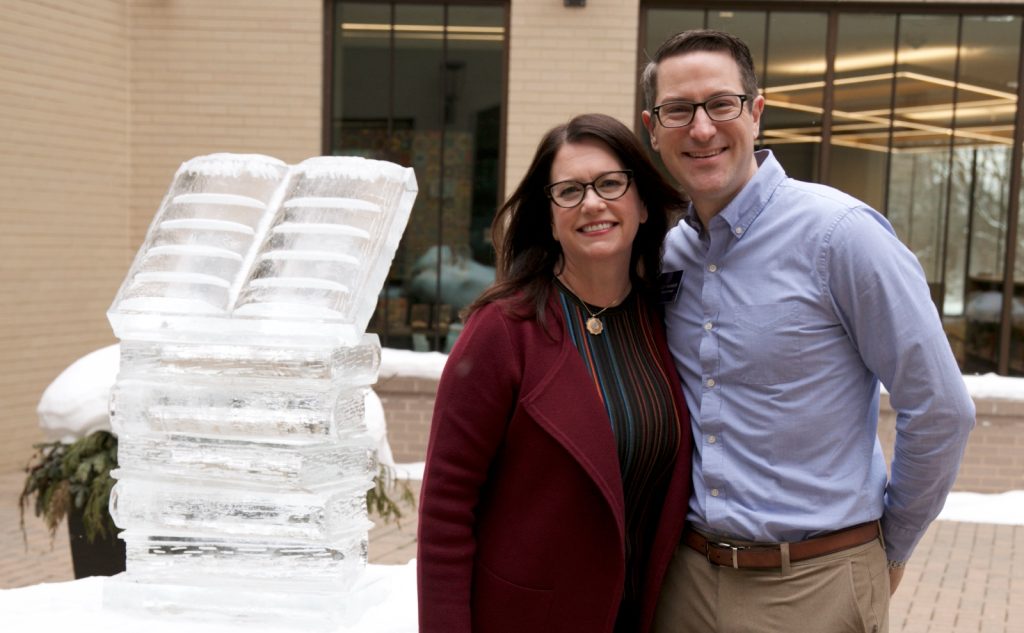
Then, at a press conference, her husband surprised her by announcing the building would carry her name.
“Once you put your name on something,” she says, “it is such an honor, but it also feels like there is a bit of responsibility.”
That sense of stewardship is a role that Van Andel embraces. She continues to serve on the “Friends of the Amy Van Andel Library” board, which is a non-profit organization that raises funds and devotes many volunteer hours to enhancing the programs, facilities, and services provided by the library. She also keeps an “I love my library” sign in her office window, which is visible from the library. A simple way to signal her deep support and connection to the building, its staff and its patrons.
For Van Andel, who grew up hauling stacks of books home with her grandmother, looking out her office window now means seeing the same cycle continue of people coming in, people going out, stories carried both ways.
“It truly is a dream come true,” she says.
Photos courtesy of KDL
Related Articles
Health center trains local residents as dental assistants to fill workforce gaps
HealthLinc, a federally qualified health center, covers training costs while preparing local residents for dental assistant jobs, strengthening workforce pipelines and expanding access to care.
Hope Starts Here stabilizing early childhood services in wake of policy changes
Long-term perspective keeps Hope Starts Here imperatives relevant despite policy changes.
The early childhood models in other states inspiring Michigan policy advocates
Michigan is making meaningful strides to advance early childhood education but could make even more by looking to other states’ models.


