
Retailer Hank Meijer shows off his storytelling talents at Dutch American celebration
At Dutch-American Heritage Day, retailer leader and author Hank Meijer reflects on family stories, immigrant roots, and the legacy of Fred and Lena Meijer.
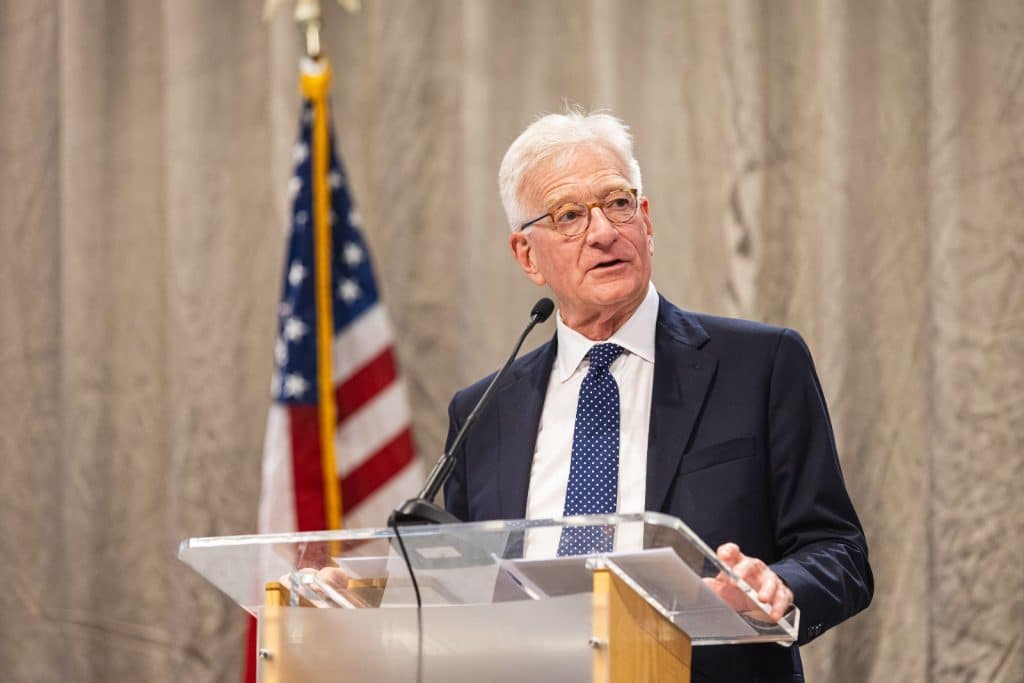
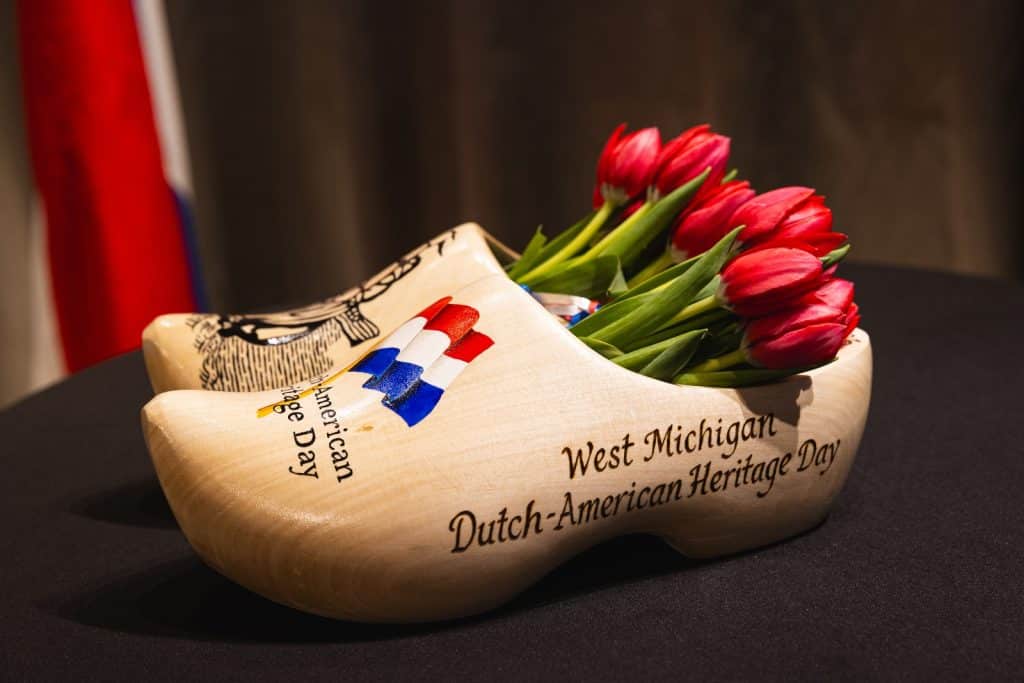
Hank Meijer’s talents as a gifted family storyteller were on full display during Dutch-American Heritage Day at the Pinnacle Center in Hudsonville, where the Meijer executive chairman spoke about his family, his Dutch roots, and the stories that shaped the company that bears their name.
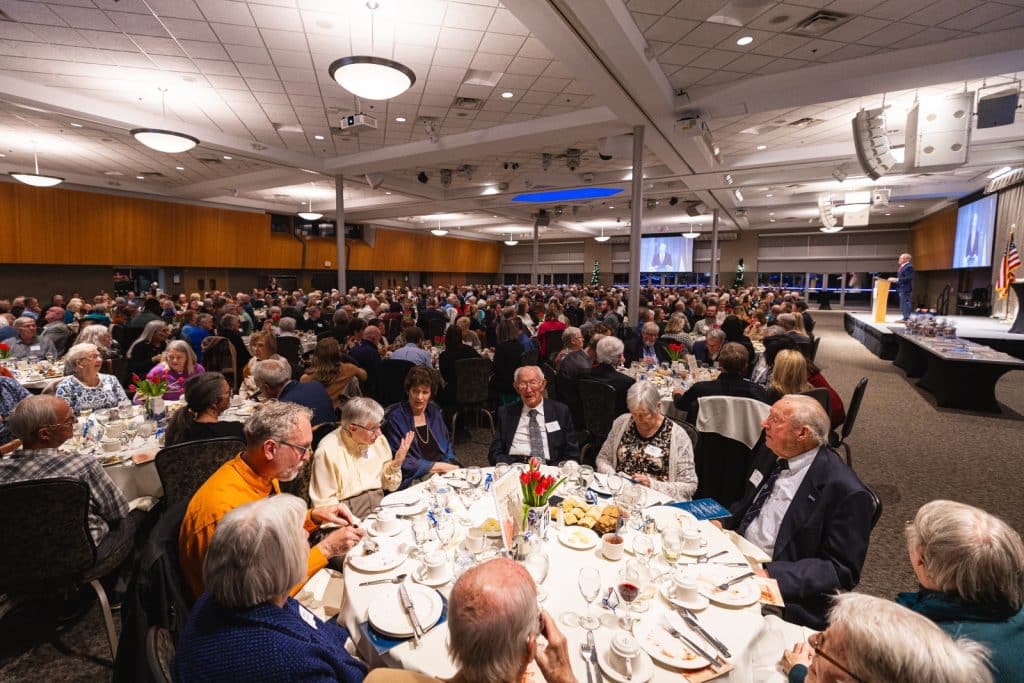
This year’s Dutch-American Heritage Day celebration, the largest in the country, drew more than 600 guests on Nov. 13 for a Dutch-inspired dinner, music, and a program honoring West Michigan’s deep ties to the Netherlands. The annual event highlights the history, culture, and contributions of the Dutch American community while raising awareness for future generations.
The 2025 celebration carried special meaning for the Meijer family. Fred and Lena Meijer were honored posthumously with the Dutch-American Heritage Day Lifetime Achievement Award for their decades of service to the region, contributions that touched health care, education, conservation, philanthropy, and the creation of Frederik Meijer Gardens & Sculpture Park.
It was the ideal setting for their son to share the stories he has spent a lifetime collecting.
But, as Hank warned early in his keynote, his heritage comes with a twist.
‘Half and half’
He opened with a story about his mother’s interaction with Dutch royalty during their 2015 visit to West Michigan. King Willem-Alexander and Queen Máxima visited Grand Rapids that year to celebrate the region’s strong Dutch heritage and economic ties. Their stop included a ceremonial tree planting at Frederik Meijer Gardens & Sculpture Park.
Meijer told the crowd that when the king warmly greeted his mother, Lena, then a widow, he thanked her for welcoming “another Hollander.” She gently corrected him.
“In her soft-spoken yet firm way, she quickly said, ‘No, I’m German,’” Meijer recalled, drawing a big laugh from the crowd.
The story set up the theme of his remarks: the value of heritage, the meaning of family stories, and the way personal history shapes identity.
“Heritage, as with so many of us, is half and half, hence the Dutch door,” he said. “Each of us has our own unique story, but all of us also draw from a shared heritage to arrive at this place we call home.”
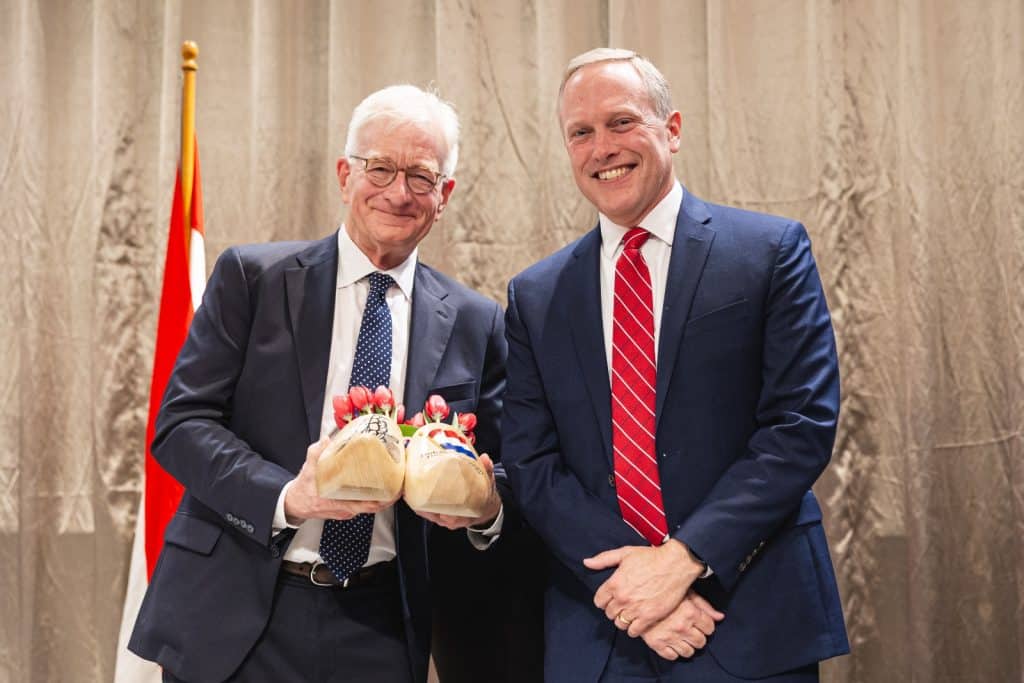
As part of the event, Meijer delivered a keynote titled “Through the Dutch Door,” focusing on the legacy of his parents. Fred expanded his father’s small grocery into the nation’s first supercenter chain.
Together, Fred and Lena championed major initiatives in health care, education, conservation, and the arts. Their most visible legacy, the gardens and sculpture park visited by millions, is rooted in their shared love of nature and beauty.
Hank said his father kept a small plaque on his desk throughout his life with a Dutch phrase that summed up his leadership style: Not I, not you, but we.
Keeping stories alive
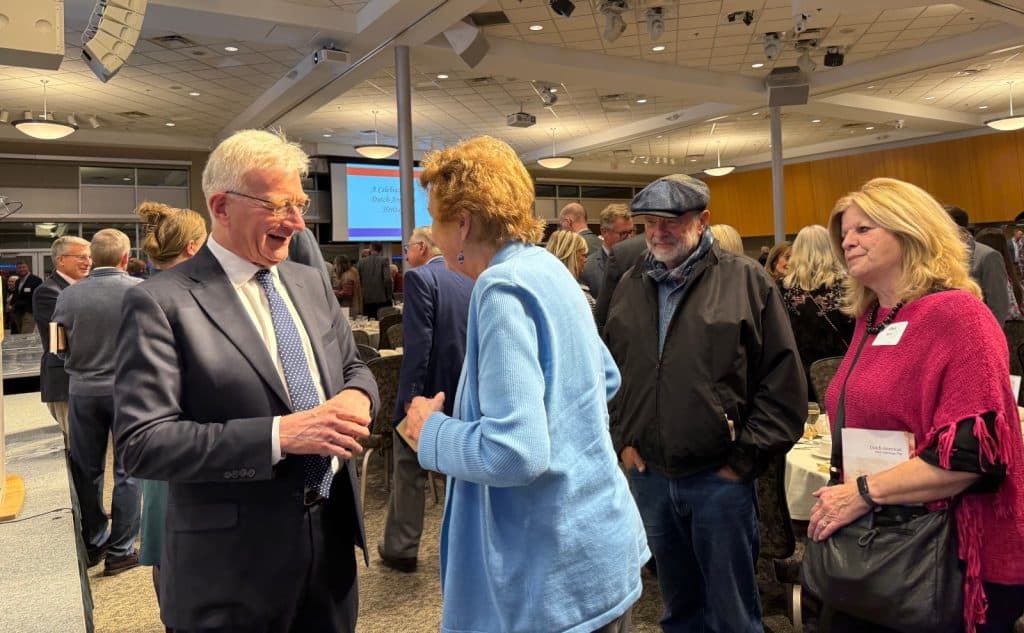
After his speech, Meijer talked more about his role as the family storyteller, a role he says came naturally.
“I suppose, by default,” he said. “Part of it is a passion for history, and part of it is being the oldest child. You hear more stories from parents and grandparents than the others do.”
Before joining the family business, Meijer briefly pursued journalism, covering high school sports for The Grand Rapids Press. Writing came easily, as did curiosity about the people who came before him.
He is the author of Arthur Vandenberg: The Man in the Middle of the American Century, the authoritative 2017 biography of the U.S. senator from Grand Rapids who was a central figure in American foreign policy in the mid-20th century.
But his first book told a more personal story. In his late 20s, he began work on a 1984 biography of his grandfather, Thrifty Years: The Life of Hendrik Meijer. The project took more than five years, squeezed between long days working at the rapidly growing company.
“It really has been a treat to reconstruct that past,” he said. “Because just as you care about the great events that shape our lives, you also care about how your own life has been shaped by the people who came before you.”
Researching the book took him deep into his family’s origins. He studied Dutch so he could read his grandparents’ letters. He interviewed anyone who remembered their early years in America. The work helped him move beyond childhood memories of his grandfather cutting his and his brothers’ hair on a kitchen stool.
“When you write a biography, you want to learn who he really was: his ambitions, his temper, the things a child is too young to see.”
Making new ideas work
Understanding his grandfather meant understanding how the family business began. Hendrik, a factory worker from Overijssel, arrived in the United States during the wave of Dutch immigration. In 1934, during the Great Depression, he opened a small grocery store, depending on a longtime barbershop customer to vouch for his credit.
Fred took that foundation and built something new.
“Fred was always trying, ready to try something new,” Hank said of his father, whose company now employs tens of thousands across the Midwest.
Not everything worked. A downtown store struggled because few people lived nearby. But other ideas reshaped American retailing. Today, shopping at Meijer is woven into the daily life of millions.
“They scrambled to make it work, and they did,” he said. “One-stop shopping became a symbol of convenience, and something called the supercenter was born.”
However, not everyone initially embraced the concept.
“I remember hearing my math teacher wonder aloud why anyone would ever want to buy a head of lettuce and a blouse on the same trip,” Hank said.
His father’s innovation was paired with grounded leadership.
“He treated teammates and customers with respect. And he was excited to come to work every day.”
His mother, Lena, played a steady and influential role behind the scenes. She began as a cashier, took on the weekly store ad, and was working at a card table in their home the day Hank was born. She even influenced design decisions, including the color that became symbolic of the brand.
Sharing a black-and-white photo of a remodel completed while Hendrik was visiting the Netherlands, Hank read from a note his father wrote to his grandfather: “Dad, Lena wanted the front all red, and you weren’t here to defend your yellow. It looks good, too, Lena says.”
Immigration’s impact
Hank said knowing this history has helped him better understand his own life, choices, and responsibilities.
“If you can understand your parents or grandparents coming from another country, what a leap of faith they were taking, what a risk, it helps you understand your own life,” he said.
He sees immigration as the shared experience of the American story.
“Unless you were an Indigenous person, you are an immigrant or a product of immigrants,” he said. “We’re not all together because we have the same background. We’re all together because we chose to find something here and identify with it.”
So what can others learn from Hank’s approach to family storytelling? His advice is simple:
“Write it down,” he said. “Save old letters. Put those little fragments of the past in a box or file. Someday, if you’re lucky, someone else in the family will rediscover them. And by doing that, they’ll rediscover you.”
Related Articles

How a sisterhood of dentists is expanding public health across Metro Detroit
A collective of African American women dentists delivers public health care, mentorship, and trust to underserved patients across Detroit, Wayne County, and Macomb County.
Fewer options, fuller ERs: The behavioral health fallout of Medicaid cuts
MHA advocates for state funding that preserves behavioral health care and keeps rural hospitals open.
#RG20LookBack: From an “Atomic” moment to the present day
For his tenth #RG20LookBack column, Rapid Growth Publisher Tommy Allen revisits its 2007 “Atomic Object is People” story, tracing West Michigan’s thriving tech culture.


