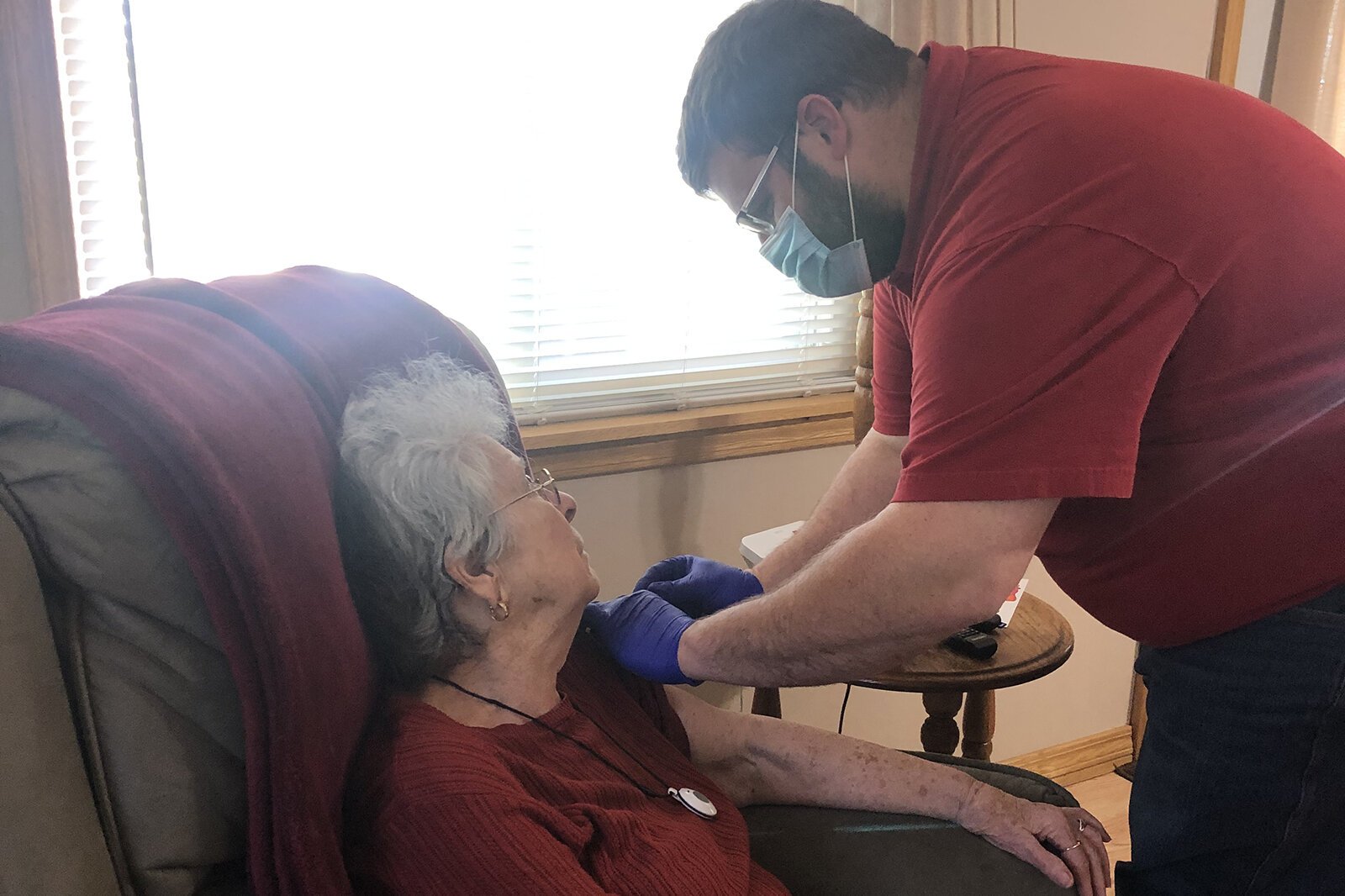
While COVID-19 vaccination efforts have plateaued, Michigan health care professionals are working overtime to understand and address vaccine hesitancy.
This article is part of State of Health, a series about how Michigan communities are rising to address health challenges. It is made possible with funding from the Michigan Health Endowment Fund.
More than seven months after COVID-19 vaccines began rolling out in Michigan, vaccination efforts have plateaued, falling short of state officials’ goal of vaccinating 70% of Michiganders aged 16 and up. And with the highly contagious Delta variant of the virus causing major disruptions in other states, Michigan health care professionals are working overtime to understand and address vaccine hesitancy.
The reasons for that hesitancy vary across Michigan communities. University of Michigan sociology professor and researcher Jeffrey Morenoff compiled data for the most recent Detroit Metro Area Community Survey (DMACS), which has done a series of surveys on Detroiters’ experience with the pandemic. Survey results are shared with state and local policymakers, media organizations, and community groups to help decision-makers understand the various impacts of the pandemic, and to possibly direct their relief efforts in ways that best match Detroiters’ experiences and priorities.
In October 2020, DMACS found that nearly 66% of Detroit-area respondents reported that they were unlikely to get the vaccine. That has changed, according to the latest DMACS report. About one-third of the people who previously reported that they were unlikely to get the COVID-19 vaccine have since gotten it. Morenoff says most reports on vaccine hesitancy categorize people as either persuadable “fence-sitters” or those who have a “hard-nosed” political or ideological opposition to vaccination. But, he says, “when I see that one-third of people who were unlikely to get vaccinated did get it, this gives me some hope that these categories are a little more fluid.”
“There may be some people who are holding out that can still be persuaded,” he says. “More could be done to get more folks vaccinated. I don’t think we’re done with all the efforts that can be made.”
New and continuing challenges
However, Morenoff also notes that some “alarming” new concerns have arisen, including one not yet addressed in the latest DMACS report: adults living in families with children under 18 are less likely to be vaccinated and more likely to say that they are not going to get vaccinated.
“More adults with kids have already had COVID-19, so [they believe that they] already have antibodies,” he says. “But the bigger issue goes back to issues of trust. Adults living with kids are less trustful of information, the validity of the vaccine development process, and of the health care system in general. That’s a concern because it doesn’t bode well for efforts to get their kids vaccinated.”
The DMACS report also finds a major ongoing racial gap in vaccination, with 76% of white respondents reporting having initiated vaccination, compared to 57% of Black and 58% of Latino respondents. Although challenges in vaccine access have affected populations of color, the DMACS report finds that the most common reasons for not getting vaccinated are concerns about the effectiveness, side effects, and safety of the vaccine – and Black residents are more likely to have concerns about effectiveness than white residents.
Joann Hoganson, Kent County Health Department director of community wellness, has also seen lower rates of vaccination among Kent County’s African-American and Latinx communities. Communities of color’s distrust of the vaccine is often deeply rooted in disenfranchisement and distrust. For the Latinx community, for example, the fear of undocumented family members and friends being deported remains real.

In our January 2021 look at vaccine hesitancy in Michigan, Dr. Joneigh Khaldun, chief medical executive and chief deputy director for health at the Michigan Department of Health and Human Services (MDHHS), addressed lower rates of vaccination in the African-American community, noting historically based reasons for people of color’s mistrust of the health care system.
“There’s a mistrust in the community and, quite frankly, there’s still implicit bias in the health care system,” she said. “There is systemic racism.”
The urban centers of Detroit and Grand Rapids aren’t the only places where vaccine hesitancy is prolonging the pandemic’s grip. Hoganson says other notable pockets of hesitancy exist among residents of Kent County’s conservative, northern, rural communities: Cedar Springs, Sparta, and Kent City.

“I don’t know if people are taking it as seriously as they should,” Hoganson says. “A lot of people are depending on everybody else. If you are not vaccinated, you stand at a very significant risk.”
Nathaniel Bergman is a pharmacist with Region VII Area Agency on Aging (AAA), which serves Bay, Clare, Gladwin, Gratiot, Huron, Isabella, Midland, Saginaw, Sanilac and Tuscola counties. He says reasons for vaccine hesitancy in his service area break down largely along age lines.
“In the older population, those 50 and older, the biggest reason is many of those individuals have other chronic health conditions,” he says. “Especially those 80 and over, they feel, ‘If it’s my time to go, it’s my time to go.’ Those people can be kind of tough to convince otherwise. The younger people, those individuals ages 18 to 30, are looking at the data. ‘It says I’ll be okay if I get it. It’s not going to negatively affect me, hospitalize me, kill me, so why do I need the vaccine?'”
Addressing hesitancy
These differing motivations for hesitancy require a variety of interventions. Bergman and his colleagues at Region VII AAA use two strategies to encourage people to get the vaccine. First, they explain that even if the individual doesn’t care if they get COVID-19, getting vaccinated will protect their friends, family, and loved ones. A 25-year-old may not be afraid to get COVID-19, but they may not understand the risks they create for their parents or grandparents who haven’t been vaccinated. And the 80-year-old needs to understand that they could spread COVID-19 to their caregivers, children, and grandchildren.
“It’s not just about protecting you. It’s about protecting everyone around you,” Bergman says. “We have seen some success in that approach changing some people’s minds. Even if I doubt it or don’t think I need it, I am still going to do it to protect my loved ones.”
As a second strategy, Bergman engages the Region VII AAA medical director, Dr. Ed Canfield, to chat with hesitant residents. Oftentimes, having a heart-to-heart with a higher-level medical professional persuades people of the vaccine’s value. However, some are still resistant.
“The third group not getting vaccinated is a political demographic, those who feel that they don’t need the vaccine,” Bergman says. “The pandemic has been extremely politicized. They will tell me, ‘They’re putting a chip in me, tracking me.’ There is not much reasoning we can do with these individuals.”
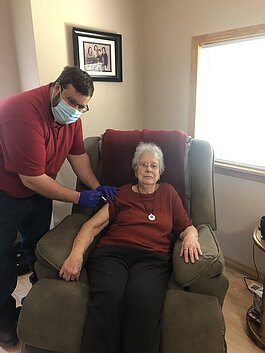
Bergman also has concerns for homebound residents who haven’t figured out how to access vaccination. While Region VII AAA has a robust in-home vaccination program for people who cannot get out to a clinic or pharmacy, he fears that the program hasn’t reached everyone who needs the vaccine. He says many homebound residents may think they don’t need a vaccine because they don’t leave their home.
“The fact is, somebody bringing in meals, family visitors, or a neighbor dropping off mail, that’s still a lot of risk for contracting COVID-19 for those homebound individuals who just don’t know who to contact for a vaccine,” he says.
In Kent County, a number of strategies are in place to reach the homebound. Programs offer free door-to-door transportation, mobile units make stops in neighborhoods, and Kent County Health Department “strike teams” provide vaccinations to residents in their homes.
“We are trying to remove every barrier for them to get vaccinated,” Hoganson says. “We know that vaccination has drastically lowered our case numbers — they are down by about 90% from the highest point when COVID-19 was spreading widely. The vaccine is doing exactly what we hoped it would do.”
Hoganson says she would be “thrilled” if 80% of Kent County residents eligible for a vaccine were vaccinated. The county is currently just above a 60% vaccination rate.
“We’re not going to get out of this pandemic until we reach a higher number of people vaccinated,” she says. “The mutations are going to continue as long as the virus is circulating. If you don’t do it for yourself, do it for your community, the people who are vulnerable. It has to be a community effort, not just one person protecting themselves.”
A freelance writer and editor, Estelle Slootmaker is happiest writing about social justice, wellness, and the arts. She is development news editor for Rapid Growth Media and chairs The Tree Amigos, City of Wyoming Tree Commission. Her finest accomplishment is her five amazing adult children. You can contact Estelle at Estelle.Slootmaker@gmail.com or www.constellations.biz.
Vaccination photos and Joneigh Khaldun photo courtesy of MDHHS. Joann Hoganson photo courtesy of Joann Hoganson.
Related Articles
Equest Center highlighted as Bank of America boosts year-round community support
Bank of America’s Day of Giving showcases its ongoing volunteer partnership with Equest Center; Lakeshore Advantage selected as bank’s 2025 Neighborhood Builder.
Retailer Hank Meijer shows off his storytelling talents at Dutch American celebration
At Dutch-American Heritage Day, retailer leader and author Hank Meijer reflects on family stories, immigrant roots, and the legacy of Fred and Lena Meijer.

It’s hard for foster kids to get the health care they need, but this project is working to change that
A Grand Valley State University project is working to create an integrated mobile care team to serve foster kids’ complex health needs.