
Workplace accommodations challenge one-size-fits-all approaches for employees
Advocate and guardian collaborate to resolve workplace accommodation gap, highlighting communication, policies, and solutions that keep a worker safely employed.
When Molly Fuller’s sister was asked by her employer to volunteer at a nonprofit food-packing site, the problem wasn’t the work. It was the environment.
“I had tried to solve it, and I was running out of options. How do I address this safety concern?” says Fuller, the legal guardian of her sister, Brooke.
Brooke has Prader-Willi syndrome, a rare genetic condition that affects hunger regulation.
“She doesn’t have the mechanism in her brain that signals satiation,” Fuller says. “Having no hope or chance to obtain food that is not part of the meal plan is paramount to well-being. That’s the main thing.”
But Brooke’s job as a peer mentor at another nonprofit had shifted when she was encouraged to volunteer at the new site, where she would constantly be exposed to food.
“It creates stress when she knows she’s going there. It’s just not a safe environment for Brooke,” Fuller says.
Brooke struggled to communicate the issue and could not advocate for herself in that moment — something Molly recognized. However, according to Fuller, Brooke’s employer spurned Molly’s intervention, saying Brooke had to speak for herself.
“This is one area of her life where she needs support and cannot advocate for herself. That’s why I’m her guardian,” she says.
Advocate offers ‘call to action’
At first, Fuller tried to resolve the issue directly. When that stalled, she turned to Disability Advocates of Kent County, where advocate Kevin Sellon began working with her.
“He sent me a sample letter template and suggested that I send it via registered mail,” she says. “This letter was a call to action.”
Sellon says situations like this are rarely simple. His work often begins after communication has broken down. Employees come to him after being dismissed or misunderstood.
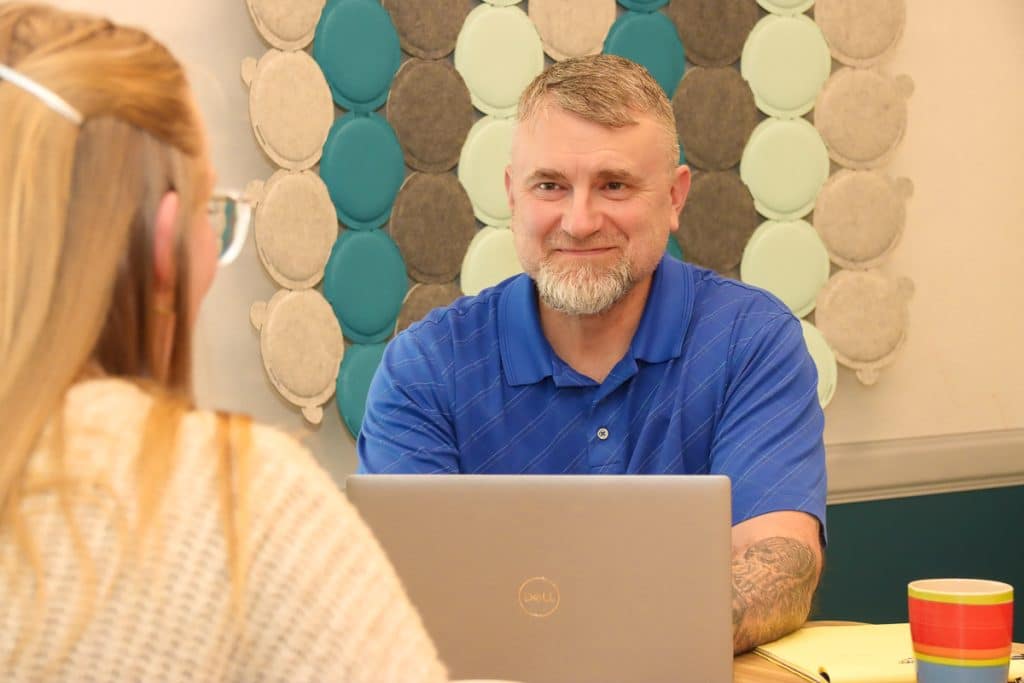
“It can be kind of challenging to convince them to just, please, just hear us,” he says.
The case involving Fuller’s sister reflected a gap in understanding rather than outright opposition.
“There was no policy. It was new for them,” Fuller says, referring to how Brooke’s employer handled guardianship issues.
Sellon says that situation comes up often.
“It’s possibly ignorance when it comes to that law,” he says.
Employers may believe they are being fair, but misunderstand what accommodations require.
Receptive employer leads to resolution
In Brooke’s case, the solution did not involve new equipment or major restructuring. It required recognizing that a specific environment — the food-centered volunteer site — conflicted with her medical needs.
With guidance from Sellon, Fuller sent a letter explaining the situation and her role as guardian. The response came quickly. Fuller says the organization’s executive director agreed to a conversation.
“She was open to learning,” Fuller says.
That openness made a difference. Rather than shutting down or deferring to legal concerns, the organization engaged in dialogue. The employer acknowledged a gap in policy and practice, and Brooke’s assignment was changed to another that was suitable.
But this isn’t always the outcome.
“I have more that refuse to make accommodations than have that want to just listen,” Sellon says.
When organizations resist, the process can escalate quickly.
“They pass everything to their lawyers like a bulletproof vest,” Sellon says. “Communication breaks down. They just stop answering.”
That breakdown can push workers toward formal complaints, a process that can be long and difficult. Cases like Fuller’s show a different path, one based on communication and a willingness to adapt.
“It’s the ones that are willing to learn that actually listen,” Sellon says.
He often frames accommodations in personal terms.
“This could happen to you or someone you love,” he says.
Advocating for sister’s needs
Fuller says it’s important for her sister’s well-being to be able to work and feel like she is contributing.
“Her job means the world to her,” Fuller says. “She is so proud of her job.”
Brooke’s current work schedule includes mentoring, volunteering at a therapeutic riding center, socializing animals at a shelter, and participating in community programs.
“She loves giving back. It’s a big part of her life,” Fuller says.
Losing that structure could have had ripple effects.
“It would have been very sad had this been a reason she lost her job,” she says.
Instead, the resolution allowed Brooke to continue working in environments that support her success.
Fuller sees the experience as both a personal victory and a broader lesson.
“This is advocacy for the future, too. What world do we want to live in?” she says.
The case also highlights an ongoing challenge: how workplaces handle employees with guardianship arrangements, which can seem like “murky waters,” Fuller says.
While Brooke’s employer addressed the immediate issue, Fuller says it’s unclear if it added a policy about working with guardians.
Fuller says she sent the employer language suggested by Sellon to add guardianship guidelines to its employee handbook. Molly says the employer replied that the issue impacts only one out of 450 employees, but “we do see potential value in exploring a policy or protocol update. To that end, we began reaching out to other employers who work with guarded adults to learn from their approaches.”
“I will follow up on that,” she says.
Sellon encourages persistence. Advocacy, he says, is not just about resolving one case but improving systems over time.
Fuller says she shares that sense of momentum, even as she recognizes there is more to do.
“I have to support my sister and help her stay living in the community,” she says.
She adds that it was important to balance her sister’s protection with independence, stepping in only when necessary.
“I don’t want to overstep my role,” she says.
Photos by Tommy Allen
The multi-regional Disability Inclusion series is made possible through a partnership with Centers for Independent Living organizations across West Michigan.
Related Articles
Health center trains local residents as dental assistants to fill workforce gaps
HealthLinc, a federally qualified health center, covers training costs while preparing local residents for dental assistant jobs, strengthening workforce pipelines and expanding access to care.
The early childhood models in other states inspiring Michigan policy advocates
Michigan is making meaningful strides to advance early childhood education but could make even more by looking to other states’ models.


