
#RG20LookBack: How neighborhood identity factors into planning a socially productive park
As part of Rapid Growth’s 20th anniversary, we revisit a 2014 innovation story by Anya Zentmeyer, documenting a subtle but significant shift in Grand Rapids public planning sessions and citywide meetings.
In 2014, Rapid Growth shared an innovation story written by Anya Zentmeyer, our then development news editor. Her reporting captured a subtle but significant shift in public planning sessions in Grand Rapids. By focusing not just on playgrounds or picnic tables, but on our identity as neighbors and the city’s evolution. These neighborhood park workshops demonstrated our willingness and readiness to reimagine parks by listening carefully, viewing each park as a mirror of its community, and recognizing that the finest public spaces are intentionally created and not here just by chance.
“A lot of these parks have never been formally designed, or at least haven’t had their designs revisited in decades, so instead of just putting in a splash pad, we wanted to have a broader discussion with the community about what’s working and what’s not working,” says Steve Faber, founding and former executive director of Friends of Grand Rapids Parks (Friends) in 2014.
Reflecting on our stories from Rapid Growth Media, this week’s feature demonstrates how initial inquiries have resulted in concrete outcomes: sustained community and public/private investments, stronger local partnerships, and a redesigned park’s mission that now extends beyond just warm-weather activities. Thanks to our collaboration with GR City Parks and Recreation with Friends, these efforts emphasize themes of nature, education, and belonging. Grand Rapids Parks and those of nearby communities have transitioned from merely offering a pleasant setting for seasonal activities to becoming core elements of community identity, fostering deeper connections to natural environments and each other in subtle yet meaningful ways.
My favorite part of winter right now is seeing that the evidence still remains. You can notice it in the consistent foot traffic in our parks in a post-COVID-19 world, increased skating, robust birdwatching, bundled walks connected (or soon to be), and above all, the reassuring feeling of having a space to breathe and find respite. It serves as a reminder that in Grand Rapids, our parks are meant for all weather, not just sunny days. They are for everyone year-round.
Parks with benefits: How neighborhood identity factors into planning a socially productive park
“Who are you? What do you want to become? What do you want to preserve? What do you want to transform? What do you think will usher in who you want to be?”
Friends of Grand Rapids Parks’ Executive Director Steve Faber knows these are big questions. However, although he says they are questions that admittedly sound a bit “metaphysical” for a conversation about parks, he also thinks they’re the kind you find at the heart of most transformational public spaces. The kind that work in balance of research-based strategic planning, and the kind he, alongside the Grand Rapids Parks and Recreation Department and Advisory Board, hopes to find some answers for through a series of eight neighborhood design workshops they will continue to host through Nov. 8.
These community forums will include the assistance of local design firms VIRIDIS and Progressive AE in verifying concept plans and identifying priority improvement projects for each park based on public comment and come nearly a year after 60 percent of voters approved a 0.98-mil, 7-year property tax expected to generate an estimated $4 million annually for city parks.
Water resources, Faber says, are one of the first things the city and friends of the community wanted to tackle after the tax millage was approved last November. Faber says Friends of Grand Rapids Parks intentionally selected the parks included in the workshop series largely based on lack of functional water resources.
“A lot of these parks have never been formally designed, or at least haven’t had their designs revisited in decades, so instead of just putting in a splash pad we wanted to have a broader discussion with the community about what’s working and what’s not working,” Faber says.
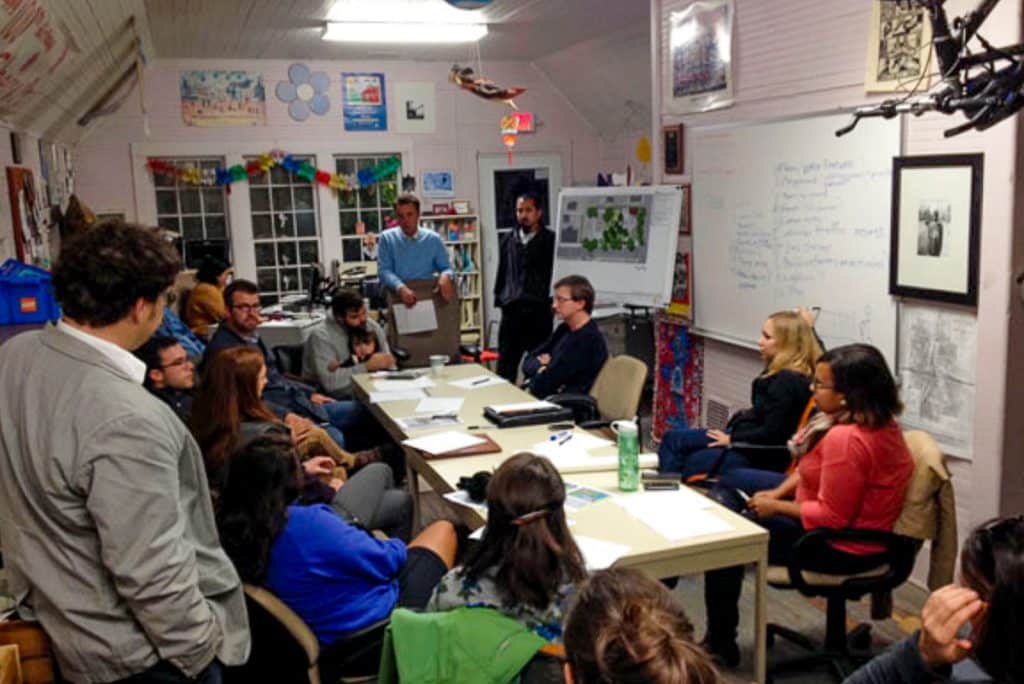
Neighborhood Planning Teams were established for each park at the beginning of the process to help consultants and community leaders better understand the parks and their surrounding neighborhoods. Faber says the neighborhood park design workshops are essentially designed to create a more cohesive level of understanding through the kind perspective only a neighborhood resident could offer.
“They’re the ones who really see how that park gets used day in and day out, and they can to say to us, ‘At 9 o’clock every Friday night, there’s people using this basketball court,’ or, ‘Nobody ever uses that thing and we think it would be great to have this other thing,’” Faber says. “With the Cherry Park neighborhood, they want to preserve some of the best things about their park – the playground and things like that – but they also want more gathering spaces, places where they can throw events and come together, because that’s kind of an extension of who they are right now and who they’re becoming.”
So, although understanding who Cherry Park neighbors are right now and who they are becoming may sound like a big, abstract undertaking, it has everything to do with how these revitalization projects can be a huge part of facilitating that positive transformation.
It creates intuitive concepts that can be implemented with realistic, existing parameters in mind and tailored to each neighborhood’s unique context so that communities can build their own answers not only to abstract questions like collective identity, but also the more quantifiable ones like reduced crime rates, increased property values and cleaner air to breathe.
“Parks can work for a city,” he says. “They can help us clean our water and keep our basements dry and clean out particular matter in the air…there’s the really tangible stuff and there’s the intangible.”
The Parks and Recreation Advisory Board will unveil final plans to general public at a Plan Review Open House on Dec. 3 from 6-8 p.m. at the Gerald R. Ford Middle School gymnasium.
Times, dates and locations for the eight neighborhood park design workshops are included below, but for more specific details on each individual park plans, links to individual Facebook event pages, or to keep up with Master Plan’s progress, visit www.friendsofgrparks.org.
Related Articles

Shark Tank stars kick off Tech Week Grand Rapids
Daymond John and Robert Herjavec open a week that celebrates innovation, entrepreneurship, and West Michigan’s growing technology community.
Trinity Health and Michigan community groups will make fresh, local food a Medicaid benefit
A new Trinity Health initiative will allow people in the Ann Arbor, Detroit, and Grand Rapids areas to access fresh, affordable produce from local organizations through their Medicaid health plans.
Voices of Youth: Lessons learned from listening to young people
Over the past three years, Voices of Youth has shown us that by actively listening to what young people want, we often develop better ideas. Here, Publisher Tommy Allen reflects on the achievements and lessons learned over three years with Voices of Youth.


