
Designer’s accessibility sticker encourages communities to rethink who automatic doors serve
Grand Rapids designer Aidan Van Doren created an accessibility sticker showing automatic doors benefit parents, workers, older adults, and people with disabilities.
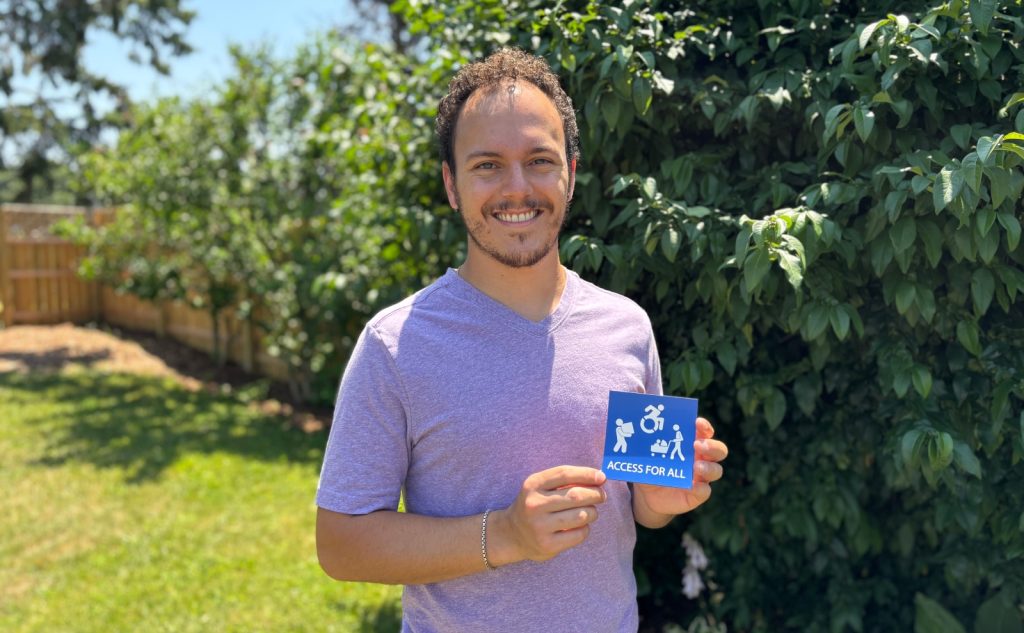
A blue sticker placed on an automatic door button is helping spark a larger conversation about accessibility, inclusion and who public spaces are designed to serve.
Designer Aidan Van Doren traces the project to a question raised years ago during a presentation at Kendall College of Art and Design of Ferris State University: Why do accessibility door buttons represent only one type of user when they benefit so many people?
“These door buttons should represent all the people that they service,” Van Doren says. “When we design a world for people with disabilities, we design that world for all people.”
The idea grew out of classroom discussions led by Dave Bulkowski, executive director of Disability Advocates of Kent County. During presentations to design students, he encouraged them to think about how accessibility features communicate who they are intended to serve.
“It took the right student to say, ‘Yeah, let’s do it,'” Bulkowski says. “I’ve been pitching this idea to many people, and it was great to see Aidan do something with it.”
Universal design
Van Doren’s sticker gives the familiar blue automatic door button a new look. It uses an active wheelchair symbol created by a team led by disability designer and researcher Sarah Hendren. The sticker also shows parents with strollers, delivery workers carrying boxes, and others who use automatic doors.
The design shows that automatic doors help many different kinds of people, not just wheelchair users.
“People who use wheelchairs are not static people,” Van Doren says. “They live active lives, and so we need to represent that well.”
The project illustrates what accessibility advocates call universal design: creating spaces and systems that work for the widest range of people. The stickers are inexpensive, easy to install, and encourage organizations to think differently about how accessibility is communicated.
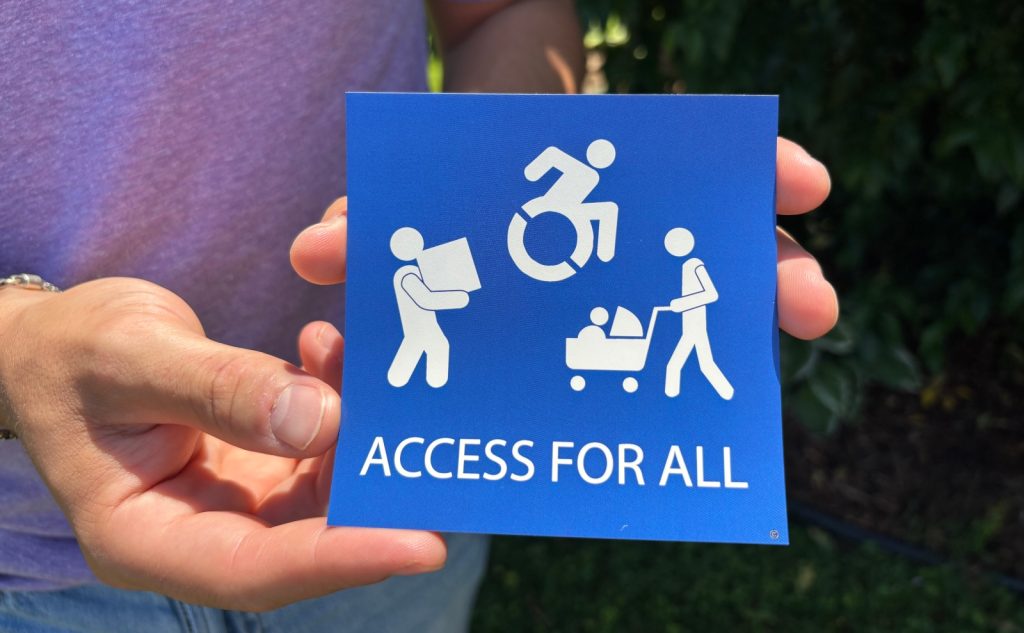
Vicky Schmidt, a member of the Disability Advocates of Kent County board of directors and one of the organization’s accessibility test pilots, says the design changes how people see something they encounter every day.
“It isn’t this niche accommodation for a certain population,” Schmidt says. “It’s a universal convenience.”
Schmidt has used a wheelchair since an auto crash nearly 25 years ago. She says accessibility is often viewed as something created for people with disabilities when, in reality, everyone benefits.
“A more accessible world makes life smoother for absolutely everyone,” she says. “So many people look at accessibility as something they’re doing for people who need it. Really, we all need it, and we all benefit from it.”
Bulkowski says the design also keeps disability visible rather than treating it as something separate.
“Disability is front and center,” he says. “At the same time, it’s included in all the possible uses. We’re not trying to hide disability. It’s part of it.”
New perceptions
Van Doren first tested the idea by putting stickers on door buttons around Kendall College of Art and Design. Students, teachers and disability advocates liked the design and encouraged him to keep going.
Now, Van Doren sells the stickers through his online store, www.accessforall.shop, and works with Disability Advocates of Kent County, which has supported the project from the beginning.
“They live this and breathe this every single day,” Van Doren says of the organization’s staff and advocates. “Having them as a resource for this project and many other projects has been so helpful.”
The stickers are printed by Swift Printing in Grand Rapids using materials made to withstand Michigan’s weather. Van Doren sells them for $3 each.
While the project encourages people to see accessibility as something that helps everyone, not just people with disabilities, it also addresses a larger challenge: changing perceptions about disability.
Much of Van Doren’s education focused on disability rights, accessibility, and systems design. Conversations with disability advocates and community members led him to view disability less as an individual condition and more as the result of barriers built into society.
“There’s no real disability,” Van Doren says. “You’re disabled by your environment. You’re disabled by the systems that are built.”
That perspective guides his work as a designer.
“The system is the problem, and I’m a systems-based designer, so I think it’s up to me to fix the system,” he says.
‘For all of us’
The stickers show that automatic door buttons are meant for everyone. Parents with strollers, people carrying heavy items, travelers with luggage, older adults, and people with injuries can all use them.
“The sticker really embodies that,” Bulkowski says. “If you’re pushing a stroller or carrying boxes, just push the button and let the robot do the work.”
Schmidt says the design also changes how she feels as someone who uses automatic door buttons every day.
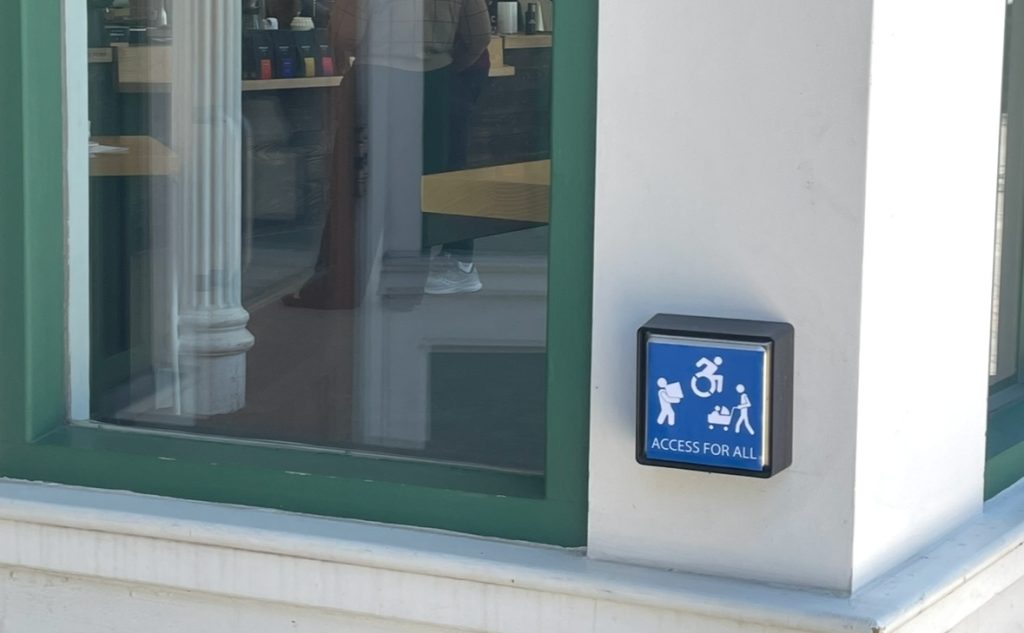
“It took it away from being something that was there for me or people like me and became, ‘Hey, this is for all of us,'” she says.
“If accessibility is there for everyone, it becomes invisible, which is beautiful because then it’s navigable for everybody.”
Van Doren says making public spaces easier for everyone to use can also help local businesses.
“It’s not only the right thing to do, but there’s a huge economic return for that,” he says. “There’s a huge return for our city when people know, ‘Hey, we’re the place that does that.'”
He adds that making an event accessible for one person often means more family members and friends will also attend.
Van Doren says that almost everyone will experience a disability at some point in their lives.
“Most people at some point in their life will experience a disability, even if it’s a temporary disability,” he says.
Van Doren hopes to place the stickers in more buildings, partner with local governments and organizations, and eventually replace the stickers with permanent metal door plates.
“When we call attention to accessibility, when we call attention to good design, that raises everybody up,” Van Doren says.
Photos courtesy of Aidan Van Doren
The multi-regional Disability Inclusion series is made possible through a partnership with Centers for Independent Living organizations across West Michigan.
Author

Related Articles
The wheels on the bus go ’round and ’round: Grand Rapids’ Central Station Early Childhood Center
The Rapid takes mom and dad to work -– and the littles to a brand new daycare opening in September 2026.


