
#RG20LookBack: The morning after, we’re still neighbors
In his 35th #RG20LookBack column, Publisher Tommy Allen reflects on what West Michigan’s neighbors have taught us about belonging. The votes are in, but the work of welcoming is never finished.
By the time you read this, Election Day will be behind us, even if some results are still being counted. Some of us are relieved, some are disappointed, and plenty are simply worn out by a brutal campaign season, with some races possibly headed to recounts as we wait for answers about voters’ intent.
What hasn’t changed, though, is that despite how polarized the country has become, we’re still neighbors here in West Michigan, the biggest small town in Michigan. The day after an election, we’ll still share the same schools, sidewalks and libraries, pass (and hopefully visit) the same storefronts, and carry on the daily work of making West Michigan home for so many people moving here in record numbers for our state.
While we started our look-back year examining a variety of topics, welcoming has been a thread running through our coverage. It’s a foundational trait I’ve found makes or breaks cities seeking to be great. That theme returns this week as we travel back to September 2014, when Rapid Growth’s Lauren F. Carlson looked at welcoming up close in “Home, heart, and history: How immigration is changing West Michigan.”
National arguments about immigration were loud then, too, just as they are today. Carlson didn’t wade into them. She spoke with local women helping newcomers navigate legal systems, find work, and build lives here.
Liz Balck, then with Justice for Our Neighbors, described Christian, Muslim and Jewish communities supporting immigrant and refugee families.
“The goodness is in people,” she said so succinctly.
I’ve been returning to her quote all week, and it’s been echoing in the back of my mind as we prepare to celebrate Native American Heritage Month this November.
Native American Heritage Month shouldn’t simply be about looking backward. I see it as an invitation to recognize Indigenous communities as contemporary, evolving cultures whose voices, leadership, and contributions continue to shape Michigan. Each year, I’m reminded that unless one embodies Native American heritage, we are all immigrants on this land.
Before French traders and Dutch immigrants arrived at the shores of the Grand River, the Anishinaabek were here, and their communities remain today. Generation after generation, families from around the world have settled here, adding their languages, businesses, and traditions to the mix. A 2025 report counted nearly 55,000 immigrants and refugees living in Kent County.
Carlson’s piece also reminds me that no single organization can create belonging on its own. Fast-forward to 2020, when Kent County released a Welcome Plan shaped by 25 community focus groups, pulling in residents, nonprofits, businesses, and local government to address barriers to employment, education, services, and civic participation. In 2026, that regional collaborative continues working to connect people with practical resources.
And just last month, Rapid Growth reported that Kent District Library and the World Affairs Council hosted From New Americans to Neighbors, inviting residents to learn about immigration through personal stories. (“KDL, World Affairs Council bring immigration conversation to West Michigan,” by Shandra Martinez)
None of this makes the disagreements go away. National decisions carry real consequences and often set the tone for the whole country. Change is hard, especially change without a roadmap toward welcoming, which leaves it vulnerable to bigger forces. But you don’t have to solve everything at once to start with what’s close to home.
This is where Rapid Growth has always anchored its coverage: looking at this region’s changes step by step, through the role each of us plays in making a difference right where we live, on so many different levels.
Sometimes that act of welcoming is helping a neighbor who needs a connection or a family trying to make sense of a system. Sometimes it’s a community meeting where someone listens before they speak.
Over 20 years, the stories I keep returning to at Rapid Growth are the ones about West Michiganders taking on problems that looked too big for one person.
The votes matter. So does what we do after Election Day. We still have a community to build, no matter what the headlines say, and hopefully we can find ways to come together, as we have for so many years before this moment, to help evolve a more perfect union.
And I still believe that if we keep our lens on the welcoming part, the rest will follow, now that we’re armed with the stories of our neighbors. Maybe I’m a dreamer, but after 20 years of listening to this community, I know I’m not the only one.

Home, heart, and history: How immigration is changing West Michigan
Immigration is a complex issue with deep roots in just about every community in the United States. Americans on both sides of the aisle struggle with the various social, economic and political implications of immigration, all while politicians battle it out on Capitol Hill. Here in Grand Rapids, opinions may be varied, but the historical evidence is clear: immigrants of all backgrounds have found, and continue to find, safe, welcoming communities in which to make their homes.
“It’s really just so cyclical,” says Liz Balck, National Regional Attorney at Justice for Our Neighbors (JFON), a nonprofit offering free immigration legal services to those below a certain income level. “The newest immigrant is demonized,” says Balck.
Balck, a Thomas Cooley graduate and Grand Rapids native, has witnessed a variety of immigrants come through her door, many facing some form of discrimination. Before attending law school, Balck also interned at the Minnesota Advocates for Human Rights, investigating the history of immigration in the Twin Cities. This hands-on research, as well as her work experience, showed her the cyclical nature of immigration. Referencing Irish immigrants in the 19th century, Balck explains that Americans have always sought a new group to fear and blame for the many problems of the day. However, all hope is not lost.
“The goodness is in people,” says Balck, who, as an attorney working in humanitarian-based immigration law – that is, for those with status seeking to apply for their families, abuse victims, refugees and children – has witnessed the open hearts and minds seeking to assist immigrants in need. “West Michigan has a long tradition of opening up their homes,” she says. Despite negative rhetoric heard on the news, “I’ve seen more of the hospitality and open-heartedness,” says Balck. At the heart of this welcoming attitude are the diverse faith communities in Grand Rapids.
“We couldn’t do it without such a strong faith community,” she says, referring especially to those churches who welcome and sponsor newly arrived refugees from war-torn countries all over the world. These refugees, who can legally work but who often do not speak English and are unfamiliar with many aspects of Western culture, find refuge where they worship. “It’s not just Christian churches.” says Balck, referencing the strong Muslim and Jewish communities supporting immigrants in the city.
Susan Reed, previously the regional attorney for JFON and now Supervising Attorney for the Michigan Immigrant Rights Center (MIRC) agrees. “When I think of Grand Rapids, I think of just awesome commitment to refugee resettlement,” says Reed. Based in Kalamazoo, Reed and MIRC utilize these committed faith communities and area nonprofits to work for immigrant equality throughout Michigan. “The people that I get to work with are not visible to anyone else,” says Reed, whose nonprofit works cases of immigrants whose civil rights have been violated or who have been scammed by the representation of unauthorized legal practitioners.
Much like JFON, MIRC’s services are offered for free. “It’s such a privilege to be able to serve our clients,” says Reed, who explains that these vulnerable immigrants, often struggling with poverty, are able to hire quality legal support. “We try to do impact work,” she says, explaining that MIRC’s casework involves a variety of areas, including working for clients who come from mixed-status families, such as the 266,329 Michigan children with one or more foreign-born parent (as of the 2012 report by the Migration Policy Institute). Above all, MIRC works in “building immigrant welcoming communities,” an essential goal that seeks to tie natural-born and foreign-born Americans together for happy, healthy and thriving Michigan towns.

Included in this goal are the the thousands of immigrant workers recruited by Michigan companies each year. Susan Im, president and immigration attorney at ImLaw, specializes in employment immigration, and works with an entirely different set of immigrants. “We represent some great companies that are using immigration as a tool in the toolkit,” she says.
The child of immigrant parents who faced language barriers and cultural differences after emigrating from South Korea in the 1960s, Im maintained a passion for immigration throughout law school. After a short time as an associate attorney in insurance litigation, she was soon drawn back to her earlier enthusiasm for this complex field. Though she felt that defending clients in insurance claims was in essence providing a helpful service, “It wasn’t immediate enough for me,” she says.
Now, says Im, “I’m in an area of law that I feel like I’m helping someone everyday.” Im’s 17-year-old firm has also witnessed the cyclical and varied stages of immigration in Michigan. However, unlike the social and political issues that fuel humanitarian-based immigration, the fickle economy is the principal propellant in employment immigration. Thus, some of the upturns and downturns are simple: when the economy is up, demand is high, and employers seek international talent as well as the domestic workforce; when it’s down, hiring decreases across the board.
However, “It’s the same level of complexity with employment based immigration law,” she says, comparing the work of local nonprofits, who work with clients in poverty, to her own firm, that deals with large, for-profit companies. Involved in international transfers of employees and providing assistance for those employees’ family members as well, Im gained an appreciation for the wide spectrum of immigration law. Regardless of the company, Im feels that her daily work makes a difference. “I find it very rewarding to help clients,” Im says, of both the companies and their recruited international employees.

In addition to the wide variety of immigration attorneys in West Michigan, non-attorneys are also working toward building a welcoming home for immigrants. Martha Gonzalez-Cortes, of Gonzalez-Cortes & Associates, utilizes her newly minted firm to focus on grant writing and program development for immigrants, Latinos and vulnerable people of color throughout Michigan.
“This sector of work is so complex and so all-consuming,” says Gonzalez-Cortes, who herself grew up in vulnerable communities, and utilizes her masters-level education in cultural anthropology from Stanford and 20 years of hands-on experience with nonprofits to better the daily life of these immigrant and minority populations.
Though working closest with the Latino populations, Gonzalez-Cortes breaks down the diverse immigrants throughout the state. “[Michigan] has the largest Arab-American community in the country,” she says. “There’s a very large refugee community.” Also, “Michigan is a very important state for refugee resettlement.” Using her experience, Gonzalez-Cortes assists nonprofits in thinking through programatic design to reach immigrant communities in need of assistance. “We are this very diverse group of people with different histories,” she says. “There’s a lot of room for growth and good work,” she continues, specifically referencing the solid Latino business growth over the past few years in Grand Rapids.
No matter how you slice it, immigration is a complex issue that has changed the fabric of West Michigan — and continues to do so today. Whether these immigrants arrive in the form of refugees fleeing conflict zones, talented international employees accepting new positions, or unaccompanied children following a dream, attorneys and local nonprofits are here in West Michigan to offer a helping hand and a welcoming community.
Lauren F. Carlson is a freelance writer and editor, Aquinas alumna, and Grand Rapids native. Her work can be found at www.emptyframecreative.com, and she can be reached at lauren@emptyframecreative.com for story tips and feedback.
Photography by Adam Bird
Related Articles
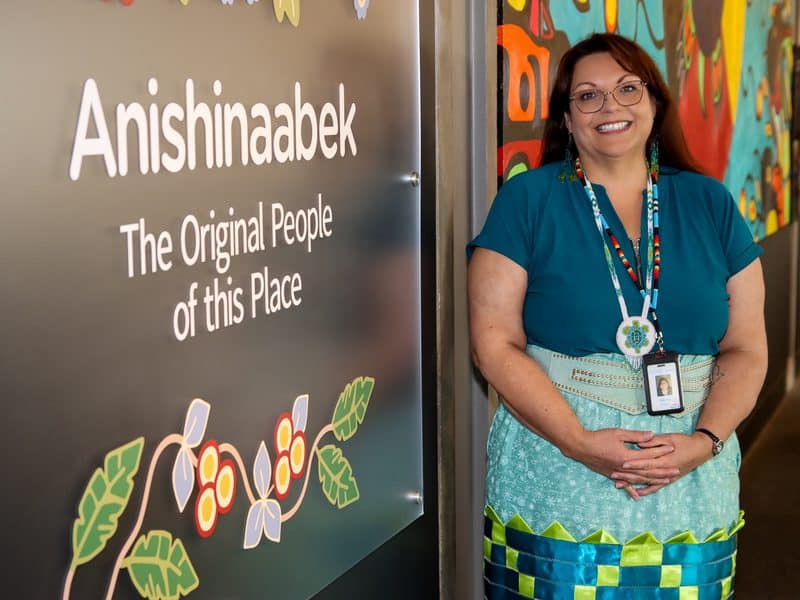
Who tells the story matters: Anishinaabek returns to the Grand Rapids Public Museum
After more than three decades, a reimagined exhibition puts Indigenous voices, lived experience, and community collaboration at the center of how West Michigan meets the original people of this place.


