
Who tells the story matters: Anishinaabek returns to the Grand Rapids Public Museum
After more than three decades, a reimagined exhibition puts Indigenous voices, lived experience, and community collaboration at the center of how West Michigan meets the original people of this place.
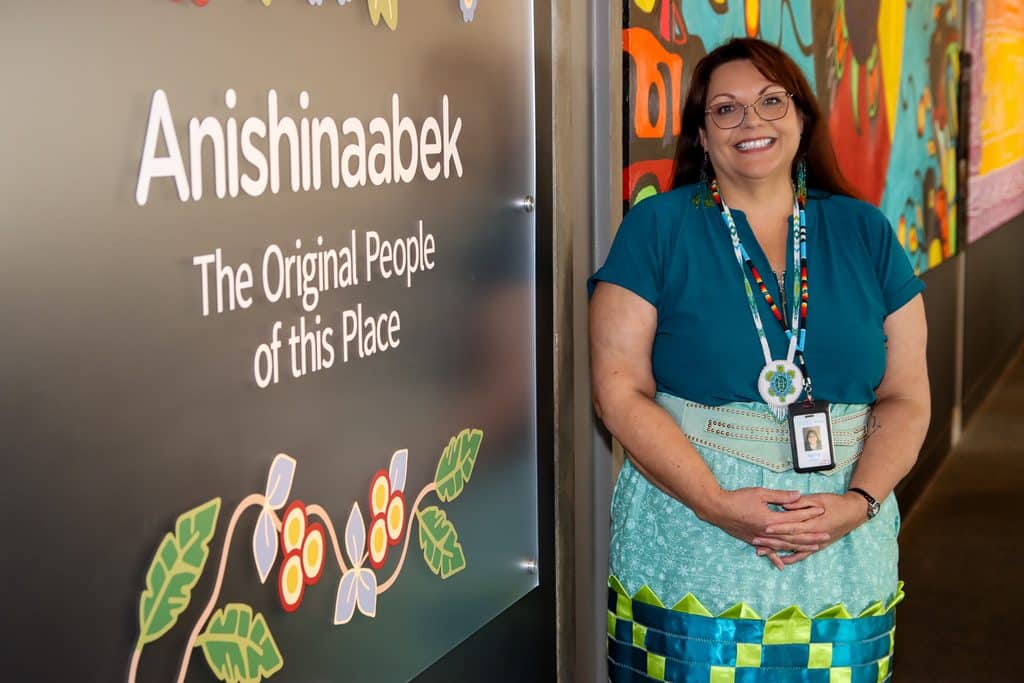
Kara Wilson nearly passed on the opportunity to join the Grand Rapids Public Museum’s newly reimagined Anishinaabek: The Original People of This Place exhibition. She had seen the casting notices from the GRPM seeking performers to help tell Indigenous stories through new holographic technology, but she kept scrolling.
“Like a lot of Indigenous people, I have a very complex relationship with museums,” Wilson said during the press event on Oct. 12, when the exhibition opened to the public.
Then, on the last day to audition, she read a script about manoomin, or wild rice. Wilson had spent years working to restore it to Michigan waterways while helping her community better understand its cultural importance. Suddenly, this became more than another casting call. With the audition deadline approaching, she jumped at the opportunity because it felt personal.
Now her image and voice are among those who greet visitors to a transformed exhibition, one that’s as much about the people living here today as the people who came before them. It is a transformational moment for everyone who ventures to the Grand River bank where the GRPM is located.
That’s the idea behind Anishinaabek: The Original People of This Place, which opened on Indigenous Peoples’ Day after nearly two years of renovation and decades of conversation about how to share these stories.
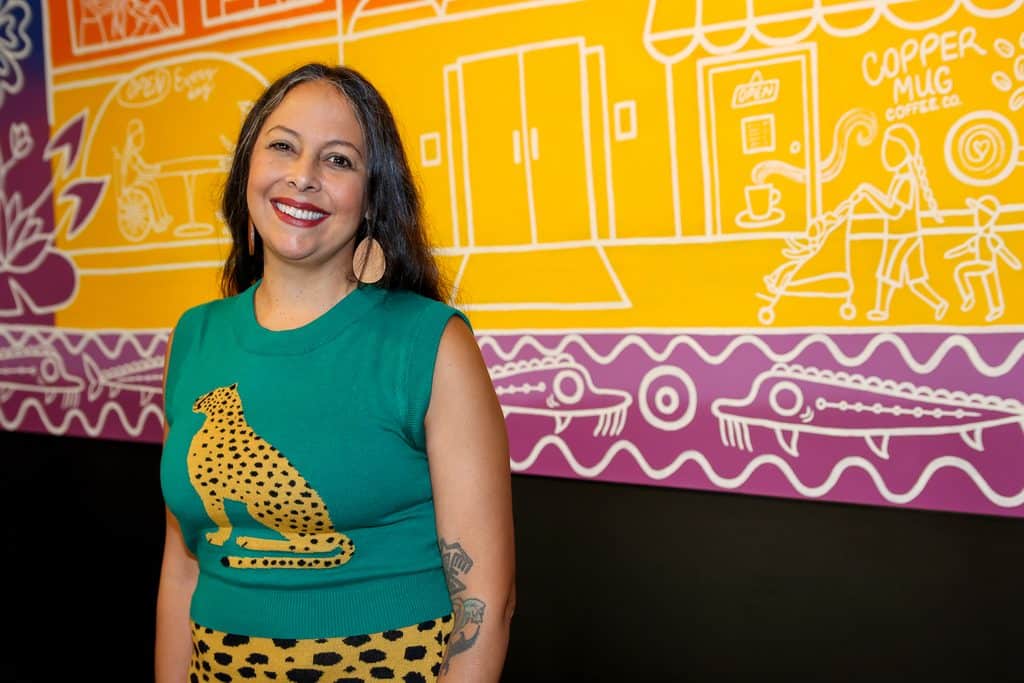
When Rapid Growth first visited the museum’s plans in December 2024, GRPM’s Anishinaabe Curator Katrina Furman described the challenge of reworking a permanent exhibition that had been on the third floor since 1994.
The 1994 version, which has had tweaks since debuting, was groundbreaking for its time, but it leaned heavily on historical photographs and artifacts, and visitors could walk away thinking Indigenous cultures belonged mostly to the past.
The new exhibition, developed alongside Michigan’s tribal communities and the Eshtoojik Advisory Council, aims to change that. Its guiding message: *We Are Still Here.*
A fresh way to tell the story
For Phyllis Davis, a Gun Lake Tribe elder and member of the Eshtoojik Council, the work started long before anything new went on display.
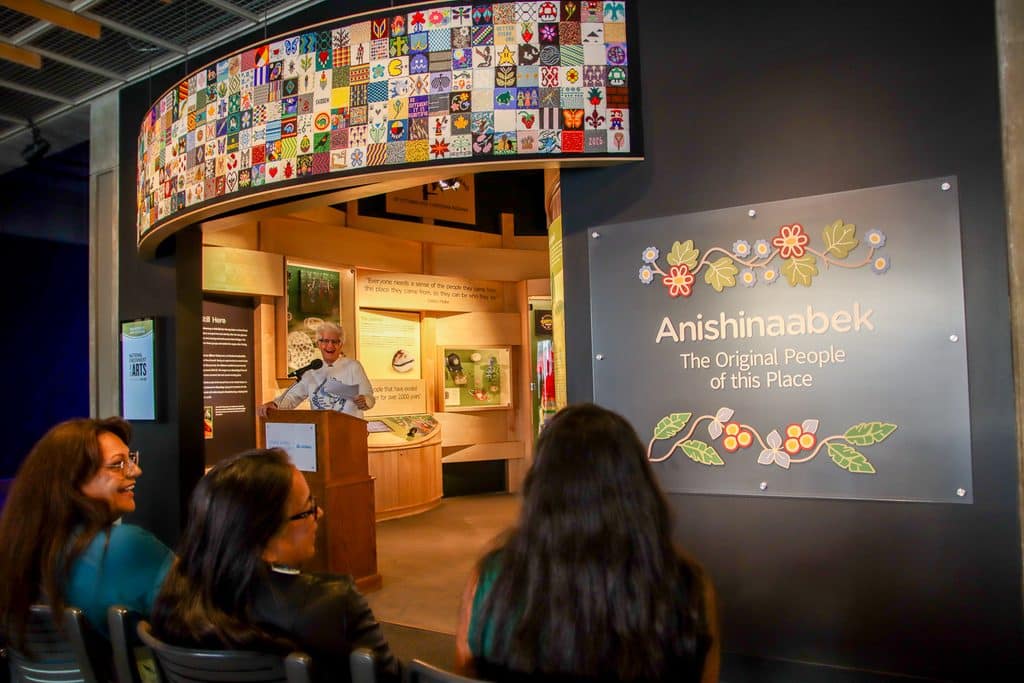
“Nothing about us without us,” Davis says to those gathered for the Monday opening, describing the principle that guided this collaboration between the museum and the community it commemorates.
Starting in 2023, about 30 council members, representing Michigan’s federally recognized tribal governments and the state-recognized Grand River Bands, worked with museum staff to review histories, cultural materials, and exhibition plans. They weren’t brought in to react to decisions that had already been made.
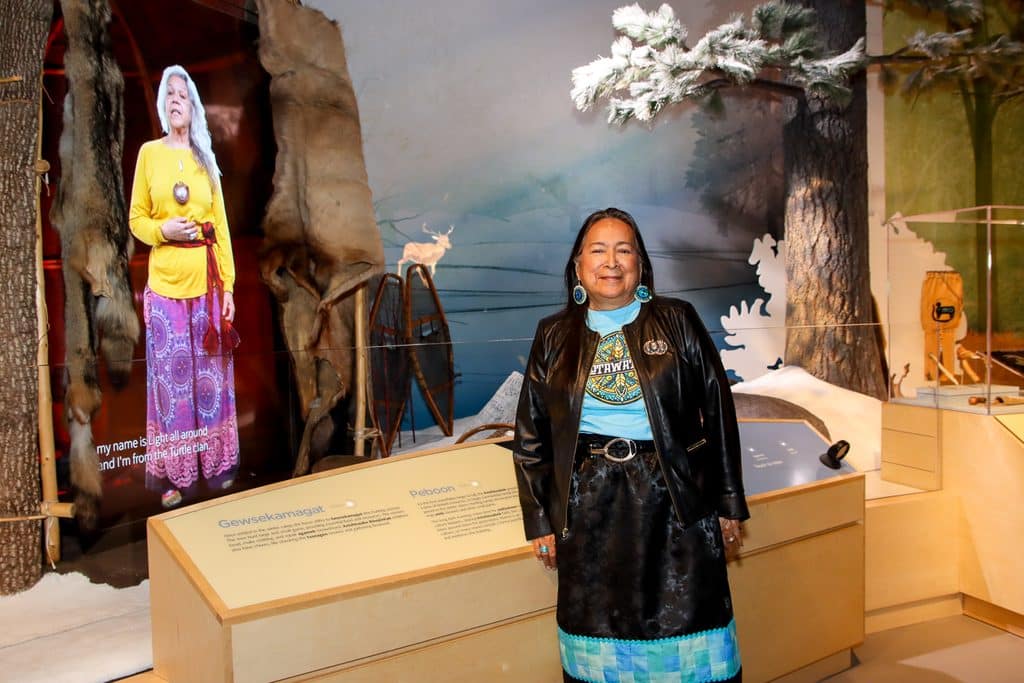
“This was not a situation where the museum created an exhibit and then asked the community what it thought,” Davis explained. “The community was part of the process.”
Sometimes that meant hard conversations about how to display certain objects, or whether they belonged in the exhibition at all.
Furman ran into this while going through artifacts for the new space. About 20 objects were flagged for further review under the Native American Graves Protection and Repatriation Act, the federal law governing the treatment and return of certain Indigenous cultural items and human remains.
It was a humbling moment for Furman. It also showed why the collaborative approach mattered.
“We were able to pivot and put different items in, continuing to tell the same story but with different objects in a respectful manner,” she says.
Davis sees that willingness to listen as one of the biggest lessons other museums can take from the project.
“That may not have always been the easiest way to create an exhibit, but it was the right way,” she says.
A living culture, woven into the experience
For Furman, the old exhibition was never just objects and historical narrative. Years before she became the museum’s Anishinaabe curator, she worked as its group scheduling coordinator, and on stressful days she’d slip downstairs to spend a little time alone in a space she fondly called the “cousin room.”
This former exhibition space, full of representations of relatives and ancestors, became a place of comfort for her.
“I’d like to go down to the cousin room and just kind of sit and relax and just feel my family’s presence,” Furman said during the opening ceremony.
She hoped to carry that centering feeling into the development and renovation of this exhibition space in 2024, when the museum began planning an engaging new design using groundbreaking technology and new ways to tell the story. Furman hopes anyone who walks into the gallery, Indigenous or not, finds a place to sit, reflect, and feel surrounded by family.
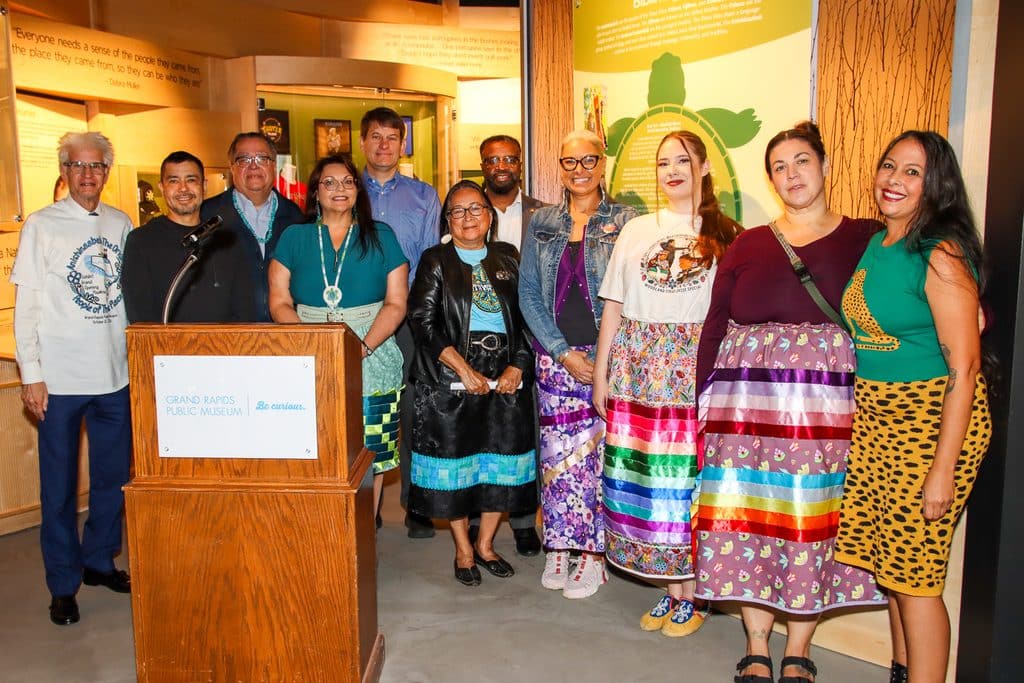
Maybe that says the most about this project. What matters isn’t only what’s newly installed, but also what the museum worked to preserve.
You can feel that connection before you even step inside the new exhibit. Above the entrance is a vibrant mosaic of 4-inch beaded tiles, made by about 70 Indigenous community members, forming one larger woven pattern. Each tile is its own piece of art. Step back, and together they become a call to explore this new exhibition space.
Inside, that woven design carries through a space Furman says resembles the interior of a basket, tying the room to longstanding Anishinaabe artistic traditions.
When we interviewed Furman in 2024, the baskets were among her favorite artifacts, so seeing this design element in the space points to the attention to detail and care of the museum staff and team of creatives and historians who brought this space to life.
A living story in three parts
The exhibition unfolds in three sections. It starts with “We Are Still Here,” which covers Anishinaabe origins and migration alongside contemporary identity, tribal sovereignty, veterans, and community changemakers.
From there, visitors move into seasonal village environments that explore traditional foodways and lifeways through holographic storytelling and immersive projections.
The last section brings viewers back to the present with Indigenous art, readings, music ranging from traditional instruments to hip-hop, and current news from Native communities, such as Native News Online, which attended the opening, all part of the exhibition’s modern storytelling aspects.
Some of the artifacts will keep changing, too, a common practice in museums with massive archives like the one our GRPM has amassed. Visitors can nominate veterans and community changemakers, and interactive language tiles can be updated with seasonal Anishinaabemowin words. It’s not a fixed account of history, but a living one.
For Wilson, the holographic format is a way to put her own experience in front of visitors of every generation.
“I try to restore my community’s relationship with manoomin as much as I try to restore manoomin physically in waterways,” she says.
Her presence in the gallery, through the holograph she recorded, also connects visitors with Indigenous people whose cultural knowledge continues to shape everyday life.
Davis spent 28 years working for the Gun Lake Tribe, including 16 years on its Tribal Council. She has contributed to a short documentary on sovereignty, language revitalization, cultural identity, and the painful history of Michigan’s Indigenous boarding schools.
She hopes the exhibition helps visitors look past the familiar images of powwows and historical artifacts and see more fully that Indigenous people are our neighbors, professionals, parents, students, and leaders. Davis’s eyes light up as she describes what she hopes young people will understand.
“I want a greater understanding for our young people to know that Indigenous people are here. They’ve always been here. They will always be here,” she says.
For Native children and families, she hopes it offers something just as important: a renewed sense of belonging and pride in their heritage.
Davis believes the exhibition’s biggest contribution may be helping future generations see how identity, community, and the natural world are connected. That last part resonated within me; in a time of rapid and unpredictable climate events and with humanity struggling to understand its relationship to the natural world, Indigenous voices and their history may offer a way forward if we are willing to listen and sit with the knowledge.
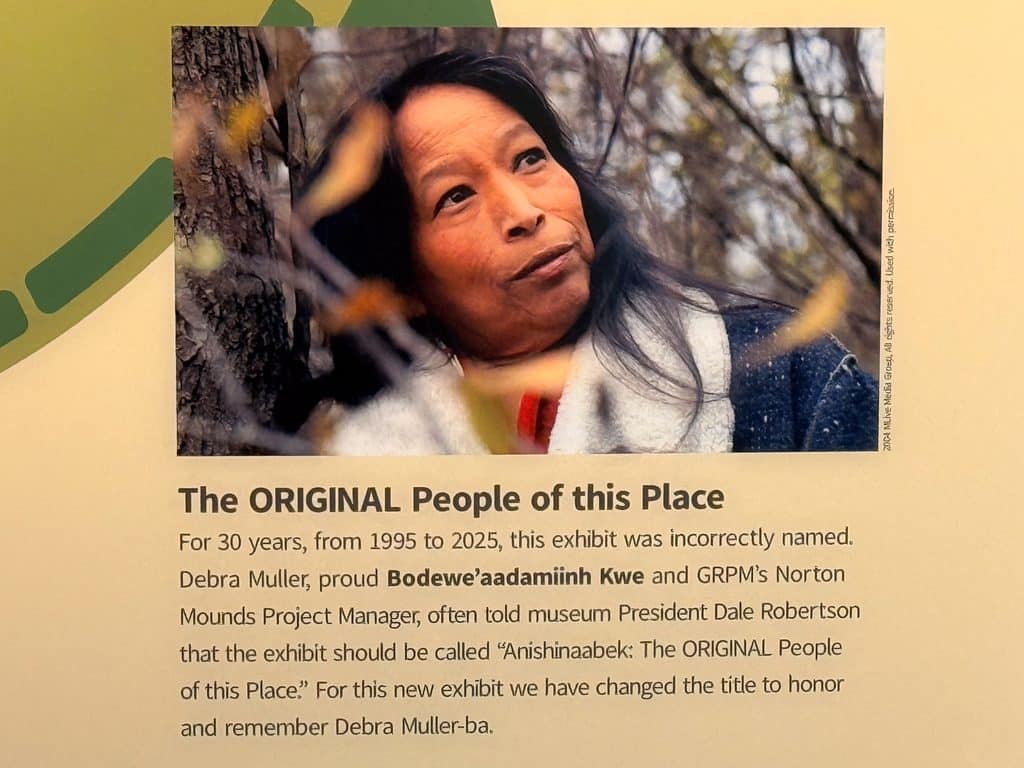
“You have to know your past to know where you’re going,” she says.
After more than 30 years, the museum’s reimagined space asks visitors to think beyond what they already know about the original people of this place. These stories are still being lived, shaped, and shared by the people around us.
For Dale Robertson, the president and CEO of the Grand Rapids Public Museum who will retire at the end of November, this reimagined exhibition may stand alongside the museum’s riverfront transformation as one of his most enduring contributions to Grand Rapids.
“How you do something is as important, if not more important, than what you do,” Robertson said at the opening ceremony.
In this new space, that philosophy will continue to greet residents and visitors long after his retirement, reminding them that whose voices shape our history matters as much as the stories we choose to tell.
Anishinaabek: The Original People of This Place is now open at the Grand Rapids Public Museum, 272 Pearl St. NW. The exhibition is included with general museum admission.
This story is part of Bridge to Community Curiosity, underwritten by the Grand Rapids Public Museum. Through this editorially independent partnership, we seek to highlight GRPM’s mission to inspire curiosity, deepen understanding, and foster belonging by showcasing the transformative power of arts and education in West Michigan.
Related Articles
Can “Poetry Saves Lives?” Festival shares how poetry benefits mental health
Free three-day event includes panel of local mental health professionals.
#RG20LookBack: When public art becomes a part of the place
In his 31st #RG20LookBack column marking Rapid Growth’s 20th anniversary, Publisher Tommy Allen revisits Grand Rapids’ relationship with public art, from Calder and Maya Lin to ArtPrize, and considers what the city might make room for next.
Kent District Library lets neighbors borrow, discover and explore together
From birdwatching kits to local music, KDL helps people try new things, save money, and share experiences.


