
GVSU grad helps travelers discover Michigan festivals with free app
GVSU alum Miguel Gutierrez created Wanderfest, a free app mapping 400 Michigan festivals to help travelers explore and shop in the state.
A stop at a small-town festival in Oregon gave Miguel Gutierrez an idea: Help travelers find festivals they might otherwise drive past.
Gutierrez, a Grand Valley State University graduate with Grand Rapids roots, created Wanderfest, a free app that maps 400 Michigan festivals. People can search near a town or along a road-trip route to find places to stop and explore.
“What surprised me most about Michigan is how hidden its festivals are,” he says. “Most live on a Facebook page or a chamber calendar that only locals check, so unless you already live there, you’d never know they exist.”
Gutierrez graduated from Grand Valley State University in 2020 with a degree in anthropology and a minor in Latin American studies.
Born in Grand Rapids and raised in Kent City, he spent nearly every weekend with his grandfather, who lived in an apartment above Maggie’s Kitchen, a beloved Mexican restaurant in Grand Rapids. Gutierrez now works in policy in Laredo, Texas.
He says he checked the facts for each festival himself. He is Mexican American and wanted Latino festivals on the map, too. These sit alongside events like Tulip Time in Holland and the Cherry Festival in Traverse City.
He is working with his longtime friend and mentor, Jorge Gonzalez. Until recently, Gonzalez was a co-director of Start Garden, where he spent years helping West Michigan entrepreneurs grow their startups. He has guided Gutierrez and connected him with people who can help spread the word about the app.
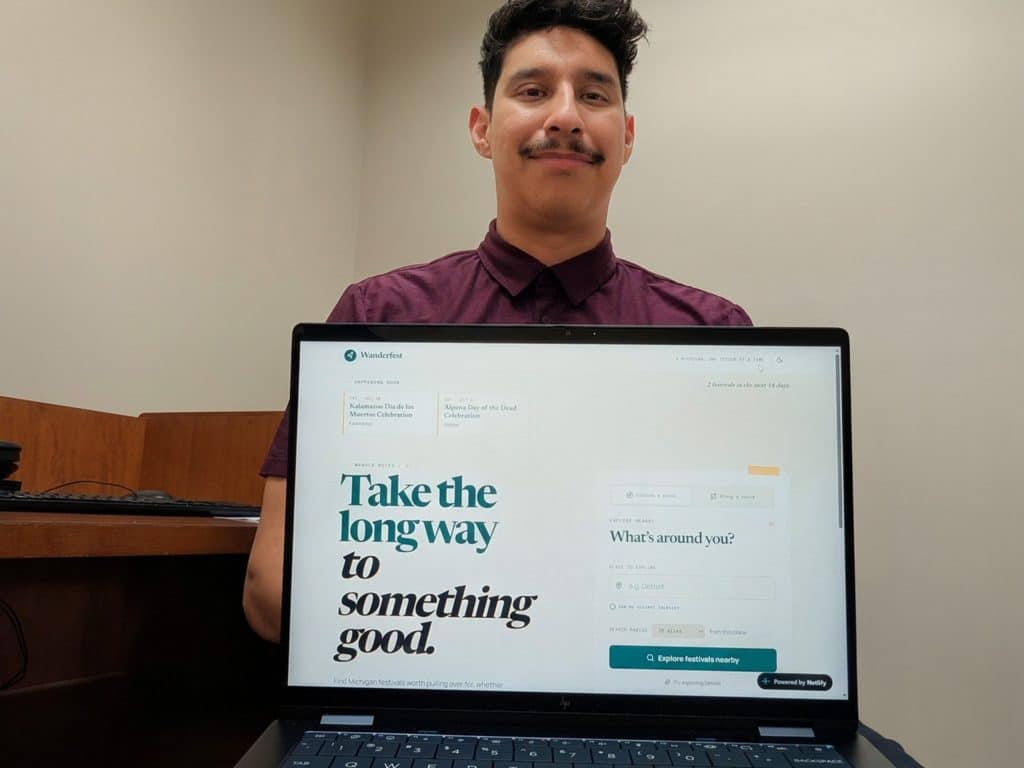
Gutierrez is now asking local business groups, tourism groups and festival planners to help keep the app’s details up to date. He hopes the app will help people find festivals, shop at local stores and stop for a bite to eat.
Rapid Growth talked with Gutierrez about how he made Wanderfest and how it helps people find fun stops across Michigan.
Rapid Growth: What inspired you to create Wanderfest, and how did your Grand Rapids roots shape the idea?
Miguel Gutierrez: I’d love to say Wanderfest was born out of a lifelong love of festivals, but that wouldn’t be true. I had just lost my federal job, had just bought a new car, and decided to take a spontaneous drive to the Pacific Northwest. Somewhere in Oregon I pulled over, opened a dating app, and a match invited me to a festival in downtown Baker City. Watching the whole town come out while the band played, I realized I never would have known it existed without a random match. That got me thinking about all the small-town festivals nobody outside town ever hears about, and I wanted to change that.
As for where to start, there was never another option. Michigan is home. Some of my favorite memories are beach days with friends, hiking trails with my mom, and taking the long, winding way through the fall colors. That’s really what Wanderfest is: taking the long way, and finding something worth stopping for. Michigan was always going to be first. I once built a longboard shaped like the Upper Peninsula. It never became a business, but it should tell you something.
RG: With no coding background, how did you use AI to build the app, and what were the biggest challenges along the way?
MG: I work in policy. I’d never built software. Day to day, I’d describe what I wanted in plain English, AI would write the code, and I’d test every change on my phone before it went live. I used AI for the research too, but I checked every festival myself, because AI is fast and confident and sometimes wrong. It would give me last year’s dates, links that went nowhere, or a pin in the wrong town. The other challenge was learning how software actually ships: moving to a new host, testing changes before they go live, and making each update count. AI did the building, but I had to be the editor.
RG: You checked all 400 festival listings by hand. What did that involve, and how will you keep the information accurate as events change?
MG: For every festival, I dropped a pin on the exact spot where it happens, clicked the link to make sure it works and belongs to the festival itself, and found proof that it happens every year, like a “54th annual” on an old flyer. Then I applied a few rules. It has to recur. It has to be an actual festival, not a concert series, a light display, or a brewery’s anniversary party. And it has to pass one test: would someone driving through be glad they pulled over? Plenty didn’t make the cut.
Keeping it accurate is the ongoing job. Most festivals follow a pattern, like “the last full weekend in July,” so I list that and confirm exact dates a month or two out. Organizers have already started sending me corrections, and I verify every change myself before it goes live.
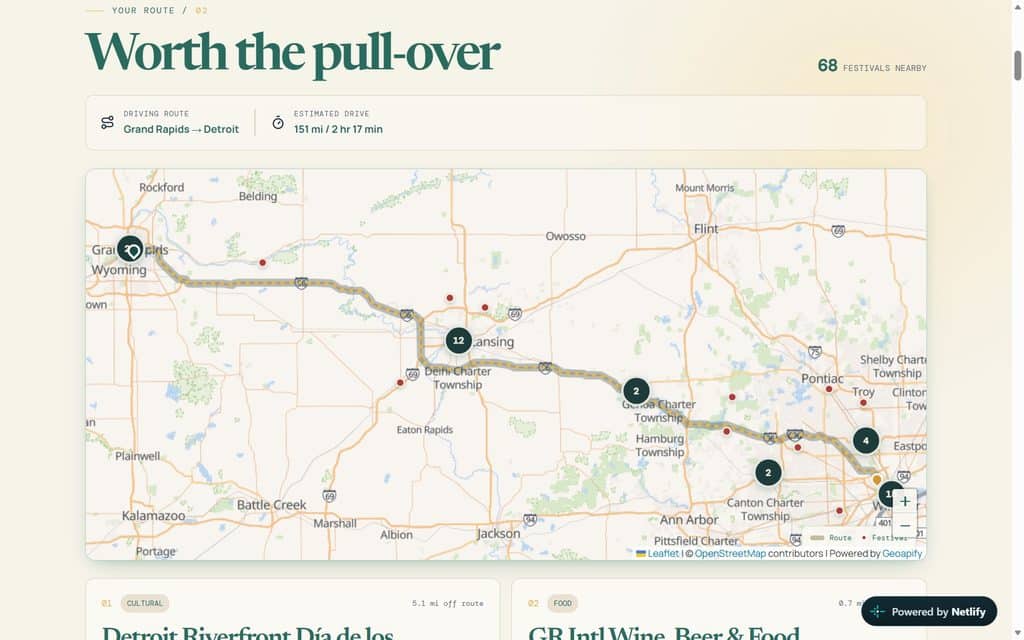
RG: As a Mexican American founder, why was it important to include Latino festivals, and what did you discover about Michigan’s festival scene while building the app?
MG: Because festivals keep culture alive. Some Latinos can’t go back to their home country, or the family that connected them to it is gone. Seeing their traditions celebrated here helps them stay rooted, and it does the same for me. That’s true of every heritage festival in Michigan, Dutch, Polish, Finnish, or Lebanese, and they teach the rest of us something along the way. I’ve always wanted to see Día de los Muertos in Mexico City, and I haven’t had the chance yet. So it was a pleasant surprise to find so many Día de los Muertos celebrations across Michigan, from Holland to Kalamazoo to Detroit, and to see that they don’t treat it as just vendors and drinks. They explain what the day actually means to us. Add LAUP’s Fiesta in Holland, now in its 62nd year, Fiesta Mexicana in Grand Rapids, and Detroit’s Cinco de Mayo parade, and these festivals belong on the same map as Tulip Time and the Cherry Festival.
What surprised me most about Michigan is how hidden its festivals are. Most live on a Facebook page or a chamber calendar that only locals check, so unless you already live there, you’d never know they exist. And the season never really ends. Houghton Lake has thrown an ice-fishing party on the frozen lake since 1951, and Hancock celebrates the middle of winter with a Finnish festival. Michigan has something worth pulling over for all year. People just need a way to find it.
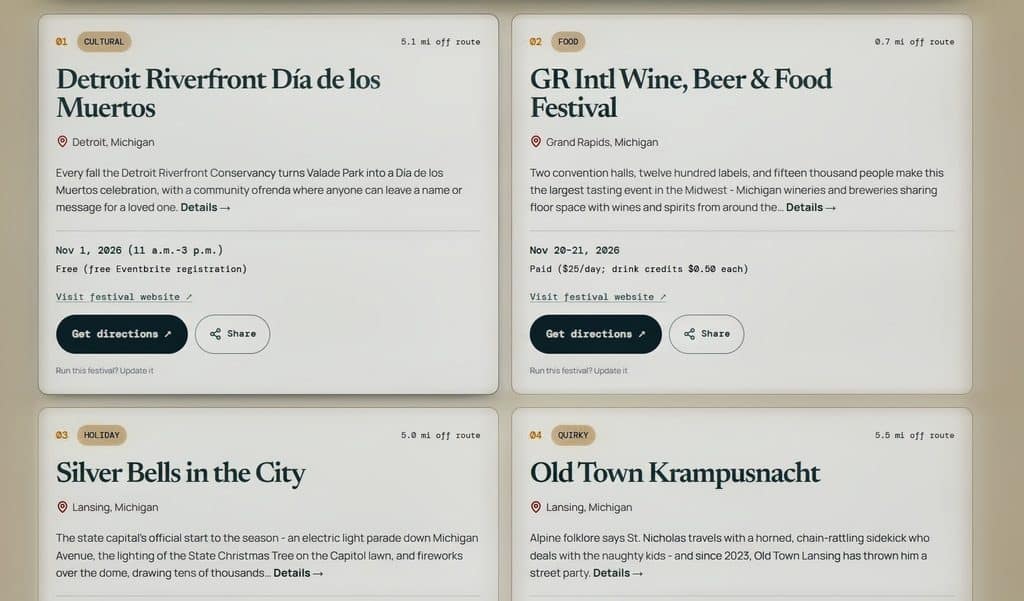
RG: How are you building support in West Michigan, and what do you hope Wanderfest can do for local festivals, small businesses, and the people who use it?
MG: I’m lucky to have people in my corner. My mom believed in the idea before anyone else and pushed me to go for it. And if there’s one person I have to give his flowers, it’s my longtime mentor and friend, Jorge Gonzalez. He didn’t just point me in the right direction; he’s been involved through the whole process. He connected me with María Erazo of MDK Marketing for the brand and marketing side, which is all new to me, and I’m happy to say I now see her as another lifelong mentor. Before I even knew what Wanderfest could become, I knew I wanted Jorge involved as a partner.
From there, it’s grassroots, one relationship at a time. I’m talking with chambers and festival organizers about what would actually help them, and on Instagram, we feature festivals and credit the organizers’ own photos. Holland Museum and Downtown Alpena have joined in. One organizer told me they promoted on six different channels and still heard from people who never knew the festival was happening. That’s the gap I want to close.
My hope is bigger than an app. For travelers, it’s a family driving from Grand Rapids to Traverse City who finds a festival they never would have known about, stops, eats at a local restaurant, and buys something from a vendor. For organizers, chambers, cities, and tourism boards, it’s one shared place for their festivals instead of a dozen scattered pages. And down the road, I want Wanderfest to become a living archive of these traditions, with interviews and videos from the people who keep them going, so they’re still around for the next generation. Wanderfest is free for travelers, there are no ads, and a festival can’t pay to be included. It’s on the map because it earned its spot.
Photos and images are courtesy of Miguel Gutierrez
Author
Related Articles

Trisha Marie talks new single ‘Bad Looks Good On Me’ and the future of her rising career
Local country artist Trisha Marie talks new single release “Bad Looks Good On Me” and the future of her rising career.
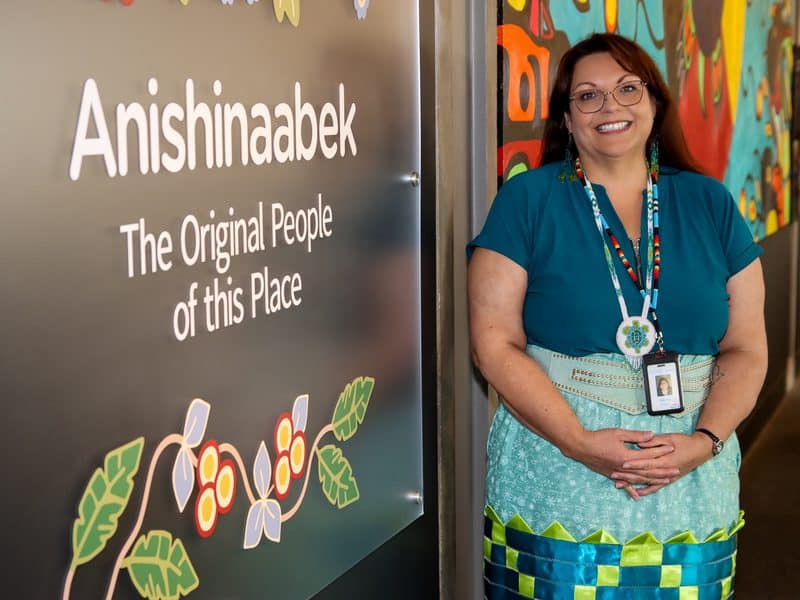
Who tells the story matters: Anishinaabek returns to the Grand Rapids Public Museum
After more than three decades, a reimagined exhibition puts Indigenous voices, lived experience, and community collaboration at the center of how West Michigan meets the original people of this place.
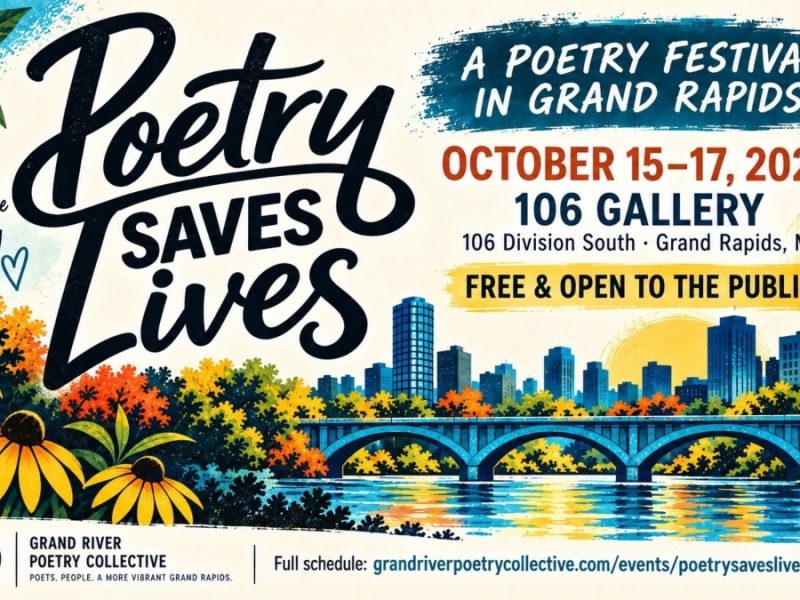
Can “Poetry Saves Lives?” Festival shares how poetry benefits mental health
Free three-day event includes panel of local mental health professionals.


