
Colleges teach students to build more accessible workplaces and communities
At KCAD and Grand Valley State University, students learn to spot barriers and include people with disabilities as they create more accessible communities.
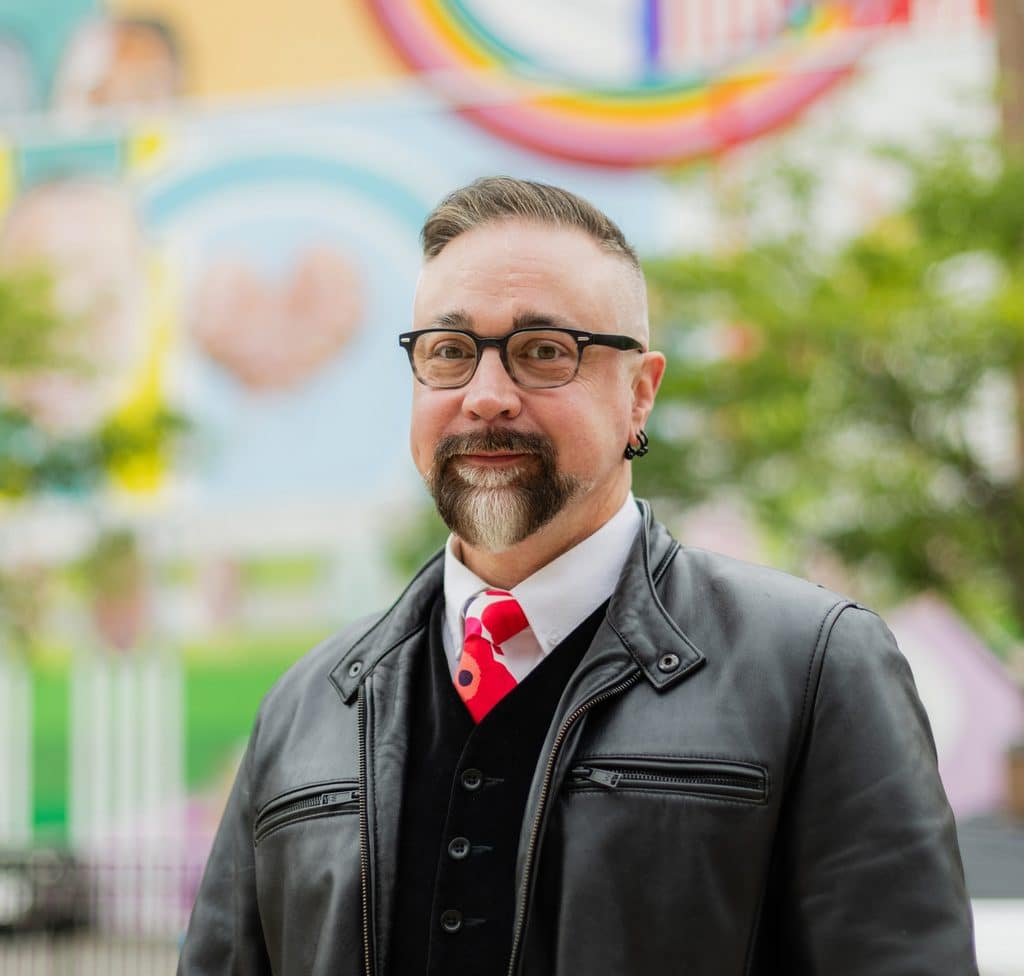
Stephen Halko can grab a paper towel without thinking about how high the hands-free motion sensor dispenser is. But working to make a college campus more accessible has helped him see how that simple task can be harder for someone else.
“Is the height the most accommodating? You know, what challenges does someone encounter just trying to dry their hands?” says Halko, dean of Ferris State University’s Kendall College of Art and Design.
At KCAD and Grand Valley State University, that question helps students think about how to make their future workplaces and communities more accessible.
Students learn through building reviews, class discussions, research, and work with local groups. They learn to spot barriers they may not face themselves and to include people with disabilities in finding solutions.
“We’re also big advocates of co-design, right? You can’t design anything without the person with whom you’re designing for,” says Gayle DeBruyn, a KCAD professor who works with the college’s collaborative design and graduate design programs.
Student involvement
At KCAD, a partnership with Disability Advocates of Kent County gives students a chance to see how accessibility decisions are made.
A memorandum of understanding signed in 2024 led to an accessibility study in 2025, DeBruyn says. Disability Advocates examined the college’s two downtown Grand Rapids buildings, identified concerns, ranked them by priority, and suggested ways to address them.
Students accompanied the assessment teams and learned, for example, why people using wheelchairs need room to turn and move around objects, or how door handles can make doors easier or harder to open. These details became more than items in an assignment when students saw how people use a space.
“When we can engage with the activity, the learning is really rich,” DeBruyn says.
The partnership also connects students with people who have lived experience with disabilities, including disabilities that are not visible. These perspectives can reveal problems a designer might miss.
Halko says that requires students to ask questions before deciding what someone needs.
“It’s asking those questions, getting in the community, asking users of spaces, of objects. ‘What is it that you need? What is your experience like?’” he says.
The assessment helps the college sort through concerns and consider different ways to address them. Students had to think about what makes a space hard to use and how to fix those problems.
DeBruyn points to light switches as an example. Moving a switch lower on a wall can require electrical work, cutting drywall, and making repairs. Motion-activated lighting offers another way to let someone use a room without reaching a switch.
Over the summer, the university completed a project to make signs for doors, rooms and classrooms consistent, with Braille and placement at the appropriate height, she says. Some doors still need lever hardware, which lets someone open a door with an elbow rather than gripping and turning a knob.
GVSU adds disability studies minor
At Grand Valley State University, Julia K. VanderMolen, PhD, teaches students about accessibility in her public health courses.
VanderMolen, a professor of public health and a board member of Disability Advocates of Kent County, asks her students to consider how people with different disabilities experience health services and community spaces.
“How do we provide resources? How do we educate? How do we look at the health literacy behind working with individuals with disabilities?” she says. “Disabilities are not just the ones that people see. It is important to be aware that an individual may have an invisible disability.”
Her interest began in college, when she was in Delta Gamma, whose official philanthropy is Service for Sight, which supports advocacy, access, and sight conservation for individuals who are blind or have low vision. This inspired her passion for disability advocacy. She later served on the board of the Association for the Blind and Visually Impaired (ABVI) before joining the Disability Advocates board.
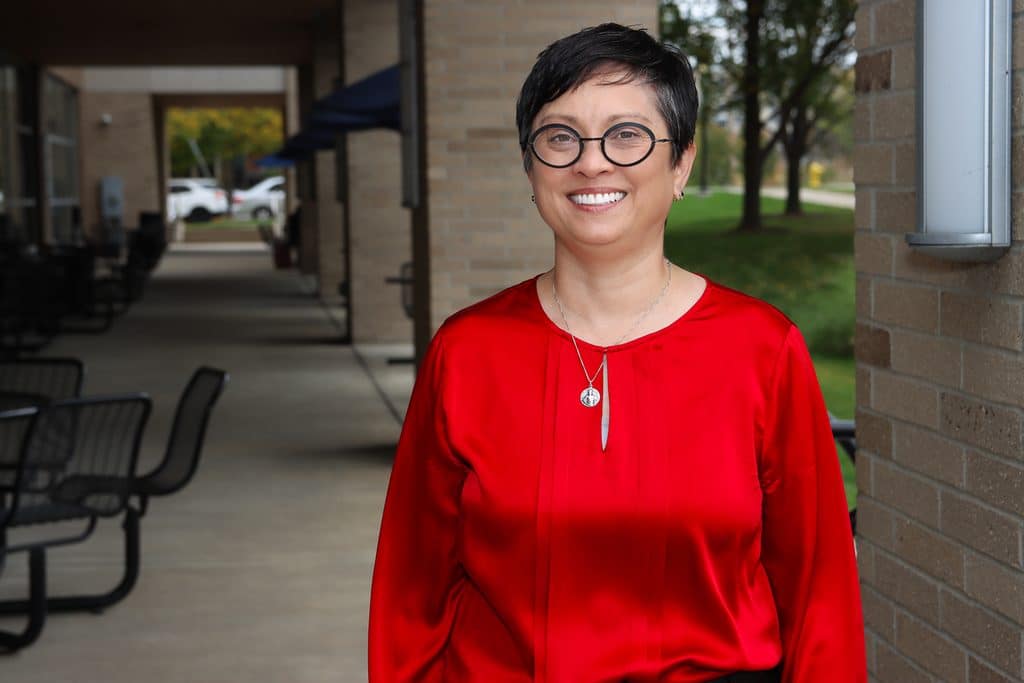
As a faculty member at Grand Valley, she promotes a new minor in disability studies. The Disability Studies minor began this fall. The minor explores disability through teaching, health care, social work, psychology, and government policies. Any student attending GVSU can elect to complete the minor. The program helps students to understand disability and to work with people with disabilities in any career field.
The program helps students to understand disability and to work with people with disabilities in any career.
“We just launched it this fall, so I’m not really sure how it’s going, but we’re hoping to gain momentum,” she says.
Students also learn through research and community events. One student studied how teachers can better support students whose brains learn and process information differently. Others attended White Cane Awareness Day to learn from people who have low vision or are blind.
KCAD alumnus Aidan Van Doren created stickers for automatic door buttons that show the range of people who use them, including wheelchair users, parents with strollers, and delivery workers carrying boxes.
Other KCAD programs bring accessibility into clothing, websites, and exhibitions.
Halko points to the fashion studies program’s Couture Code show, which explored barriers related to apparel. Students considered fasteners that are easier to use and materials that accommodate people with sensory sensitivities.
“People might be sensitive to certain textures or certain sounds. What kinds of materials can you use in a design to help accommodate and alleviate some of those sorts of things?” he says.
Life lessons
At Grand Valley, VanderMolen sees students carrying those interests into their careers.
One former student works in the University of Michigan’s adaptive sports program after researching, publishing, and presenting work on accessible recreation, she says. Another student’s research on medical clinics serving people with Down syndrome encouraged the former student to pursue a nursing career to better serve individuals with Down syndrome
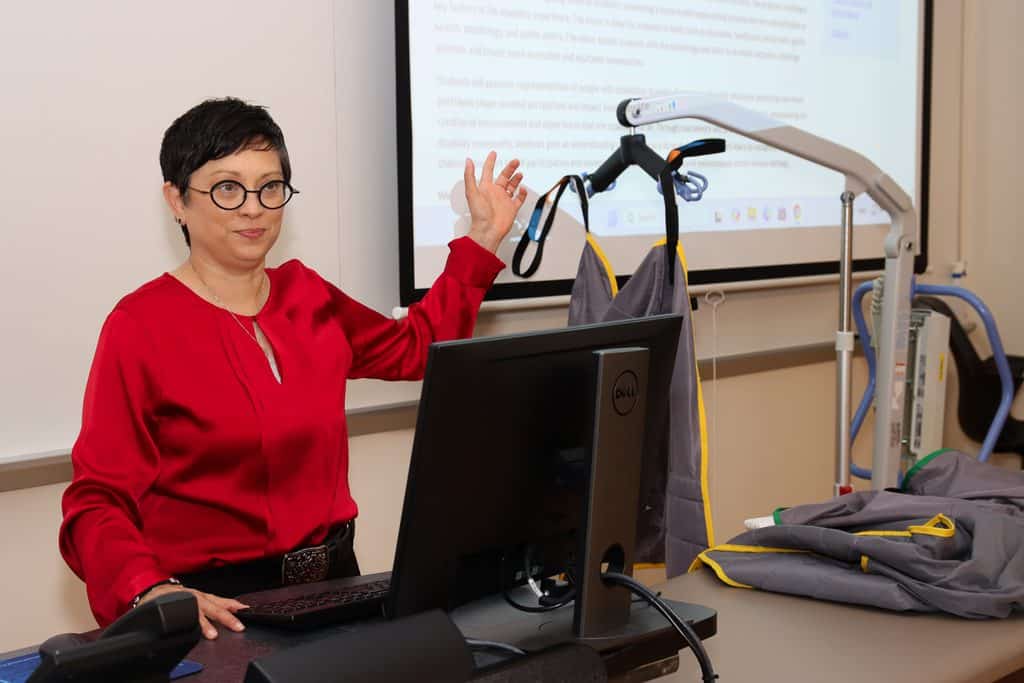
“I’ve had a number of students go into this, whether they’re helping with the social media of organizations and disabilities, or whether it’s providing different services and advocacy and policy for persons with disabilities,” VanderMolen says.
The colleges’ own campuses also show why the work needs to continue.
VanderMolen points to Grand Valley’s audible crosswalk signals as a helpful feature for people with low vision. But she says she teaches in a classroom that is not accessible, in a building with only one accessible bathroom.
At KCAD, while its assessment has helped the college identify priorities and complete changes, other concerns remain on its list.
Students can use what they learn when they design buildings, help people and work in their communities. DeBruyn says the first step is knowing that people need choices.
“It’s not one solution that’s going to fix it for everybody, but indeed it’s many choices that people will be able to make,” she says.
The multi-regional Disability Inclusion series is made possible through a partnership with Centers for Independent Living organizations across West Michigan.
Author
Related Articles
#RG20LookBack: The morning after, we’re still neighbors
In his 35th #RG20LookBack column, Publisher Tommy Allen reflects on what West Michigan’s neighbors have taught us about belonging. The votes are in, but the work of welcoming is never finished.
#RG20LookBack: How welcoming is Grand Rapids, really?
In his 35th #RG20LookBack column, Publisher Tommy Allen revisits a question that still resonates: How welcoming is Grand Rapids to newcomers? Five transplants shared their experiences at our October 2013 Speaker Series.

Accessible Halloween event brings trick-or-treaters and senior residents together indoors
Disability Network Northern Michigan partners with Grand Traverse Pavilions to help people of all ages enjoy an accessible Halloween celebration.


