
It’s A Wonderful Bank
Looking back on 2008, it’s hard not to think how a little more George Bailey might have averted a financial catastrophe of historic proportions.
In one of the key scenes in Frank Capra’s Christmas classic, “It’s a Wonderful Life,” George Bailey convinces the people of Bedford Falls to stay true to his family-owned community bank, arguing is so many words that his bank can be trusted to look out for the town’s best interest because it’s run by the people, for the people, with community members lending to and borrowing from each other.
While the movie is now 62 years old, Bailey’s community and neighborhood-centered banking model is as relevant today as it ever was. In a year rife with bad banking, modern community banks and credit unions are seeing a renewed interest in the desire for more personalized banking among neighbors who share the same values.
“We are community based, this is our home,” says Laurie Beard, CEO and president of Founders Bank & Trust, which is headquartered in Grand Rapids. “We focus on the one community where we conduct all of our business. That’s where deposits and loans are made and it’s our whole reason to exist. We’re here to serve Grand Rapids.”
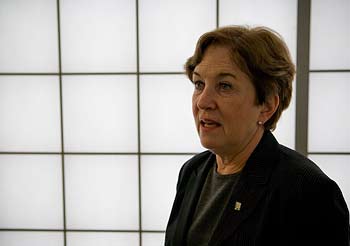 Community banks are rooted within a single community, with one or just a handful of branch offices. Deposits are made by local residents, loans are extended to community members, and decisions are made locally. These financial institutions typically have less than $1 billion in deposits and pride themselves on providing more personalized service than the big banks.
“We appeal to people who are eager for a real relationship with a bank, people who are sick of low customer service expectations and people who realize that they do have choice,” says Beard. “We develop relationships with customers so they’ll always know someone here.”
Credit unions have similar cultures based on one-on-one service and a dedication to the neighborhoods they serve, following the industry motto of “people helping people.” Credit unions differ from banks because they are not-for-profits that are owned by their members, with membership requirements ranging from place of employment to county of residence.
“Credit unions are member-owned and democratically run. Each member in good standing has a say in how the credit union operates,” says Jen Thurow, marketing director for Rivertown Community Federal Credit Union, which has three greater Grand Rapids locations and is open to anyone who lives, works, worships or attends school in Kent County. “Any profit is returned to members in the form of higher dividends and lower loan rates.”
Your Friendly Neighborhood Banker The health of community banks and credit unions depend heavily upon the economies of the neighborhoods they serve. If the community is struggling, smaller institutions tend to be more directly affected than a larger bank that can spread risk among hundreds of locations. “Our bank is a reflection of our customers. When they do well, we do well,” says Beard. “Weakness in the local economy affects us, too. We’re all connected.”
“By keeping deposits and profits in the community we’re doing business in, we can help provide for the needs of the community,” says Leonard Iakiri, vice president of sales and marketing for Northpointe Bank, which has just over 5,000 customers and one banking location on the East Beltline.
Because of the link between a community bank and the neighborhoods it serves, these banks have a greater motivation to help their customers remain financially stable. “We have an obligation to contribute to the financial success of our customers,” says Beard. “Our roots are here and we have every reason to help our customers be stronger. It’s what community banking is all about.”
Prospering in Hard Times
With uncertainty climbing and 401k values plummeting, community banks and credit unions haven’t been left untouched by the economic crisis. Although it has been a rollercoaster, the changes in consumer spending and saving attitudes have generally led to growth in community banking.
Phil DeVries, senior vice president and Grand Rapids market manager for The Bank of Holland, says that although individuals have less money than they did a year ago, the bank’s deposits and loans have increased as customers have moved over from big banks, growing to 400 Grand Rapids customers.
BANK OF HOLLAND PHOTO COMINGThe perception of trust that comes along with banking at a place where everyone knows your name, combined with the feelings of uncertainty due to the failure of big-name banks, has led to a renewed interest in local banks. “Deposits increased as we started entering into the current economy,” says Northpointe Bank’s Iakiri. “We get a lot of inquiries about FDIC insurance and our safety and soundness. Our deposits are increasing and customers feel more comfortable keeping their money local.”
Kim Wilson, CEO and president of Grand Rapids Family Credit Union, says that the credit union has experienced growth in deposits as members move money into safer insured savings, money market and certificate of deposit accounts.
Thinking Local First
Another factor driving the popularity of community banks is the trend toward staying local, which doesn’t only apply to shopping and eating habits. Founders and Northpointe are two of five financial institutions that belong to Local First, which they feel is a point of differentiation. “People have a sense that local banking has some appeal and it’s a good thing,” says Founders’ Beard. “People are thinking about their buying habits and purchases more and are starting to look at the advantages of staying local.”
In addition to keeping more money in the community, banks that are operated locally are able to reduce some of the red tape and provide customers with quicker and more flexible solutions. “Decisions are made at a corporate level rather than the local level at large financial institutions,” says Wilson. “Community banks and credit unions understand the unique dynamics of the community and work closely with the consumer.”
Just like George Bailey’s fictional Bailey Building and Loan Association, community banks and credit unions really do know the people and the neighborhoods they serve. “Our employees live and work in the community, so we live and work with our customers,” says DeVries. “Communities are very important to the success of our bank.”
Because they know their customers, community banks are able to take individual circumstances into consideration when making lending decisions, and not just black and white results generated by a computer program. “All applications are looked at by a human being,” says Iakiri. “In addition to all the standard lending requirements, we can dig into clients’ unique needs or situations.”
Grand Rapids Family Credit Union, which has 4,700 members primarily from employer groups such as the City of Grand Rapids, also takes a conservative and hands-on approach to lending. “We follow conservative lending guidelines, and we do not want to give someone a loan that would hurt them financially,” says Wilson. “We’re looking at our relationship with our member for life, not just for the individual transaction.”
 Not only is this model better for customers and their communities, it is also better economics. An understated driver of the Great Depression was the initial failure of a large number of neighborhood banks, driving unfamiliar customers to institutions in adjacent communities. Unable to accurately gauge the financial situations of these new members, subsequent waves of banks began to collapse under unexpected losses. The remaining financial institutions quickly lost trust in the markets and the nation’s financial system seized up.
In a general sense, these same financial mechanics were at work over the past 18 months: Large lending institutions didn’t know their customers, their loans defaulted, losses skyrocketed, and finally the financial system with it.
Local bank leaders know that by helping out their communities, they can help provide a wonderful life for all. “If you are committed to the community and in touch with what the community needs, the rest will follow,” says Iakiri.
Kelly Quintanilla is a freelance writer born, raised and living in West Michigan. She is also the marketing director at Ada-based CUSO Development Company.
Related Articles

#RG20LookBack: Standing Rock and learning to listen to the land…and each other
In his 33rd #RG20LookBack column marking Rapid Growth’s 20th anniversary, publisher Tommy Allen connects lessons from Standing Rock with a reopened Grand Rapids exhibition, reminding readers that Indigenous history remains in the present tense.

Shark Tank stars kick off Tech Week Grand Rapids
Daymond John and Robert Herjavec open a week that celebrates innovation, entrepreneurship, and West Michigan’s growing technology community.

Trinity Health and Michigan community groups will make fresh, local food a Medicaid benefit
A new Trinity Health initiative will allow people in the Ann Arbor, Detroit, and Grand Rapids areas to access fresh, affordable produce from local organizations through their Medicaid health plans.


