
From ‘Unseen Oceans’ to GVSU, exploring the Great Lakes anew
Grand Rapids Public Museum’s Unseen Oceans reveals the hidden wonders of the sea, while Grand Valley State University’s Water Resources Institute, just 40 miles away, brings that exploration closer to home on the Great Lakes.
The Grand Rapids Public Museum’s new Unseen Oceans exhibition doesn’t just show you the ocean. It shows you how little of it you’ve actually seen.
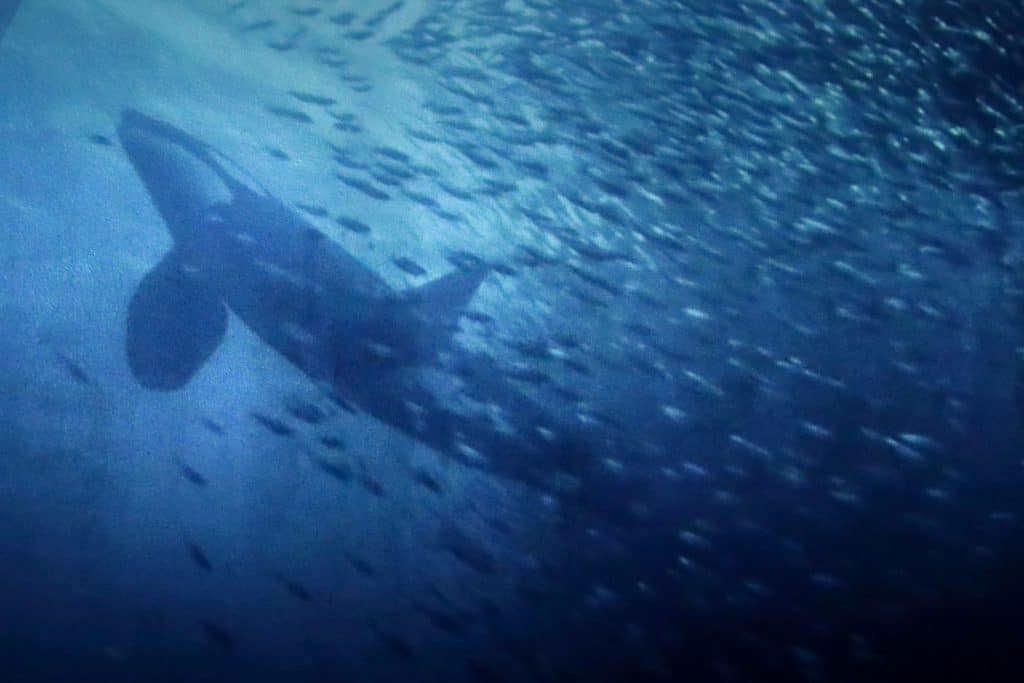
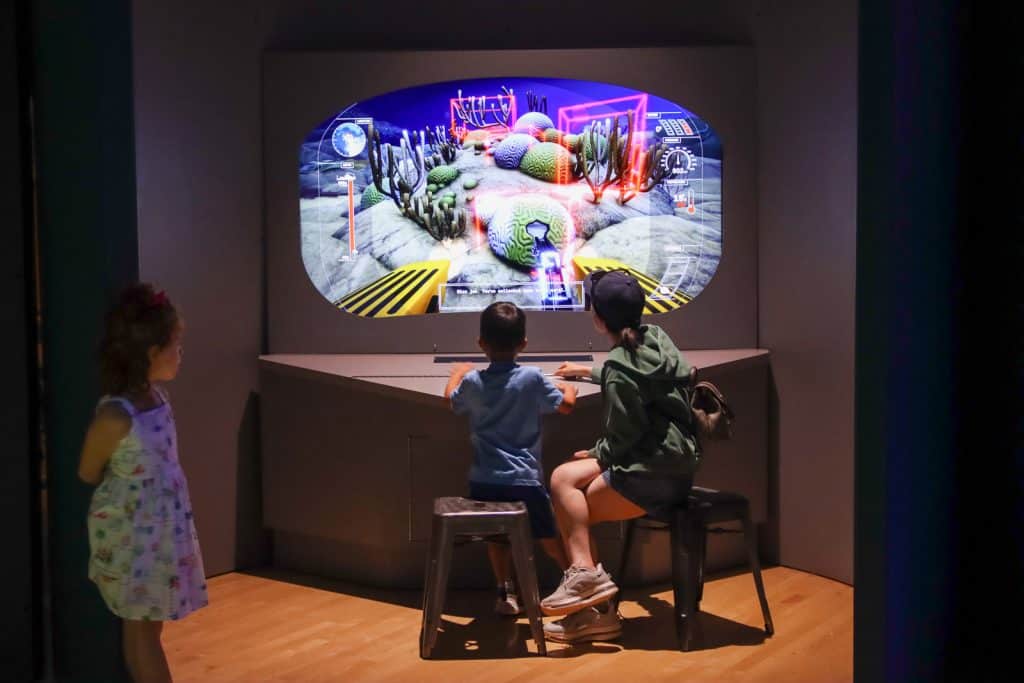
Plankton, normally invisible to the naked eye, get blown up via 3-D printing into fantastical, larger-than-life forms overhead. Biofluorescent creatures glow in the dark against a mirrored background, mimicking the vast landscape they inhabit in the wild. Stepping out of this representation of the beginning of the ocean’s food chain is an 180-degree screen that showcases stunning blue whales, manta rays, and giant squid drifting past at a scale close to their real size.
The traveling Unseen Oceans exhibition, built by New York’s American Museum of Natural History, draws heavily on in-the-field scientists and researchers from around the world to explain how robotics, remotely operated vehicles, satellites, and high-definition imaging have created fresh ways to observe our world, enabling scientists to see once-hidden places, sea life, and microscopic organisms.
Unseen Oceans runs at GRPM through Jan. 2, and it’s worth the visit for what it reveals about one of the last frontiers of our planet. As I reflect on my visit and the more lasting takeaways and inspirations, I found myself wondering what more has been revealed since this exhibition was created and launched in 2018 – and what is still hidden.
And, as with many exhibitions that GRPM has brought to our community, it stirred my curiosity about what other educational opportunities are available locally, as I again realized that knowledge doesn’t have to end at the museum doors.
As I dug deeper, I realized my thirst for knowledge doesn’t even require an ocean to be satisfied.
Just over 40 miles west of downtown Grand Rapids, researchers and educators at Grand Valley State University’s Robert B. Annis Water Resources Institute (AWRI) in Muskegon have spent four decades studying a globally significant body of water sitting in our own backyard: the Great Lakes.
And they’ll happily put curious minds to work.
Infusing curiosity in the water
As I entered Unseen Oceans, I loved seeing a large sign pointing visitors toward a suggested reading list, curated with Kent District Library, for anyone who wants to continue exploring after they visit the exhibit. Similarly, AWRI offers a complementary next chapter — the chance to physically get on the water and investigate freshwater with the same methods that drive the ocean scientists featured in the exhibit.
Founded in 1986, AWRI combines research, education, and public outreach around freshwater and aquatic science. Researchers study everything from microorganisms and water quality to toxicology, fisheries, restoration, and the effects of human activity on aquatic systems, from streams to rivers to the Great Lakes.
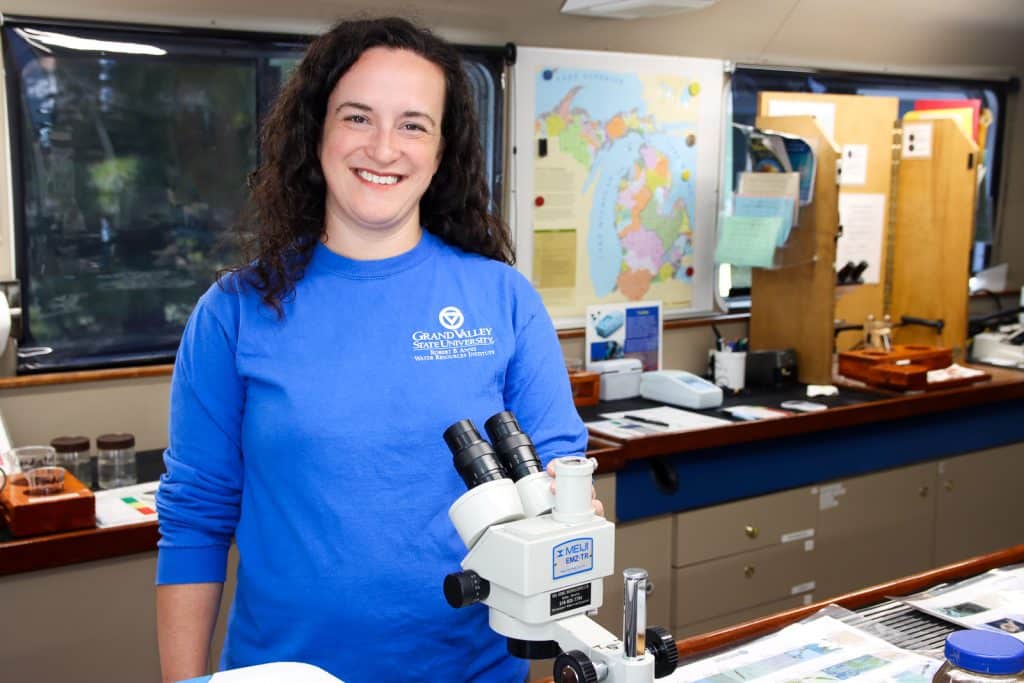
During our recent visit to the institute, education specialist Christina Catanese said a core piece of their work is making science accessible to people who’ve never thought of themselves as scientists.
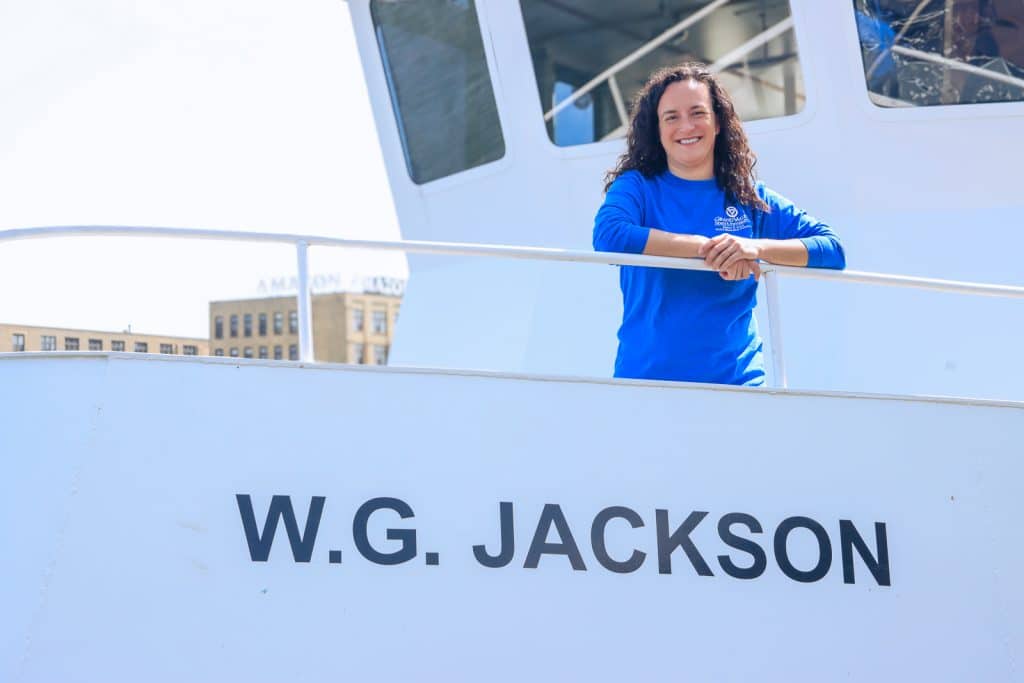
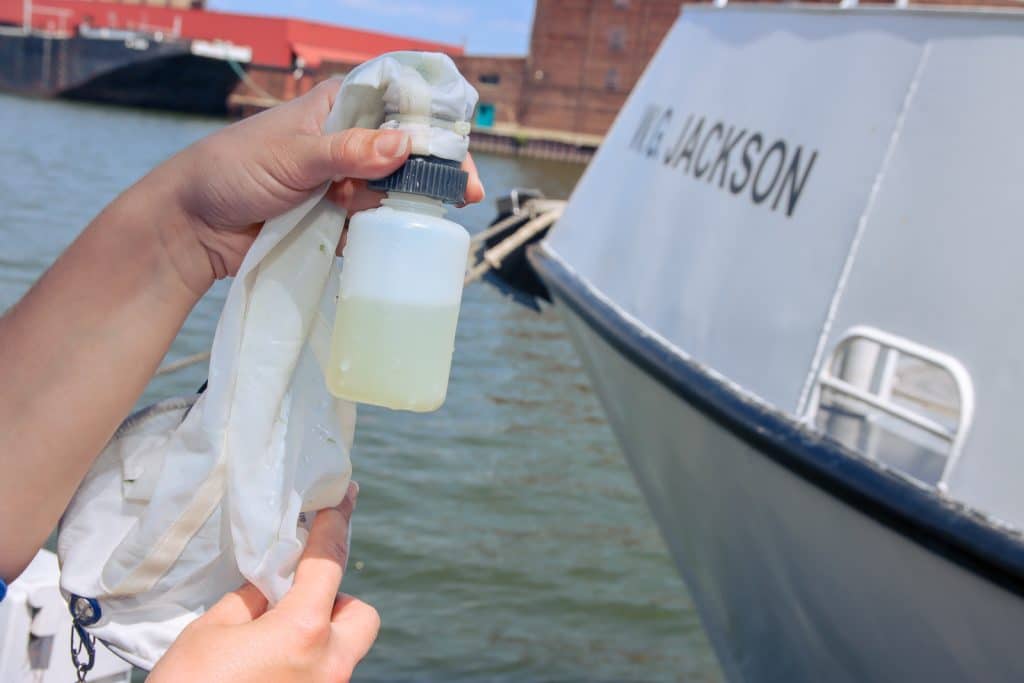
“There’s not a lot of sitting and listening that goes on during our program,” Catanese says. Instead, passengers aboard AWRI’s two research and education vessels — the W.G. Jackson, based in Muskegon, and the D.J. Angus, based in Grand Haven — are handed the equipment and put to work.
Folks who join a cruise, as Catanese calls them, will collect samples from the lake, take measurements, test the water, and draw their own conclusions as they add their data to years of work conducted by others before them. All told, more than 200,000 passengers have come through the program since 1986, from fourth graders to adults, including school groups, neighborhood associations, faith communities, and other organizations. (Individual entry is offered only during AWRI’s annual open house at its Muskegon location.)
What happens to the data matters just as much as the experience. AWRI has kept water-quality records from its educational cruises dating back to 1986 and makes that archive publicly available for research and education. Participants aren’t cosplaying as scientists for an afternoon. They’re doing the actual work.
What we can’t see changes us when visible
The clearest link between Unseen Oceans and AWRI comes from something almost too small to notice.
Early in the exhibit, visitors encounter giant 3D-printed models of plankton — microscopic organisms that anchor aquatic food webs yet largely escape our unaided vision.
Catanese says one of the most memorable moments on an AWRI cruise happens when participants scoop up a plankton sample and put it under a microscope. A single drop of lake water that looked empty to the naked eye suddenly, through the scope’s lens, dances with life.
“There’s so much microscopic life in the water,” she says. Much like the GRPM’s exhibition, she describes an ecosystem of plant-like plankton, the organisms that eat them, and predators further up the chain — a food web that ultimately supports the fish and other species people more commonly associate with the Great Lakes.
Catanese drives the point home by sharing how two jars of water with the naked eye look identical. However, a pinch of salt has been dropped into one, and testing showcases a dramatic swing on a conductivity probe.
“We can’t just look at the water to know how healthy it is,” she says. “There’s just so much more that we can’t see with our eyes that we need scientific tools to understand.”
It’s hard to imagine a better freshwater companion to the whole premise of Unseen Oceans.
The Great Lakes are still a place of discovery
Living near Lake Michigan can make it feel ordinary and easy to take for granted. We know the beaches, the sunsets, the summer rituals so well that familiarity starts to look like understanding. It isn’t.
Catanese points to AWRI researchers studying diatoms — those tiny microscopic algae — where new species are still being identified, including a recent one taken from Michigan’s Douglas Lake. Other AWRI research has looked at fungi pulled from Lake Michigan sediment for compounds with potential medical uses.
Technology keeps expanding what’s possible. The Muskegon Lake Observatory runs a buoy-based system that continuously tracks water quality and conditions through the ice-free season — a very different picture than the single snapshot you get from one research trip. AWRI also works with remotely operated and autonomous tools not unlike the ones featured inside Unseen Oceans, including a machine that crushes the invasive zebra mussel.
AWRI’s long-term monitoring matters because the Great Lakes aren’t static. Climate, invasive species, pollution, development, and watershed changes keep reshaping Earth’s ecosystems, and it takes years of data to see the patterns that a single observation can’t reveal.
For Catanese, understanding water is about more than collecting numbers. It’s about building a relationship with it.
From looking at the lake to becoming part of it
For some AWRI passengers, a cruise is their first time on a boat. For others who may live just miles away, it’s their first encounter with Lake Michigan in this manner.
Catanese still watches for the moment the lake opens up to passengers working on board their vessels, reminders that there are valuable avenues for locals seeking concrete experiences rooted in science within a short drive.
The Great Lakes hold roughly a fifth of the world’s surface freshwater, which gives everyone living around them a connection to a resource of global significance — whether they realize it or not.
“We can’t protect the things that we’re not connected with,” Catanese says, reminding us that this is a deeper experience than going out for a sail or riding the ferry to Milwaukee.
A connection lasting decades
Catanese regularly runs into adults who remember taking an AWRI cruise as kids, including one recent graduate student who first boarded the W.G. Jackson as a sixth grader and came back to AWRI to finish her master’s degree.
It’s the kind of full circle the program’s curriculum is built to encourage — not just teaching scientific testing and observation, but building a sense of belonging rooted in freshwater science.
That may be where Unseen Oceans and the Great Lakes finally meet. Both ask us to stay curious about worlds we can’t fully see. Both remind us that discovery takes tools, questions and people willing to keep looking. And both make the case that science doesn’t belong only to the names on research papers or museum walls — sometimes it starts with somebody looking through a microscope at a drop of water, or boarding a boat.
Even after five years working around the Great Lakes, Catanese says her sense of wonder keeps coming back to something bigger: water connects everything. She reminds us that the water moving past us today has already passed through clouds, groundwater, rivers, lakes, oceans and living organisms long before we showed up. It’s easy to take that abundance for granted in West Michigan, she says, but it also comes with a responsibility to understand it.
AWRI’s cruises are one way in, and we hope that visitors to Unseen Oceans seeking more opportunities to deepen their knowledge will consider signing up for a cruise.
“It reminds you that you’re part of the system, too,” Catanese says. “We’re not above the system. We are part of it.”
And once you start seeing yourself that way, these waters don’t stay quite so unseen.
Photos by Tommy Allen
This story is part of the Bridge to Community Curiosity, underwritten by the Grand Rapids Public Museum. Through this partnership, we highlight GRPM’s mission to inspire curiosity, deepen understanding, and foster belonging by showcasing the transformative power of arts and education in West Michigan.
Related Articles
#RG20LookBack: When public art becomes a part of the place
In his 31st #RG20LookBack column marking Rapid Growth’s 20th anniversary, Publisher Tommy Allen revisits Grand Rapids’ relationship with public art, from Calder and Maya Lin to ArtPrize, and considers what the city might make room for next.
Kent District Library lets neighbors borrow, discover and explore together
From birdwatching kits to local music, KDL helps people try new things, save money, and share experiences.
Something for every season: Fashion, curiosity, and community at the GRPM’s new archive center
Inside the Grand Rapids Public Museum’s new Archives Center, Kendall College of Art and Design students are turning decades-old garments into inspiration for their next designs.


