
#RG20LookBack: From an “Atomic” moment to the present day
For his tenth #RG20LookBack column, Rapid Growth Publisher Tommy Allen revisits its 2007 “Atomic Object is People” story, tracing West Michigan’s thriving tech culture.
When Rapid Growth published “Atomic Object is People” on Nov. 15, 2007, it conveyed our view that technology is more than code; it includes people, culture, work, and community. The article by Tonya Schafer portrayed Atomic Object as a values-driven software company in Grand Rapids, distinguishing one of our earliest tech firms as a model of what a healthy innovation-focused company could be.
Nearly 20 years on, the emphasis on healthy office culture and the promotion of our local tech culture persist, with technology’s influence remaining a core area of Rapid Growth’s editorial focus. This enduring focus on tech and innovation reflects the ever-evolving economic landscape of West Michigan.
This dedication is evident not only in our story archives but also in recent reports and regional initiatives like Tech Week Grand Rapids, which The Right Place debuted in 2023 and has helped transform into one of the largest civic and economic events in our region of Michigan.
Tech Week GR’s growth has been remarkable, jumping from nearly 40 events in 2023 to over 70 in 2024, and by 2025, it featured a sold-out kickoff with Apple co-founder Steve Wozniak. This highlights the region’s serious commitment to technology, talent, and innovation as vital elements to future prosperity. The event’s popularity and expansion are also evident in the more than 120 independently organized events held during 2025’s Tech Week.
Atomic Object’s recent updates show significant growth in the company and its regional ecosystem. Proof of this evolution was seen on March 16, 2026, when Atomic Object announced Kimberly Crawford as Managing Partner of its Grand Rapids office, joining Jason Porritt as Jeff Williams shifts to Managing Partner of Digital Health. Crawford, with Atomic Object since 2015, has strong ties to West Michigan and regional leadership experience in design and tech communities, especially during this AI-driven, fast-changing period. Her appointment aligns with Atomic Object’s expansion beyond Grand Rapids into Ann Arbor, Chicago, and Raleigh, and reflects a growth from about 50 employees in 2015 to 130 today.
Rapid Growth’s journey reflects a remarkable development, too, as Atomic Object was among our initial sponsors, helping us showcase West Michigan’s innovative culture and thereby attract vital talent to the area. Since this story was published, Issue Media Group, our parent company, has grown from three magazines in 2006 to over 20 outlets across the country.
Rapid Growth in 2026 continues to feature influential regional leaders and companies shaping West Michigan’s future. We also want to celebrate Kimberly Crawford and the entire Atomic Object team for their enduring contributions. Special thanks to leaders like Randy Thelen of The Right Place, whose leadership has created more opportunities for us to work together to build a vibrant, connected, and ambitious tech community, fulfilling early visions of this region’s potential.
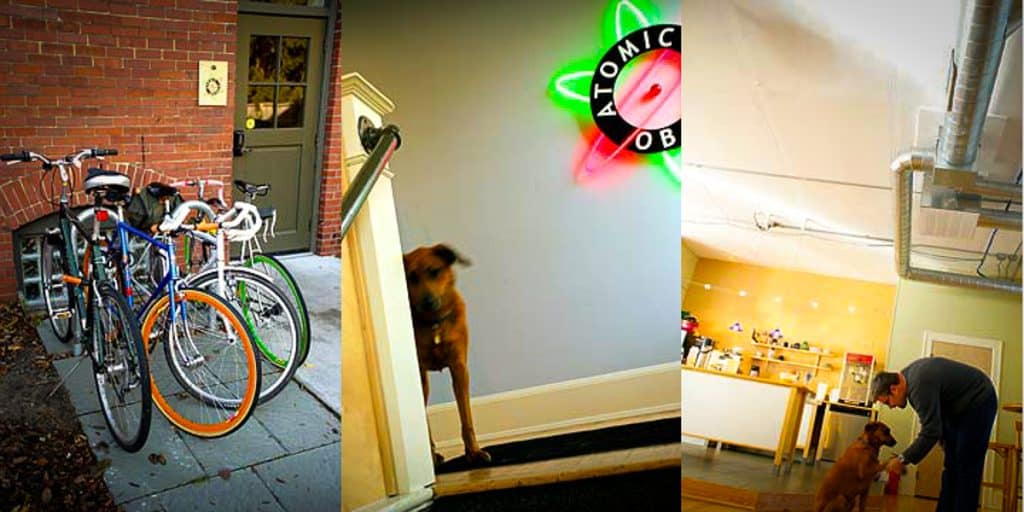
Atomic Object is People
Atomic Object is the sixth-largest software development firm in West Michigan. But binary code is secondary for a company focused on satisfying customers, rewarding employees, and building community.
When employees arrive for work at Atomic Object, they get a friendly greeting from Maya, the office’s resident canine. They stop by the snack bar to grab a cup of coffee, and then leisurely settle in at their computers, which are scattered on desktops arranged across the hardwood floor. Throughout the day, they design computer software as the sights and sounds of an urban neighborhood filter in through the windows. Jeans are the uniform of choice; not a tie or business suit to be seen in the place.
Atomic Object is not your typical professional software development firm. And that might be why, six years after its creation, the company is pulling in more than double the dollars its owners expected when they started the business in 2001. At that time, Carl Erickson and Bill Bereza hoped that in five years their Grand Rapids-based company would earn one million dollars in annual revenue. This year, they’ll do $2.7 million in business with clients from across the country.
Erickson attributes that success to the company’s work environment and methodology, both of which deviate from the status quo. Atomic Object uses the Agile software development method, in which customers receive incomplete but functional versions of their software every week or two so that they can test those versions and measure how it performs against their expectations.
Likewise, Atomic Object has a laidback culture that strives to encourage innovation among its 20 employees. Workers design software in an open loft space that lets them share ideas from computer to computer. Meanwhile, perks like a communal snacking area offer informal spaces to bounce ideas off each other. It’s all part of the vision Erickson and Bereza had when they formed the company in the wake of the dot-com boom of the late 1990s.
“I’d been to IT firms and I’d seen where their developers worked,” Erickson says. “They had cubicles, artificial lighting and dead space. I wanted to create a company whose employees looked forward to work every day.”That concept came to fruition in the partnership that formed between Erickson, a former professor at Grand Valley State University, and Bereza, a GVSU grad. Both veterans of the computer industry, the pair started their own firm with just three apprentices in an office in the Eastown neighborhood.
“We had no customers,” Erickson says, “but we had good people and a good process.”
Getting ‘Er Done Right
The “no customers” part quickly changed as clients learned about Atomic Object’s approach to software development. Traditional, or predictive, methods plan software far in advance, mapping out rigid performance features from the get go to guide the execution of the project. Customers might meet with the development firm a handful of times to answer questions and provide feedback. But, in the end, they typically take delivery of a software package that is in many ways untried and unproven in day-to-day business affairs.
With the Agile method, developers are in constant contact with customers, incorporating suggestions about one iteration of the unfinished software into the next. The technique not only makes the software more receptive to changes throughout its lifecycle. It also helps developers complete the software on time and on budget, Erickson says.
The process is based on para-programming, in which developers work in two-person teams with one helming the computer and the other defining strategy and tactics. And because customers receive workable software every week, developers are constantly testing those programs to ensure the software is running correctly. The result tends to be a job done right the first time.
“Instead of an unhappy customer bringing back the software six months later, we’re able to get the client’s vision from the start and build the project according to their priorities,” Erickson says.
Acting Locally, Reaching Globally
Benjamin Gott, cofounder of www.thecommon.org, agrees. He says Atomic Object’s project management style was exactly what was needed to build his organization’s unique web-based collaboration platform.
“They really, really got our vision right away,” Gott said. “They seem to embrace and promote creative thought and execution of ideas within their staff. That’s not something you see more traditional development shops doing.”
Atomic Object’s innovative spirit extends to its relationship with the community. In 2004, Bereza and Erickson finished renovation of the former Station C post office building and moved in among the historic homes and revitalized business district on Wealthy Street.
“It was a leap of faith,” Erickson says. “But we’re committed to the core city of Grand Rapids and it’s nice to be part of the neighborhood. Half our employees are able to walk or ride their bikes to work.That sense of community building extends to Atomic Object’s launch of XP West Michigan, a non-profit trade association designed to build relationships and connections among the region’s IT professionals. The organization meets monthly to distribute information and promote Agile software development practices.
“We have anywhere from 30 to 90 people at our meetings, and the attendance goes well beyond our company. There’s wide participation from throughout the area,” Erickson says.
In addition to their local work, Atomic Object developers publish papers and present their philosophy at conferences across the country. This national prominence has helped cultivate a diverse client base that includes major multinational companies such as DaimlerChrysler and The World Bank, as well as local businesses like X-Rite and Valley City Linen.
Realius, an online “fantasy real estate” program, is one of Atomic Object’s more unique projects. The web-based game enables players to rack up points by buying, selling, and renovating virtual properties in numerous cities. Chuck Teller, Realius cofounder and CEO, said that Atomic Object’s approach meshed perfectly with his company’s needs.
“I wanted a development team that could build a robust application that scales across the world, handles large volumes of data, is extremely easy to use, and able to change on a moments notice as we figure out what works best,” Teller says. “Atomic Object delivered on every expectation.”
Tonya Schafer is a freelance writer who lives in Grand Rapids. She also works as a technical writer for General Electric Aviation. She last wrote for Rapid Growth about LaFontsee Galleries in downtown Grand Rapids.
Related Articles
Library classes help residents learn skills, build community connections
At Kent District Library, in-person classes help residents learn practical skills while meeting neighbors and building connections in their community.
Gentex engineers help nonprofits improve efficiency
Gentex engineers apply manufacturing skills to streamline donations, boost volunteer impact, and expand services at Community Action House and Kids’ Food Basket.
The Established Home mother-daughter designers launch children’s book to help families navigate life transitions
West Michigan design duo Jean Stoffer and her daughter, Grace Start, share a new children’s book offering families practical, faith-centered strategies to help children cope with moves and change.


