
Stepping into the origins of Grand Rapids, where curiosity and hidden histories continue to rise
A longtime favorite at the Grand Rapids Public Museum is evolving, with Streets of Old Grand Rapids adding new areas that encourage visitors to slow down and observe more closely.
For decades, visitors to the Grand Rapids Public Museum have stepped into the Streets of Old Grand Rapids permanent exhibit and felt an immediate sense of time travel, as storefronts locked in time quietly began to unfold into stories of the city’s origins. Those who slow down through this space are often rewarded with a deeper understanding of the past, one that lingers even after they return to the present-day streets.
And beginning May 1, this experience has expanded upward within the museum.
With the opening of a newly accessible second floor, the museum has introduced two new areas to its favorite exhibit: a replica of the Kent Scientific Institute and Dr. E.S. Holmes’s dental office. These additions enhance the narrative of Grand Rapids in the 1890s and highlight a key theme: how curiosity played a fundamental role in shaping the institution that now presents this history.
“This expansion was a significant undertaking for our curatorial and exhibits staff, from historically researched design to artifact selection to exhibit construction,” says Kellie Rosekrans, director of marketing at the GRPM. “We can’t wait to share that work and more of the fascinating stories that shaped this community.”
These new spaces encourage visitors to engage with the exhibit in a more leisurely, deliberate, and deeper manner.
An origin story within the story
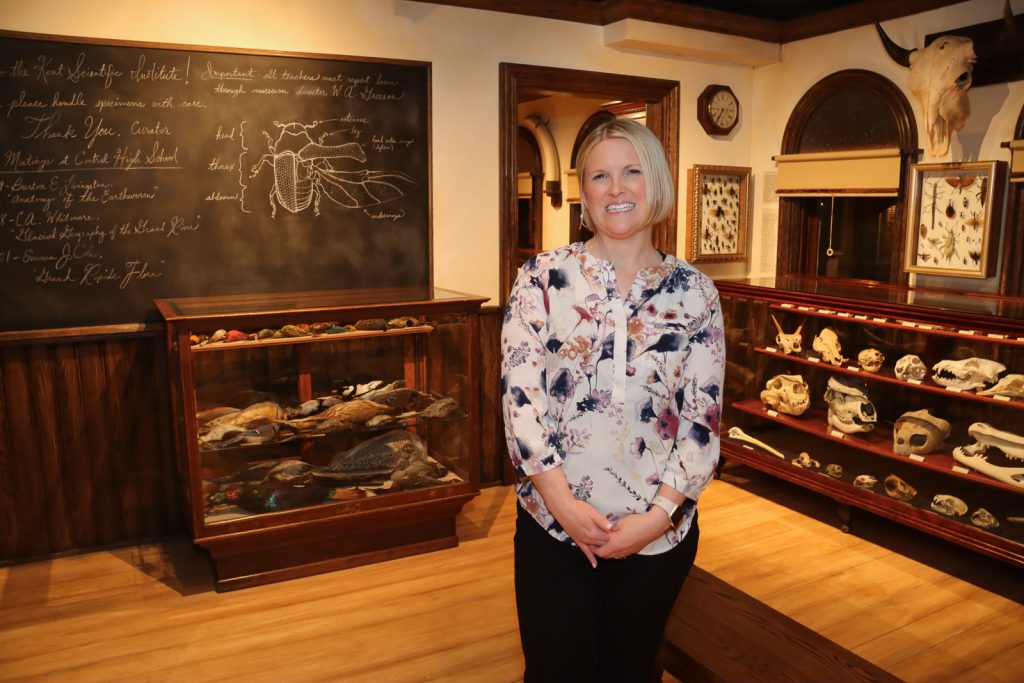
The heart of the expansion is the Kent Scientific Institute, a recreation of the late 1800s Grand Rapids Central High School setting that represents the original version of what would eventually become the GRPM.
“The Kent Scientific Institute is the early name for the Grand Rapids Public Museum,” says Andrea Melvin, senior curator at GRPM. “It’s really the origin story of the museum, and seeing where that all started—and how the collections were used for education then, just like they are today—is a really important story to share.”
The Institute was founded through the collaboration between local civic leader John Ball and a group of high school students whose initial collection of scientific specimens contributed to its first programs. It was created at a time when curiosity was not just an academic pursuit but was embraced and celebrated by the community, because the artifacts often carried a deeper story.
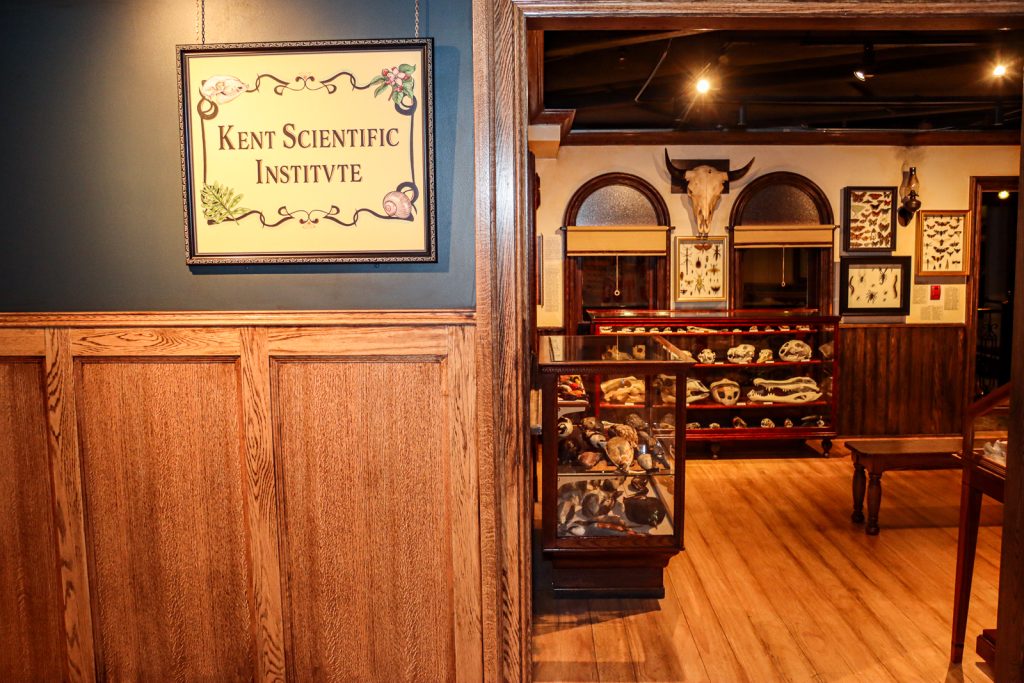
“The core principles have been the same over time,” Melvin says. “We’ve continued to be a public, educational place. And these collections have always been about learning.”
The walls are lined with cabinets filled with specimens from across the region and beyond. Carefully recreated handwritten labels (many by former employee Gina Bivins) serve as a reminder of an era when knowledge was accumulated gradually … and often by hand.
And that, Melvin says, is part of the point.
“Just take your time,” she says. “You’re in this immersive space – look closely, investigate an item, ask why it’s there. That’s where the experience really opens up.”
Why slow down?
In a typical museum environment, visitors frequently hurry to see everything, racing from exhibit to exhibit, stopping just long enough to take a photo before moving on. This new second floor, with its relaxing, treehouse-like atmosphere due to its location high above the Streets of Old Grand Rapids, invites the eye to slow down and take it all in, as this experience is truly layered and rewards gentle viewing.
In her 1996 book Art Objects: Essays on Ecstasy and Effrontery, Jeanette Winterson wrote about how we often move through museums at an almost galloping pace, trying to see everything. In doing so, we often miss what is right in front of us because we don’t allow the eye to just rest a spell, letting an object come into better focus.
Winterson advocates slowing down and narrowing your focus to spend time with a single object until it unveils something deeper. Similar to contemplating a work of art, sitting with an artifact often uncovers a hidden language that frequently prompts more questions.
This new exhibition space, which features seating scattered throughout, encourages visitors to stay longer.
For example, one of the hands-on experiences is an old mailbox complete with drawers that open to reveal reproductions of archival materials such as letters, postcards, and documents, all based on original artifacts, that invite interaction.
For visitors with a handheld device connected to the web, the museum enhances their experience by allowing them to explore an object’s significance through its online digital collection, which connects the exhibits to more in-depth research.
“If you want to dive deeper, you can sit right there and explore the entire collection online,” Melvin says. “You can really ‘nerd out’ on it.”
This combination of a physical artifact and digital access transforms the exhibit from a static display into an engaging entry point for visitors. The digital collection can be accessed here. (You may have to create a login, but it’s free and easy to do.)
This digital aspect helps everyone from researchers to journalists to students working on school reports. It is a reminder that the museum is not a one-time visit but an ongoing relationship with which new insights are often developed over time and with repeated views.
A dental office as a classroom
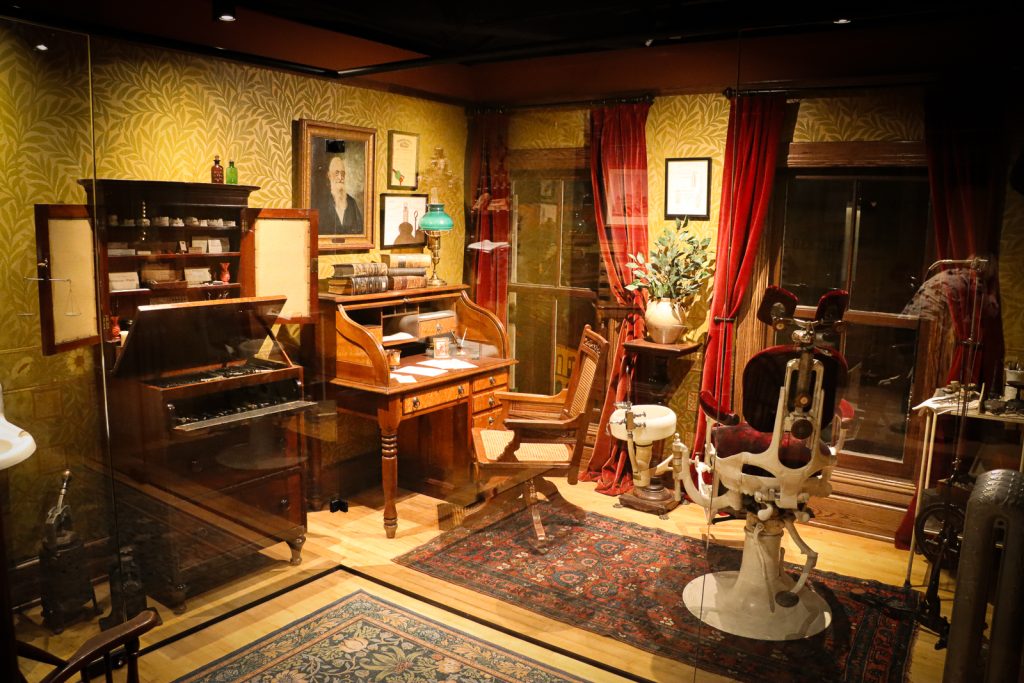
Just beyond the expansive floor-to-ceiling glass walls, the Holmes dental office beckons visitors.
The red velvet dental chair shows signs of wear in the areas where patients used to grip its arms – most likely to fight off pain – a tangible reminder of the time before modern pain relief was part of dentistry. It is a physical, personal object that can make us share the discomfort of a suffering patient more than a century ago.
Within such details, the experience opens up.
A wooden wastebasket under a tiny sink. A desk with handwritten correspondence scattered about. Tools whose purposes are no longer obvious. Each object on display raises a question – and the museum is inviting visitors to follow that curiosity further.
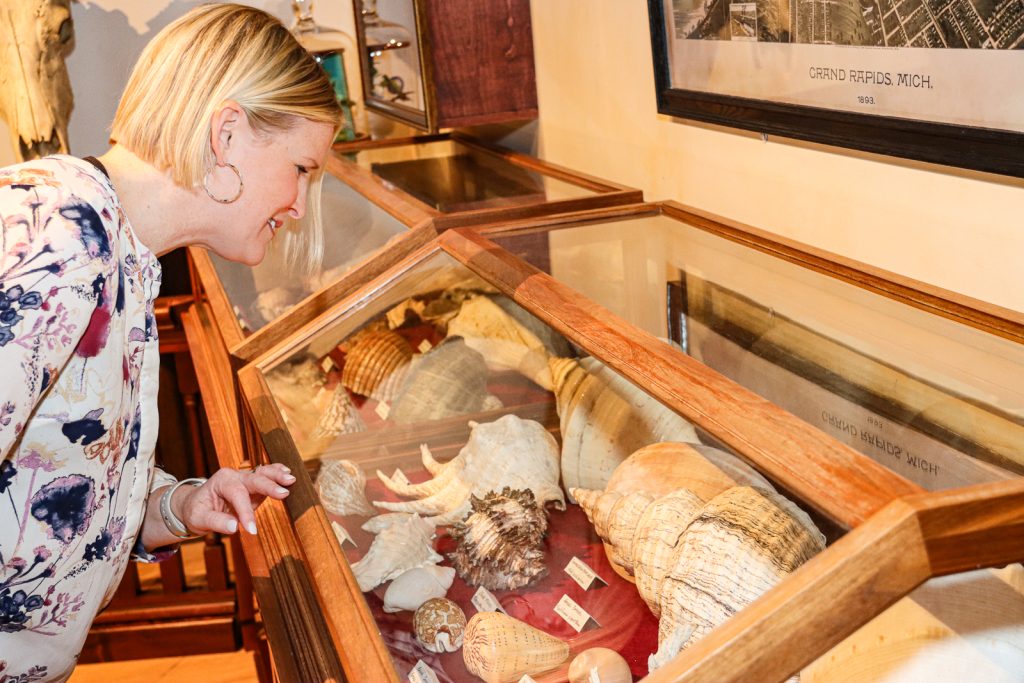
“We want people to take their time,” Melvin says. “Look closely, ask questions, and really investigate what you’re seeing.”
This invitation encourages visitors to slow down and extend their learning beyond the exhibit. For instance, at the Holmes dental office, digital access offers an opportunity to explore the deeper meaning and history of each artifact. (Here is a link to this collection of artifacts.)
“It’s a way to go deeper,” Melvin says. “You can sit right in the space and explore the collection in a whole new way.”
For those who slow down, the museum becomes more than just a recreation. It acts as a gateway to research, memory, and the intricate story of a community, fueled by curiosity, that has recorded its history over generations.
Women emerging into view
In this expansion, the museum continues to emphasize previously underrepresented stories and narratives, reflecting its rich representation of the people of Grand Rapids.
For instance, entering the Kent Scientific Institute, you’ll see the name of botanist Emma J. Cole on a classroom chalkboard listed among the era’s presenters. All the other names are male, which was typical for that period. Nevertheless, there she is — Emma — standing alongside the boys.
“Emma Cole was a trailblazer,” Melvin says. “She went to Cornell University, came back here, taught in the public schools, and built a significant scientific collection that’s still used for research today.”
Cole’s presence is not symbolic – it is rooted in documented history. Her work collecting and cataloging plant life in the region continues to inform scientific study more than a century later. A sizable portion of her collection is on loan to the University of Michigan, aiding students of botany to better understand our heritage plants via her specimens that are over a hundred years old.
Situated between the Institute and the dentist’s office, another signal reveals itself. A Bell Telephone switchboard station, complete with a shawl draped over a chair and a purse on the floor, points to the women who once operated these systems that connected calls, managed communication, and helped shape one of the city’s earliest infrastructures.
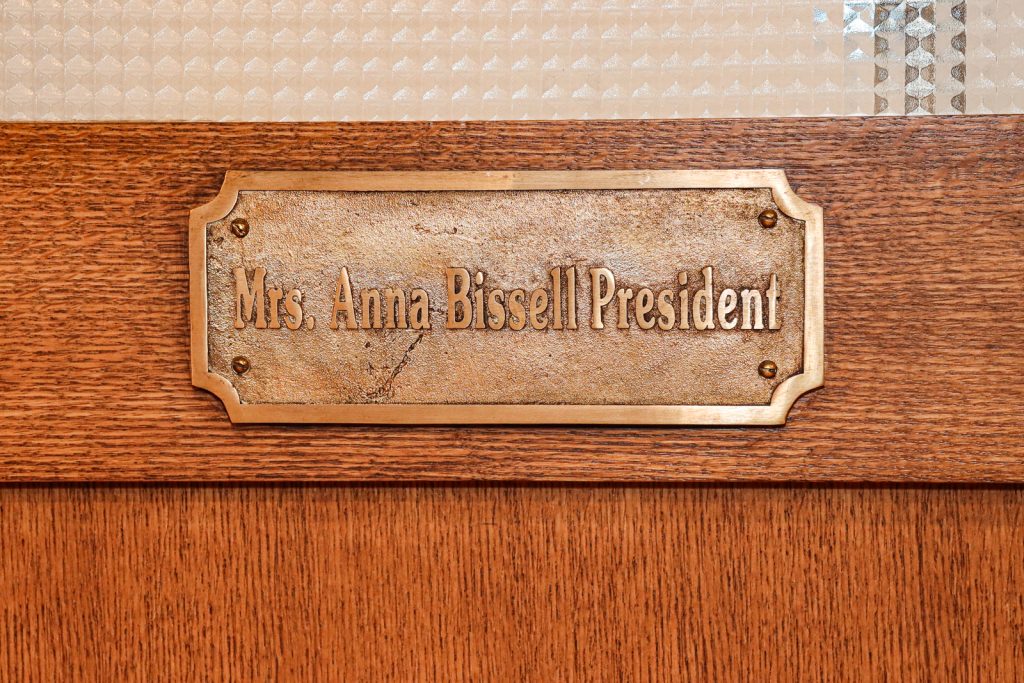
One more sign of the emerging role of women in U.S. society long before they could even vote is a name in antique brass on an office door, “Mrs. Anna Bissell President.”
“She really elevated the company,” Melvin says. “She focused on making their products more accessible and even expanded it into a global business, while also supporting women and staying rooted in Grand Rapids.”
These moments form a continuous narrative that recognizes women not just as background figures but as educators, operators, leaders, and innovators who shaped the city’s future. How inspiring it must be to be a young girl visiting this new space and seeing that, even when they had far less than today, women still strove to make their mark.
A community-built museum
Spending time in these new spaces makes one theme clear: the GRPM has always been shaped by the community it serves.
“So many people have come together to make these collections exist,” Melvin says. “We have thousands and thousands of donors—people who have contributed objects over time. It’s truly a community effort.”
This concept is evident everywhere — from the dental tools donated by Dr. Holmes to specimens gathered by early scientists to everyday objects that now help reconstruct an entire era… all searchable thanks to the museum’s commitment to expanding access.
Each artifact becomes a piece of a larger puzzle. When taken together as presented here, they tell a story no single archive could tell on its own. We are better because of the sum of all our parts.
Curiosity as connection
What makes Streets of Old Grand Rapids stand the test of time for Melvin is not only its historical accuracy but also its capacity to ignite conversation today.
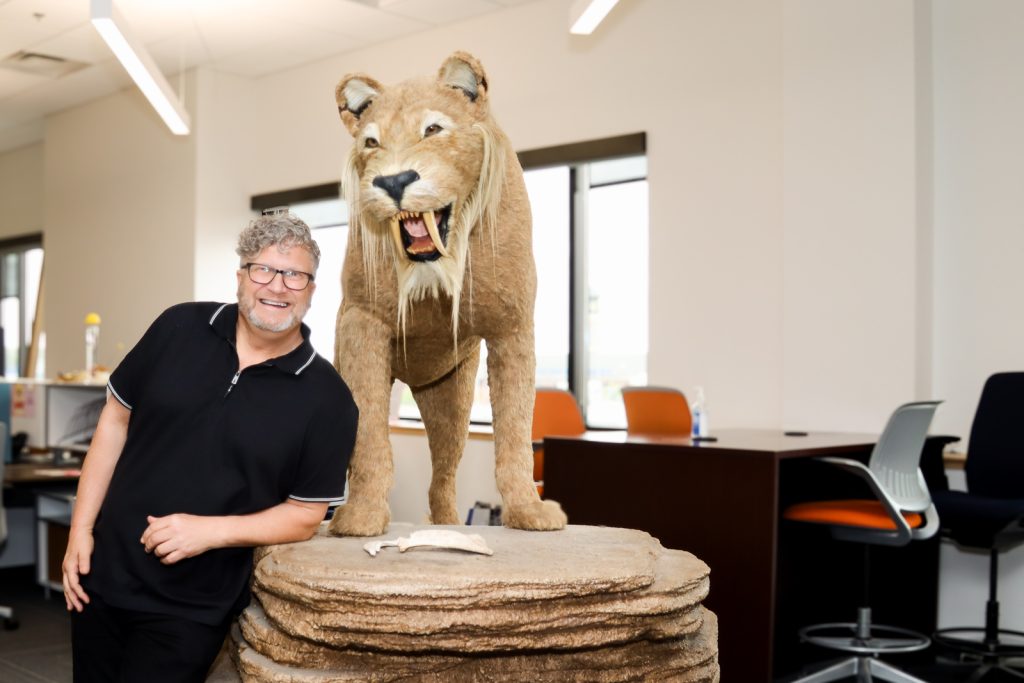
“Streets is about conversation,” she says. “It connects people. There are so many little details that make you stop, look closer, and ask questions.”
In that way, the second-floor expansion accomplishes more than simply increasing the Street’s square footage. It emphasizes a concept particularly pertinent today: that curiosity — when shared, explored, and maintained — is a key way a community comprehends itself.
Sometimes, the best way to move forward is to slow down and reflect on one’s past.
Photos by Tommy Allen
This story is part of the Bridge to Community Curiosity, underwritten by the Grand Rapids Public Museum. Through this partnership, we highlight GRPM’s mission to inspire curiosity, deepen understanding, and foster belonging by showcasing the transformative power of arts and education in West Michigan.
Related Articles
Something for every season: Fashion, curiosity, and community at the GRPM’s new archive center
Inside the Grand Rapids Public Museum’s new Archives Center, Kendall College of Art and Design students are turning decades-old garments into inspiration for their next designs.
KDL event becomes world’s largest book club gathering
More than 6,000 readers filled Van Andel Arena as authors Kristin Hannah and Megan Chance discussed friendship, books and belonging during KDL’s On the Same Page. Those who missed the sold-out event can watch a recording through July 9.
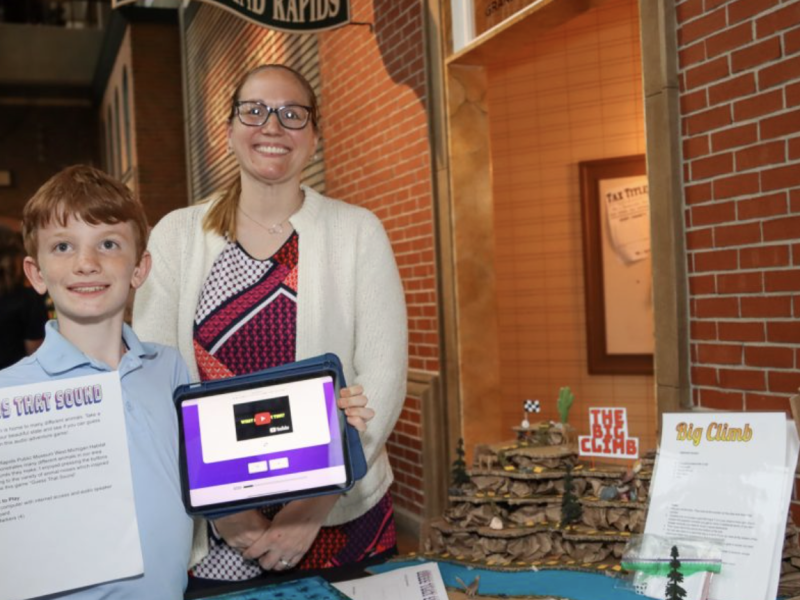
Beyond the field trip: Public Museum’s Immerse program transforms how students learn – and see themselves
For most students, a visit to the Grand Rapids Public Museum is just a simple field trip. But for those in the museum’s Immerse program, the experience is more engaging and meaningful.


