
#RG20LookBack: More than a real estate offer, revisiting the Westside’s Tip Top Deluxe
In his 16th #RG20LookBack, Rapid Growth Publisher Tommy Allen revisits Nick Manes’ 2011 story on Tip Top, depicting the West Side bar as gritty, inviting and central to community life.
As Rapid Growth continues its 20-year look back, we invite you to join us in illuminating stories that still resonate with our culture. This time, we return to one because its future is uncertain.
A recent story from Crain’s Grand Rapids Business confirms that the Westside’s Tip Top Deluxe Bar & Grill is now on the market. Unlike some buildings’ sales, this one, with its long history tied to our local music history, raises a common question: What are the implications when a local institution with such a legacy in a place changes ownership?
It’s not only about ownership but also about honoring the legacy and purpose in GR’s placemaking journey.
In 2011, Nick Manes, a budding journalist with Rapid Growth, conveyed the essence of the venue in “Tip Top Deluxe: All-American Bar, All-American Neighborhood.” The story portrayed Tip Top not just as a bar, but as a reflection of the spirit of the West Side—rough around the edges and yet inviting with a dash of honest grit, providing life-giving connective tissue to its community.
Fifteen years later, walking through this venue just a couple of months ago to connect with another city’s mayor and the son of a local philanthropist, I can confirm that Manes’ framing still holds weight today, and at a time when the big and fantastical often shines brighter than the time-worn patina of old wood that lines the bar at Tip Top.
Tip Top Deluxe, along with similar small venues often overlooked, has never been merely a spot for a local farm beef hamburger or a cold beer on summer days. Most evenings, it offers diverse programming—ranging from hyper-local events to offbeat shows and visiting acts—which give locals and those who venture to the westside a unique, intimate chance to connect with performers in a space built for the art of gathering.
Cultured city to thrive
As we look back on our archives, the Tip Top shows up again and again—not always as the headline, but as the connective tissue needed for a cultured city to thrive as we have under the programming of such venues.
A comedy night, a touring band, a burlesque show, a vegan kitchen takeover, an experimental projection event, and a franchise art drawing class rooted in NY—these are just some of the diverse events covered by Rapid Growth over the past 20 years. Throughout, the focus has been on how Tip Top consistently created space for new, local, or transient happenings, making each one meaningful through its context and the community it embraced.
That is the quiet role of a third space that responds and serves the lives of the everyday in our city.
Sociologist Ray Oldenburg introduced the idea of the “third space” as those places beyond home and work where community takes shape. The term may be trending, but the reality is far more complicated. These spaces aren’t easily replicated, and they rarely come fully formed from the ground up.
Too often, what replaces these spaces when they disappear or attempt to resurface leans into the aesthetic of place without the conditions that made them accessible—higher costs, curated experiences, and fewer opportunities for the kind of casual, repeat visits that turn a bar into a community node. The result is something that looks the part, but doesn’t quite live it, …especially when the bar tab is presented at the end of a night out.
The why is quite simple: Third spaces aren’t designed overnight.
They are earned over time.
Our neighborhood gathering spaces accumulate meaning over time—through the friction of ideas, the risk of programming something unproven, and the willingness to let a stage be imperfect but open. Tip Top’s legacy is not just in who performed there, but in how many were given the chance to.
I know this firsthand. When debuting a new stand-up routine, as the opener for Comic Sarah Jean Anderson, I ended my set with an impromptu call from the stage to an elected Hooker — then State Rep Hooker of Byron Center — the intimacy of the room mattered, enabling me to take a without-a-net risk. Even if it didn’t land, the space was small enough, supportive enough, that a fragile artist like me in this moment could ultimately recover. I wasn’t on DeVos Performance Hall’s stage attempting this; I was on a stage less than 16 feet wide.
Make room for risk
That’s what places like this enable. They make room for risk. They make space for something new.
While larger, newer venues play an important role in our city’s growth, welcoming larger acts and providing an appropriate space for their art, we shouldn’t overlook the quiet power of the smaller ones.
In a city that continues to evolve, these spaces carry culture forward in ways that can’t always be scaled. And it’s worth remembering that many of the artists who now command our biggest stages began in rooms like these—where they first honed their craft.
When a building such as Tip Top Deluxe is sold and repurposed—or entirely demolished—it isn’t just about replacing physical space. The cultural community it nurtured cannot be easily moved elsewhere. Touring acts don’t automatically secure a new venue with the same ambiance. Emerging performers don’t instantly find a stage that welcomes them. Additionally, neighborhoods don’t quickly regain the credibility that only time can establish.
This fragility became evident during the pandemic, and some of its effects persist, with certain local industries not yet returning to their pre-COVID state.
In the final stretch of COVID, Rapid Growth even partnered on a series of very DIY Facebook Live streams hosted at Tip Top, featuring locals and even the farmer who provides the meat for the venue’s beloved burger — these small efforts were aimed at reconnecting audiences not just with this public space but with all the spaces that were trying to reopen, at a time when many in the public were not yet ready to return. It was a reminder that places like this do more than entertain. They anchor us as humans. They offer a way back to one another, something I say more and more as I watch social media reduce our dialogue to shouting, with little listening.
Start by asking questions
This is why this moment matters and why we wanted to discuss not only the Tip Top being for sale but also how all our neighborhood centers face forces of change that could reshape the fabric of our city in ways that may not be recognizable or welcoming to the emerging arts and cultures of our diverse communities.
Make no mistake, this is not a call to stop change, but as an invitation to think more deeply about it and the layers as we move through a time of great opportunity for our city.
Ultimately, we start by asking questions, as we have always done at Rapid Growth when faced with a change.
What are we willing to lose when a heritage neighborhood business changes hands?
What kinds of spaces do we value enough to protect—not always physically, but culturally?
As Grand Rapids continues to expand, how can we ensure it doesn’t outpace the spaces that give it vibrancy—places created not just from bricks and mortar but by the artists, risk-takers, and off-the-beaten-path voices that contribute to our region’s vitality?
The story of Tip Top Deluxe is well documented. More importantly, it has been lived—night after night—by those who walked through its doors, stepped onto its stage, danced to its DJs on its floors, sang alongside a room full of theater lovers at the piano, or simply found themselves in conversation with a neighbor at the bar.
This type of legacy doesn’t carry over in a sale. It either persists intentionally or diminishes. While reflecting on the past, we naturally look toward the future and consider what kind of city we aim to keep building, as we have always attempted to do… together.
Author’s note: While Nick Manes wrote for many Grand Rapids publications over the years, we are happy to share that his journalism trajectory has led him to the Eastside of Michigan as Crain’s Detroit Business reporter covering residential real estate and local mortgage companies.
Tip Top Deluxe: All-American Bar, All-American Neighborhood
By Nick Manes
The west side of Grand Rapids is one easily one of the most interesting areas in our city. Part residential, part business district and part industrial (often all three within a few blocks of each other), it is an area that really feels like a bigger city.
While certainly having some great restaurants and bars, as well as some very pretty neighborhoods (a drive or bike ride down Leonard west of Walker Avenue is highly recommended), it’s fair to say that the west side has had a stigma attached to it. A good friend of mine may have summed it up best when he once (jokingly) stated, “The west side? Oh you mean the place where hipsters go to die?” The good news is that due to the work of a couple of entrepreneurs, a small neighborhood in the southwest side of Grand Rapids is ready for hipsters, and anyone else for that matter, to start to hanging out.
The Tip Top Deluxe Bar and Grill, located at 760 Butterworth SW, fits in pretty well in its neighborhood. Hidden in between the shadows of the downtown high rises and John Ball Park Zoo, the area is mostly small, older single family homes, as is the standard in so much of the Midwest.
It was these low-key characteristics that made the neighborhood appealing to Tip Top owners Ted Smith and Frank Lehnen. However, Tip Top is not just another neighborhood tavern; one must consider the theme Smith and Lehnen have selected for their new venture.
“Both [Lehnen] and I are big fans of traditional American music,” Smith says. “We’ve been pigeon-holed as a rockabilly bar, but we’re doing blues, folk and jazz.”
Smith and Lehnen each have deep roots to the west side of Grand Rapids. “[Lehnen] was born and raised on the west side and I’ve lived here for 15 years,” Smith says.
Not only are Smith and Lehnen each tied to the west side, they bring an extensive knowledge of bar management. Aside from co-owning the Tip Top, Smith has been the GM of Kentwood music venue The Orbit Room for nearly a decade. Prior to that, he worked at The Intersection while in its classic Eastown location.
Lehnen is behind several of the west side’s favorite neighborhood watering holes including Rocky’s, the Monarch’s Club and the adjoining Mercury Bar. Lehnen draws a strong connection between when he remodeled the building that houses Monarch’s Club and Mercury and his latest project. Both buildings were ready to be condemned by the city until the developers came, he explains.
“I think, in a nutshell, what a lot of these properties have in common is that there is a transition going on in a lot of these neighborhoods. I think you see that on the east side with Wealthy Street development,” Lehnen says. “I’m just happy to be in an area where there is something going on.”
Advertisement
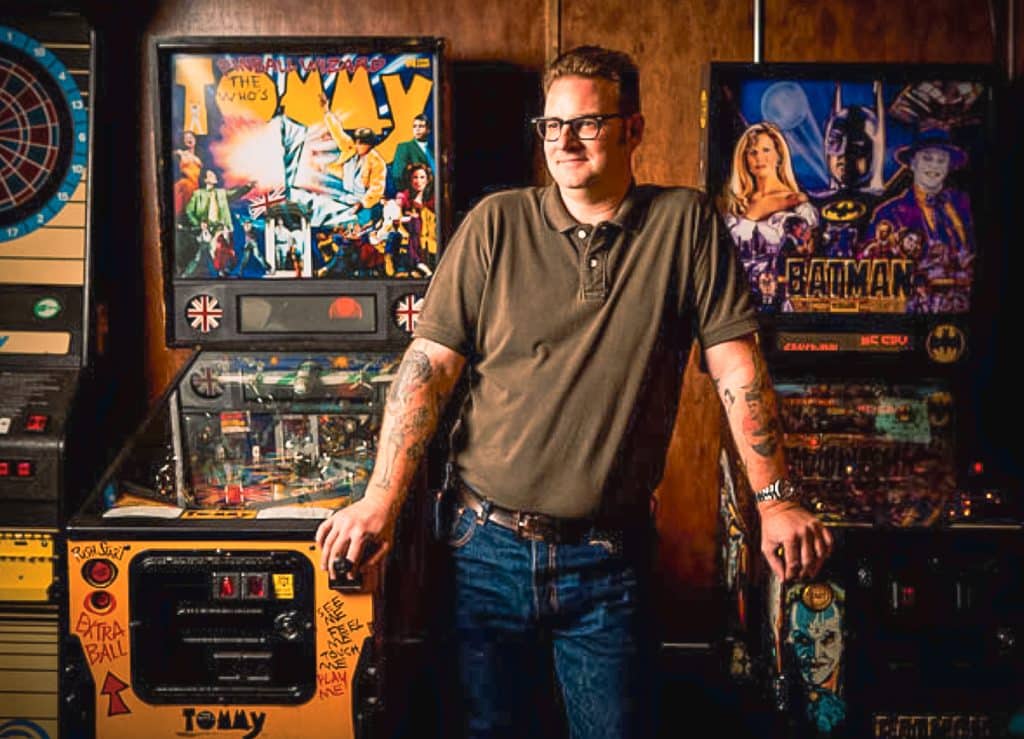
Despite opening in late June, Smith says they are still in something of soft-opening mode, though the bar itself is fully operational and an outing there will deliver a great combination of neighborhood bar and music venue. The bar itself is all mahogany wood and was made in 1949. Smith says they found it in a salvage yard in Indianapolis.
The décor mixes well with the classical bar. You won’t find beer posters hanging on the walls. Rather, the owners have gone with framed period artwork and posters of Americana music stars. Smith and Lehnen have also put in a good selection of pinball machines and a jukebox that fits their Americana music tastes. Needless to say, you won’t find Lady GaGa as a selection. The line-up of live acts includes string bands, surf rock, rockabilly, blues, jazz and other period essential groups.
Soon, Smith says, the Tip Top will also start serving food. While a menu has not been finalized, Smith says it will consist of a lot of sandwiches. “We’re going to do some kind of over-the-top grilled cheeses, both meat and vegetarian. There will also be some southern fare,” Smith adds.
It’s too early to be to tell if the Tip Top Deluxe will do to its tucked away southwest side neighborhood what places like the Meanwhile and the Winchester have done in the East Hills neighborhood. However, both Lehnen and Smith believe there is a lot of potential for that area. Each pointed to examples like the Goei Center just down the street from the Tip Top, as well as Grand Valley State University’s plans to expand their downtown campus in that area.
“I think what makes a city strong is the core neighborhoods that surround downtown,” Lehnen says.
For the most up to date information regarding drink specials, upcoming shows and other general FAQ, I suggest checking out the Tip Top’s Facebook page. For those without Facebook, you can also look at www.tiptopdeluxe.com.
Nick Manes is a freelance writer based in Grand Rapids, Michigan. His work has appeared in outlets such as Rapid Growth Media, Revue Magazine, and The Rapidian. He blogs occasionally at www.nickmanes.com and Tweets quite frequently @nickmanes1.
Related Articles
Can “Poetry Saves Lives?” Festival shares how poetry benefits mental health
Free three-day event includes panel of local mental health professionals.
#RG20LookBack: When public art becomes a part of the place
In his 31st #RG20LookBack column marking Rapid Growth’s 20th anniversary, Publisher Tommy Allen revisits Grand Rapids’ relationship with public art, from Calder and Maya Lin to ArtPrize, and considers what the city might make room for next.
Kent District Library lets neighbors borrow, discover and explore together
From birdwatching kits to local music, KDL helps people try new things, save money, and share experiences.


