
Kent District Library expands accessibility services through technology, training, community partnerships
Shelley Roossien leads Kent District Library efforts to improve accessibility through adaptive technology, staff training, and inclusive library services.
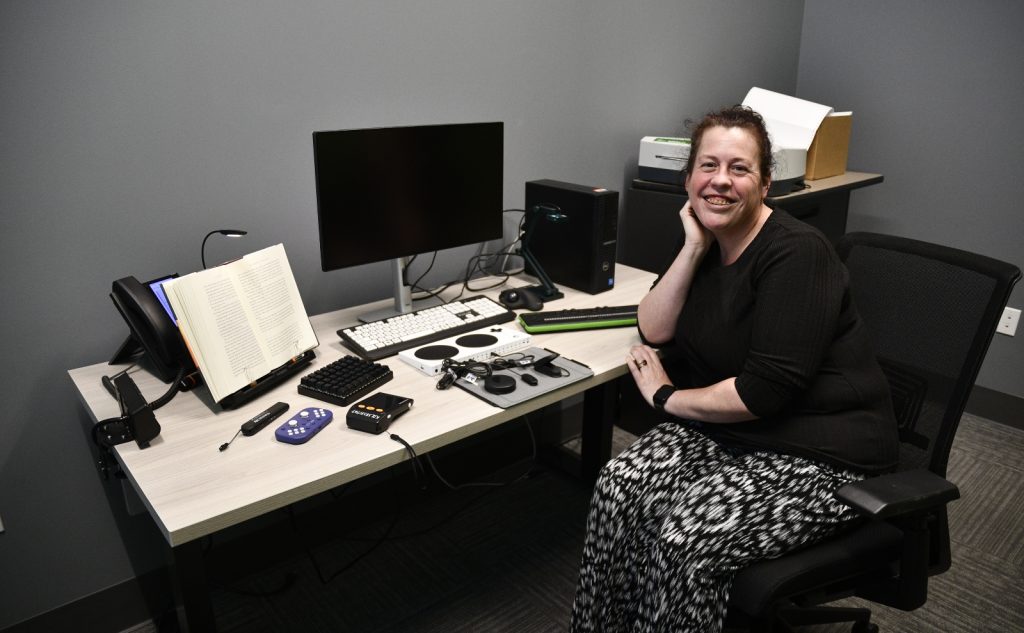
Shelley Roossien never expected her career in libraries would lead her into accessibility advocacy.
With a background in psychology and an interest in working with older adults, Roossien originally imagined becoming a counselor or therapist. Instead, she found herself drawn to libraries, where books, technology, and public services connect with community needs. During more than two decades at Kent District Library, that interest grew into a systemwide effort to make services more accessible to residents with disabilities.
“I always thought I was going to help people,” Roossien says. “It just naturally fits with my love of older adults, my love of books.”
Roossien is the accessibility and inclusion specialist for Kent District Library and works out of the KDL Service and Meeting Center in Comstock Park. Her work includes adaptive technology, staff training, accessible programming, and partnerships with disability organizations throughout Kent County.
Public libraries are important community spaces where people use the internet, attend events, find local resources, and get educational support. However, people with disabilities can face challenges getting reading materials, using technology, or participating in programs. Kent District Library has worked to remove some of those barriers through specialized services, employee training and expanded accessibility tools.
“My job is to make sure that all of our services, our programs, pretty much everything we do is as accessible as possible,” Roossien says.
Expanding responsibilities
Roossien has overseen the Talking Books and Braille Center since 2007. The national program, operated through KDL, provides accessible reading materials for people with visual, physical and reading disabilities.
“One of the big focuses that the library has is to provide reading materials to people that may not be able to read standard print,” she says.
Her experience with the Talking Books and Braille Center led her to pursue additional training in blindness and low-vision accessibility. Although Braille literacy was not required for her role, Roossien completed certification through the National Federation for the Blind so she could better assist patrons using Braille materials.
“I felt it was important to know at least some Braille, so that when I was helping people with Braille materials, I kind of knew what it was, and not just a bunch of bumps on a page,” she says.
Over the years, more staff members came to Roossien with questions about helping people with disabilities, and she realized the library needed someone focused full-time on accessibility. In 2019, she proposed creating an accessibility and inclusion specialist position.
“I wrote a job description, presented that to our leadership team, and they were all for it,” she says. Roosien was then hired to fill that position.
The job grew during the COVID-19 pandemic as libraries looked for new ways to help people online and in person. During that time, Roossien completed more training in disability services and helped improve accessibility across the library system.
Her work touches almost every part of Kent District Library, including book collections, events, outreach, and staff training.
Popular technology
One of the biggest changes at Kent District Library has been the growth of its “Beyond Books Collection,” which lets people check out helpful technology. Items include portable video magnifiers, gaming controllers for people with disabilities, adjustable book stands, listening devices, and reading pens.
The reading pens quickly became one of the library’s most popular items. The pens were first made for people with dyslexia and other reading disabilities. Users can scan printed text with the pen, and it reads the text aloud. The pens can also translate text into several languages.
“Something that’s been designed for someone with a reading disability has become a really good translation tool as well,” Roossien says.
Demand for the devices surprised library staff.
“The reading pens have had a hold list on them since I bought them,” Roossien says. “Obviously, that was a need that I didn’t know until it was in the collection.”
Accessibility work at KDL also includes employee training. Roossien developed disability decorum training that all newly hired staff members complete. The training focuses on disability awareness, communication, and assisting patrons with varying accessibility needs.
“We want to make sure all of our staff have a good knowledge of how to help someone with disabilities if they come in,” she says.
Large public events also require accessibility planning. Roossien helps coordinate accessible seating, assistive listening devices, and accommodations for major programs and presentations.
Partnerships with community organizations also play a role in the library’s accessibility efforts. Roossien regularly collaborates with Disability Advocates of Kent County and accessibility advocate Nicholette Driggs on outreach projects, accessibility planning, and inclusive programming.
Driggs says KDL frequently seeks outside feedback and works to improve accessibility across library branches and services.
KDL continues to test new services and technology as library staff identify barriers affecting residents with disabilities. Roossien says community feedback guides many of the library’s decisions.
“I’m constantly learning, and I’m constantly listening to what people need,” she says. “It never hurts to try things.”
Photo courtesy of KDL
Literacy Matters is a series focused on the importance of knowledge, community resources seeking to remove barriers to access, and the value of our library systems to society. Literacy Matters is supported by Kent District Library.
Author

Related Articles
Ticket to Work helps people with disabilities return to work safely
The program offers guidance and support so people with disabilities can work without losing benefits, addressing fears, complexity, and financial instability.
Leadership program helps dental directors improve care in underserved communities
Program supports dental leaders in Ohio, Michigan, and Indiana with skills to manage clinics, improve care, and advocate for underserved patients.
How mentorship helps one man build stability despite setbacks
A long-term mentoring relationship shows how accountability, honesty, and persistence can support progress, even as challenges and setbacks continue along the way.


