
#RG20LookBack: Harm reduction’s Naloxone is the CPR we never talk about
In his 27th #RG20LookBack column celebrating Rapid Growth’s 20th anniversary, Publisher Tommy Allen revisits Heidi Stukkie’s 2012 story about The Red Project and the power of community partnerships to improve public health across West Michigan.
For our RG20LookBack story, we want to revisit the timely harm reduction story on Grand Rapids Red Project by our former Do Good Editor, Heidi Stukkie, whose 2012 piece, “The Red Project is preventing HIV, reducing risk and improving health,” reminds us once again that this type of critical work is something we need to consider adding to our life-saving skills toolbox.
We teach CPR as a matter of course; everyone should know how to save a life if they’re standing there when it matters. Harm reduction deserves that same baseline of public knowledge, and mostly doesn’t get it… until someone illuminates what this looks like in reality.
Sadly again, that gap is exactly what played out locally again, and this time The Rapid was at the center of the story. When our area transit leadership and later the board both moved to reject an ad from local harm reduction agency The Red Project, we weren’t surprised…and we weren’t worried either.
We have come to terms via the lens of history that this is how it tends to go in Grand Rapids: deny first a proven solution, then come back around once the case gets made in public. That’s what happened. The ad got rejected more than once by The Rapid, then it was reconsidered after real pushback from locals with institutional and scientific expertise to curb fears.
To be fair, The Rapid never framed the rejection as opposition to naloxone itself. Their read was that the campaign ran up against existing ad policy — agency leaders and legal counsel decided that because naloxone gets tied so closely to illegal drug use in people’s minds, running the ads risked breaking their own rule about keeping advertising viewpoint-neutral. The board upheld that call on appeal by a 5–4 vote, though even then there was agreement the policy itself needed a second look.
I’ll give them that context. But it’s worth naming the logic underneath it, because it’s the same logic The Red Project has been up against for decades. Naloxone is a legal medication. It saves lives, full stop. Treating a conversation about it as too tangled up with illegal activity to put on a bus ends up deciding whose survival gets talked about in public and whose doesn’t. So many of us have been here before, and with all we know today after years of harm reduction data, Naloxone deserves our best, not what we have witnessed again, because above all, like CPR, it saves lives. That’s the stigma sticking around, still doing its work quietly, even tucked away inside a well-meaning policy.
And this moment sent me back to a story we filed on The Red Project in 2012 about the work they were doing that was lowering our HIV infection rates in West Michigan.
That piece on their harm reduction work traced things back to 1998, to then-Mayor John Logie’s task force on drug-policy reform, the effort that got Clean Works, our city’s syringe-access program, off the ground.
It, too, like the ads for the Rapid buses, met the same skepticism these kinds of emergent public health programs always meet at first.
Then the numbers came in: by 2012, HIV/AIDS cases tied to intravenous drug use had dropped from a quarter of cases to 8 percent, a shift owed in large part to Logie’s refusal to let people struggling with addiction be written off.
By then, The Red Project was already training everyday Grand Rapidians to recognize and reverse an overdose. When we talked to Executive Director Steve Alsum for that story, what stuck wasn’t a statistic – it was how simply he explained the whole philosophy: this works because you treat people like human beings.
I’ve carried my own naloxone story for almost 15 years now, since overhearing a local coffee shop staff talk about someone who’d overdosed and died in their bathroom early that day.
Someone said if they’d had naloxone on hand, that person would still be alive. The police did arrive eventually and had naloxone, but it was outside the window of time needed to save this person’s life. If it had been on site, then that person may still be with us today.
That kind of thing stays with you, and it’s exactly why we’re glad to report The Rapid has reversed its view on those ads and will soon be running on buses across the region, one more reminder that this tool belongs in the same category as CPR: something any of us might be called on to use to save a life.
What started in 1998 was only the beginning of building a better and informed citizenry that understands what people facing addiction actually need from the rest of us.
We acknowledge that the ground keeps shifting around us and that people forget our history and battles of the past that were fought to clear the way for even more advancements in community care.
And yes, as a result of this lack of historical knowledge within the culture is an opportunity for a new crop of gatekeepers who need the same education all over again. As we stated earlier, we have been here before and I am grateful that a few board members were able to illuminate our past for those who may have forgotten the mission and legacy of harm reduction in our city.
Progress rarely moves in a straight line from task force to policy to permanence. However, if we want to be a community that takes our neighbors’ hardest journeys seriously, showing up again is just part of the job. Grand Rapids Red Project has never stopped proving that…and we are glad they are taking the message of this harm reduction tool to more places soon.
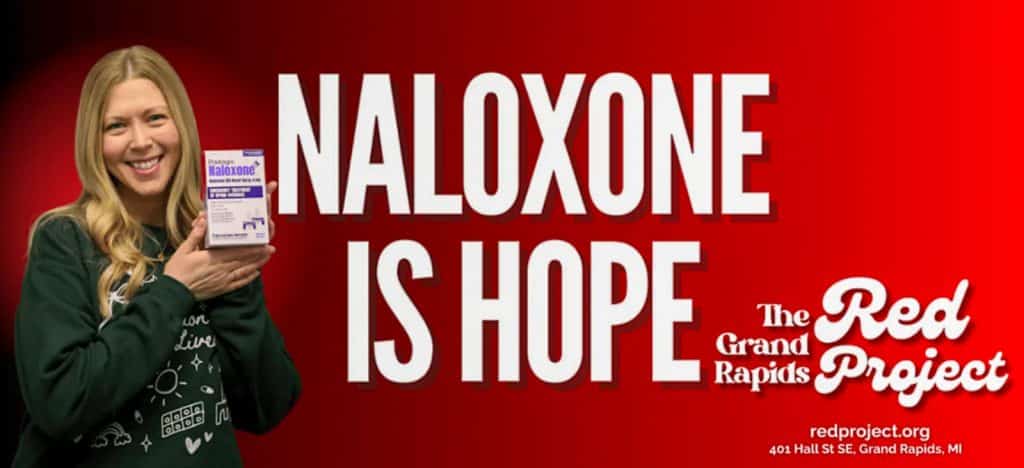
The Red Project is preventing HIV, reducing risk and improving health
By Heidi Stukkie
Would it surprise you to know there are an estimated 1,080 people living in Kent County with HIV/AIDS? Or that approximately 260 of these people — nearly 25% — don’t even know they’re infected?
In 2011, there were 42 new HIV/AIDS diagnoses in Kent County and so far in 2012, there have been 28 new cases as of July. Statewide, a little more than 19,000 people are now living with HIV/AIDS.
Of all the HIV/AIDS cases in Kent County, 44% are white males. Communities of color and traditionally marginalized segments of the population are disproportionately affected, too. African Americans make up 9% of the population here, yet they accounted for 34 percent of all HIV/AIDS cases in 2011.
What’s worse, if you’re an African American female, there’s a 25% greater chance of being infected than if you are a white female.
With cases of HIV/AIDS still rising, education and prevention are the keys to reversing this trend and one organization has a mission to do just that. The Grand Rapids Red Project is actively reaching out to the community to prevent the spread of HIV and they also provide support to those who have already been diagnosed.
Last year, the Red Project distributed 62,000 free condoms in Grand Rapids to prevent HIV and other sexually transmitted diseases. As part of their outreach program, they also encourage everyone to get free Rapid HIV testing at the Kent County Health Department.
Advances in modern medicine allow many people diagnosed with HIV/AIDS to live longer, but these individuals face many challenges as well as discrimination. The Red Project provides a monthly support group called Positive Choices to help them cope.
Back in 1998, former Mayor John Logie started a task force on drug policy reform and one of the committee’s recommendations was to implement a clean needle exchange program.
The Red Project developed its Clean Works Risk Reduction program as a result and now supplies clean needles to intravenous drug users in an effort to reduce the spread of HIV/AIDS and Hepatitis C, a blood-borne virus that attacks the liver. Since the program’s inception in 2000, HIV/AIDS cases related to drug use went from 25 percent down to eight percent.
Drug overdoses are currently the leading cause of death for adults ages 21-65 in Kent County. Since 2008, the Red Project is also working to address this issue by providing training to prevent and respond to drug overdoses. More than 300 people have been trained so far and of that number, more than 90 reported back to say they were able to prevent an overdose with what they learned.
Steve Alsum, the Red Project’s executive director, says they get most of their new clients through word of mouth from current clients. Earlier this year, they also began going into the neighborhoods where their services are needed the most with a new mobile health unit.
“We’re on a big push to make our service accessible to all people,” says Alsum. “We try to meet clients where they are.”
In addition to the Red Project’s fixed locations of its office at 343 Atlas Avenue and inside the Heartside Ministries building at 54 South Division Avenue, the mobile health unit has scheduled times and locations where it will be each week. Currently, they visit the intersections of Stocking Avenue and 5th Street, Madison Avenue and Hall Street and Burton Street and Division Avenue each week.
At all locations, the Red Project offers safer sex and safer shots supplies, Hepatitis C testing, drug overdose training, risk reduction counseling and referrals to other organizations for drug treatment, vaccinations and HIV/AIDS testing.
Each client is issued an anonymous card when they visit the Red Project. This card has basic identifying information that, if the card is lost, the person could share and easily be found in the database system. The Red Project keeps track of what services they provide to each person and what testing and training they’ve had.
Alsum says their reputation on the street is “pretty good.” People are often hesitant to come into the program at first, and that’s why the anonymity is important. Dignity and respect is important as well. The ultimate goal is to “provide people the knowledge and tools to stay healthy” regardless of what activities they engage in.
“We wouldn’t have the success that we do if we didn’t treat people like human beings,” says Alsum.
The organization can boast of a success story with one of its own employees. Brandon Hool was once a drug-using client of the Red Project who had always engaged with them and referred others to the agency. Then he disappeared for about six months.
“We had no idea where he was — if he was clean, in jail or died of an overdose,” Alsum says.
One day he showed up, clean and drug-free from being in a rehabilitation facility, and wanted to volunteer. Eventually, he was hired by the nonprofit. Now he says working there reminds him daily how important it is to stay clean.
Hool was lucky. Sometimes it can take months to get into one of two medically assisted rehabilitation facilities in West Michigan. There are less than 250 beds total at both places with a waiting list to get in at each. With roughly 3,000 people injecting illegal drugs in the area, the training and supplies that the Red Project provides are critical.
“When people need treatment, they really need it right now,” Alsum says.
Related Articles
How Rx Kids brings trust and financial relief to moms
Cash support program expands into southeast Grand Rapids, giving families flexibility while reducing financial stress during pregnancy and infancy.
Designer aims to elevate quality of life through accessible housing plans
Disability Advocates and a West Michigan designer create housing plans for safe, independent living.
Trinity Health and Michigan community groups will make fresh, local food a Medicaid benefit
A new Trinity Health initiative will allow people in the Ann Arbor, Detroit, and Grand Rapids areas to access fresh, affordable produce from local organizations through their Medicaid health plans.


