
#RG20LookBack: Permission to play
In his 24th #RG20LookBack, Rapid Growth Publisher Tommy Allen revisits his 2011 story about Rob Bliss’ Grand Rapids LipDub video, where he joined hundreds of others in the communitywide production. He reflects on the “Rob Bliss factor.”
Looking back at the ground Grand Rapids has covered over these past 20 years, I knew I’d eventually have to write about the Rob Bliss factor. Not to rehash who gets credit for what, or which ideas were generously borrowed from others without a nod or acknowledgment back. Time changes your perspective on that kind of stuff, and mine has changed plenty over 20 years of living and watching our local culture evolve into the city we have become today.
I wrote Grand Rapids Lipdub Video Shoot: Everyone Is Welcome on May 12, 2011.
What interests me now isn’t the credit — it’s what Rob’s work revealed about this city at a particular moment.
For a while, Grand Rapids stopped asking whether something could happen here and started asking, “Why not?”
Long before “placemaking” and “tactical urbanism” showed up in every planning deck, Rob Bliss — no relation to former Mayor Rosalynn Bliss, for the hundredth time — was working off a much simpler idea: what if public space invited us to play? What if downtown wasn’t just somewhere you worked or passed through, but somewhere you gathered, laughed, and made a memory or two?
Most of what he pulled together lasted a few hours. And yet, the effect lasted longer. His events pushed at what people assumed was possible here and got thousands of residents looking at streets they’d walked a hundred times like they were new. For a city still building its confidence, that permission to play in the streets mattered.
While I was there when Pillow Fight debuted, and the Zombie Walk’s 4,500-plus people spilled off the sidewalks and into the streets, terrifying some who had never seen such a public play outing on this level, nothing captured the spirit of play quite like the Grand Rapids LipDub.
Now watching it on YouTube, with over six million views thus far, it plays more like a time capsule than the response video it started as. Back then, national coverage of cities like ours skewed toward decline when it bothered to mention us at all.
Then a few hundred people — myself included — showed up to participate in a massive shoot of a single-take music video that was messy, joyful, and entirely homegrown. It wasn’t polished either. It didn’t need to be.
The Grand Rapids LipDub was a document from a community telling its own story on its own terms, using readily available technology to make its point about our future. Grand Rapids created its first citywide response video in response to an article, and the world took notice.
Sure, the spectacle is the part people remember. The part that still interests me is what was underneath it.
I knew Bliss during those years, and I’d come up in Grand Rapids’ arts scene back in the ’80s, so I recognized what he was doing — it echoed experiments happening in creative cities everywhere, including Grand Rapids. The difference here was that people actually showed up en masse to play a part.
I’ve come to think the best civic ideas rarely start with a budget line or a ribbon-cutting. They start with someone asking a different question and getting others to picture something a little improbable. Whether those experiments worked or not, they raised the ceiling on what people here thought was possible.
You can trace a line from these moments in our city’s evolution to the influx of block parties, neighborhood match-grant programs, increased public art interventions, and city parks redesigned to reflect changes in how we play. These free activations from Bliss became easier once someone had already shown that our shared public spaces could be more than functional — it could be fun.
Rob later took that same instinct somewhere heavier, helping Grand Rapids rethink chronic homelessness, and eventually beyond city limits with White Man Walking, the documentary about his 1,500-mile walk across America after George Floyd’s murder. Different work. Same belief underneath it: before people change a system, they usually have to change how they see each other.
Design thinking, a way of working embraced by local firms like Steelcase and nonprofits like West Michigan Center of Arts and Technologies, has a phrase for this — play isn’t the opposite of serious work, it’s often where serious work starts. Play lowers the stakes of failing. It gives people room to try things and to picture a future that doesn’t exist yet. Before a community can change its future, it has to be able to see one.
Twenty years into Rapid Growth, that’s the lesson I keep coming back to. Cities change because of planners and builders, artists and neighbors. But every so often, they change because one person is stubborn enough to ask, “Why not?” And with the right setting, a pillow fight can be the start of something much bigger that benefits the whole.
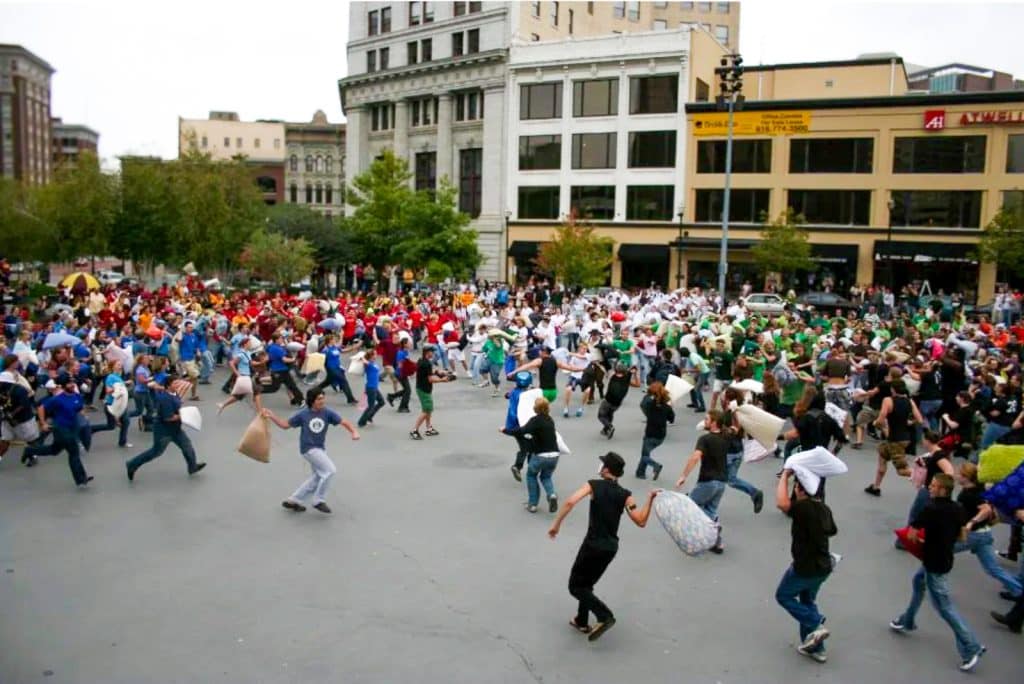
Grand Rapids Lipdub Video Shoot: Everyone Is Welcome
By Newsroom
NULLNULL
NULL, NULL NULL
NULL
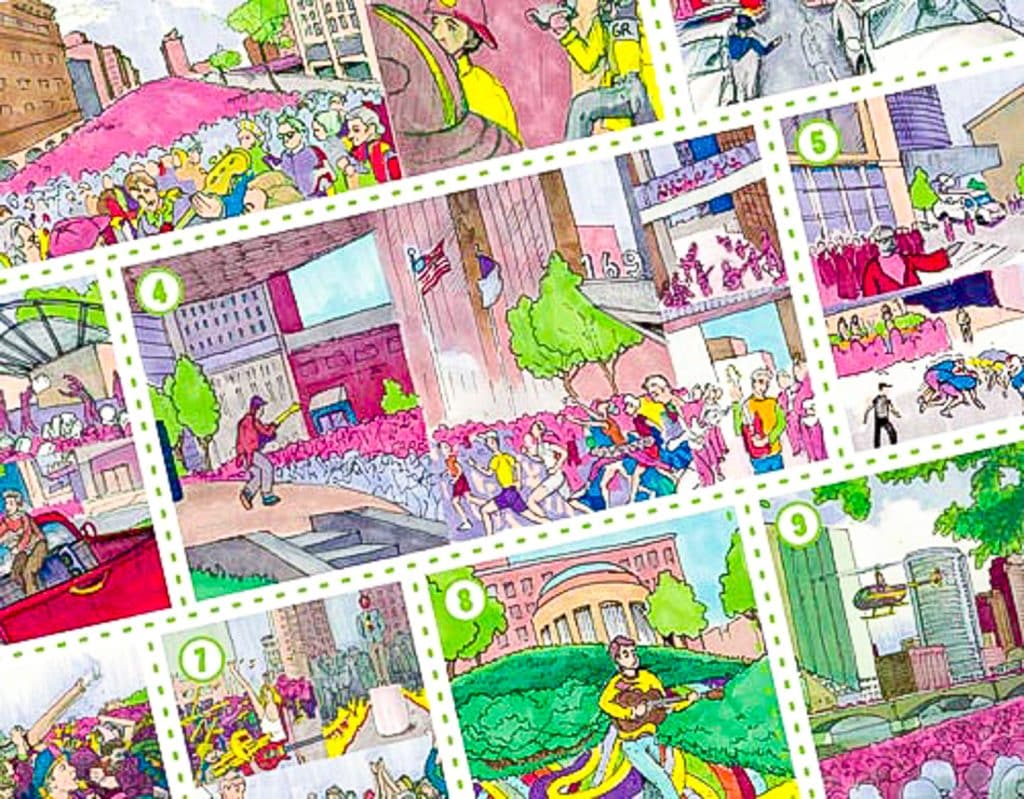
If you have wondered where Rob Bliss has been as of late, the easy answer is planning his next event. But as I walked the streets of Grand Rapids listening to what those plans entail, it is clear he has planned probably his largest and riskiest creative endeavor to date.
For those who have missed this trend, a lip dub is a music video captured in one long shot, continuous and unedited, with all participants lip-syncing to a song.
The trend has been done elsewhere, but Grand Rapids has never attempted one on this level before.
The lipdub has popped up on area campuses over the years, with Calvin College landing on the Huffington Post as one of the best in 2010. Lip dubs have even crossed the hipster barrier to be featured on The Office. It is nothing new, but it is when you look at the scale that Bliss is seeking to replicate.
As I walk the streets, I am fascinated by how Bliss will be getting his card punched by various groups, from politicians who must approve his events to the events’ rites of passage through the GRFD (which has a prominent role in this video). Even the media and social media will be there side by side in this one long take.
What is equally fascinating is not the choice of song (“American Pie,” by Don McLean), but how he has woven his own history carefully into the city’s, which is portrayed throughout the choreography.
And here is where it gets weird for some, but heck, why shouldn’t he do it this way? It is his project, and name another person who in the last 10 years who was able to make people want to feel or be a part of something.
The public is invited to be a part of this video, and Bliss hopes that a couple of thousand people will make the journey downtown this Sunday to be an extra in this interesting and playful look at our city. Plan on being there from 10 a.m. to 3ish, and be sure to bring a big sack lunch. As one who used to work on film productions, these kinds of affairs can run at a glacial pace, but are worth it when you get to see the finished product.
So come on down and join the fun. It is going to be a change of pace from being a tulip peeper in Holland — that much I can guarantee.
If it rains, please visit his Facebook event page for details on the rain date.
Admission: Free
Photo of Pillow Fight and Lipdub storyboard courtesy of Rob Bliss Creative
Related Articles
Kent District Library lets neighbors borrow, discover and explore together
From birdwatching kits to local music, KDL helps people try new things, save money, and share experiences.
Something for every season: Fashion, curiosity, and community at the GRPM’s new archive center
Inside the Grand Rapids Public Museum’s new Archives Center, Kendall College of Art and Design students are turning decades-old garments into inspiration for their next designs.
From ‘Unseen Oceans’ to GVSU, exploring the Great Lakes anew
Grand Rapids Public Museum’s Unseen Oceans reveals the hidden wonders of the sea, while Grand Valley State University’s Water Resources Institute, just 40 miles away, brings that exploration closer to home on the Great Lakes.


