
Removing barriers so people can live their best lives
Improving old technologies with new is, in many ways, the heart of improving access for humans. It is also a great motivator for those with the talents to do so. Here are the people behind those efforts and why this work is so important to them and within the region.
Ride Your Way Founder and CEO Thomas Sikkema was a registered nurse in 2013 when he underwent treatment for brain cancer.
“I was a very active person, prior to my diagnosis. It really changed my perspective on the world,” Sikkema says. “I got to see everything through a different lens of, if I did end up in a wheelchair after my brain surgery, or chemo or radiation, is there something available and [were there] resources available that would allow me to live the life that I wanted to live — whether I was facing a mobility challenge or not.”
For a few days following surgery, Sikkema recalls having to manually pick up one leg and put it in front of another. Even with help from expert physical therapists, he had to face the fact that he might wake up one day and need a wheelchair.
“That definitely changed my perspective on the world,” he says. “It’s really a driving force of why my team and I do what we do.”
Moving people through the city
Sikkema started Ride Your Way, touted as West Michigan’s only five-star rated wheelchair accessible transportation company, to help disabled people get to where they need to be as comfortably, quickly and affordably as possible. The service operates 24 hours a day, 7 days a week. Users can call for a ride to dialysis, physical therapy or anything in between.
Recently, the company partnered with a technology company in the mobility transportation industry, MUVE. The MUVE platform was already integrated into a full dispatch and scheduling suite along with a rider app, similar to ride-share companies like Uber and Lyft.
This partnership improves transparency and accessibility of the Ride Your Way system by enabling individuals to schedule wheelchair accessible transportation via the GoMUVE app.
“The old system of calling in with a phone and talking to a dispatcher to schedule a ride or filling out some sort of form on a website can very easily get lost on the internet,” Sikkema says. “MUVE took a different perspective on things and harnessed technology to allow consumers access to the care that they need.”
Along with on-demand and advanced ride scheduling, the MUVE app features an events page highlighting wheelchair friendly and accessible events in the area.
“Back in 2013, during brain cancer and through that whole part of my life, I never had any access to something like that,” Sikkema says. “This makes it so I can still live that life that I want to live.”
GoMUVE’s tagging initiative brings in crowdsourced data to help people understand the level of wheelchair accessibility at their potential destination spot. Users are asked to answer a series of questions related to wheelchair accessibility at those destinations. If the address is fully accessible with parking, ramps, elevators, etc., then the aggregated data results in a green tag for the space. If users report that a business has few accessibility features or is inaccessible, the app will show an orange or red tag at the address.
“Our mission here at Ride Your Way is to remove the barriers in life that prevent people from living their best life,” Sikkema says. “The power of the GoMUVE app allows people to get out into the community and enjoy what Grand Rapids and the surrounding area has to offer. This is helping people continue to do everything that they want to do and have a high-quality life, whether they’re facing mobility challenges or not.”
Moving people through life
Michael Williams, community organizer and volunteer and intern coordinator for Disability Advocates of West Michigan, notes that technology is often a double-edged sword, improving life for one group of people but potentially complicating things for another.
“Every service requires a different app, if there even is an app,” Williams says. “So, navigating a route using public transit or micromobility, such as the scooters or e-bikes downtown, there’s no one service that can plan your route for that.”
That could be coming soon, though.
Williams points to one example in The Rapid’s Wave card, which uses near-field communication (NFC) technology to enable ticketing and payments with a single interface, albeit limited to The Rapid bus system.
“It’s as simple as taking a single card that’s pre-loaded, and you can just tap it to pay for all your services on a unified front or using your cellphone with that same technology,” Williams says.
“I think we’re a few years out from that, but a unified app for all transit services and [a] unified payment system will be a major discussion point in the coming county-wide mobility task force,” he adds.
On that journey, wayfinding apps like GoMUVE and DisArt have undoubtedly made big improvements to the accessibility of events in the area, including, most notably, ArtPrize. DAKC has maintained conversations with groups advocating for inclusivity and access, while supporting the new apps and resources that further those areas.
“We’re staying as involved as we can with those groups just to help improve those apps as they develop on the transportation front,” Williams says. “I think we’re moving closer to the concept of a unified app for all transit services. I don’t think we’re there yet.”
The city of Grand Rapids and Downtown Grand Rapids Inc. are both heavily invested in improving accessibility as well as inclusivity, Williams says. This is evidenced by the new Special Olympics Michigan Unified Sports & Inclusion Center. which not only houses Special Olympics and the DAKC, but also Deaf and Hard of Hearing Services, Autism Support of Kent County, Down Syndrome Association of West Michigan and other important nonprofit partners under one roof.
With two gyms, two fields, an auditorium and lots of room for community space, it’s the largest Special Olympics facility in the world.
Micromobility projects are another growing trend in West Michigan. Williams says Mobile GR earlier this year completed the pilot phase of an effort to improve accessibility through micromobility vehicles using e-scooters from Lime and e-bikes from Spin. Those vehicles will remain in use in a 13-square mile section of the city, soon joined by other options.
Williams says Mobile GR has also chosen a partner to help supply new vehicles, including seated scooters and motorized devices that can mount to a wheelchair.
This will improve access for many, however, “this technology can be either an advantage or a barrier,” Williams says
Micromobility provides many city transit options, potentially alleviating issues with parking and traffic. The options are generally safe if they’re used properly and maintained. But, there is growing concern — and in some cases public displays of contempt — when scooters and e-bikes are left out in the middle of the sidewalk or in the street.
When solutions otherwise become hazards in traffic or barriers to people traveling on sidewalks, it’s hard to justify them as solutions, Williams says. “Especially if you do have to use a wheelchair and there’s no way around it and it’s blocking the sidewalk.”
“There’s definitely some education that needs to go [on] with this micromobility issue,” he says. “As a public transit user, I have benefited from these micromobility devices and I’m a big advocate for them, but we’ve got a long way to go and I think we’ll see a lot of development in that sphere.”
Grand Rapids is also making an impact on mobility at a personal level.
Helping people move safely and efficiently
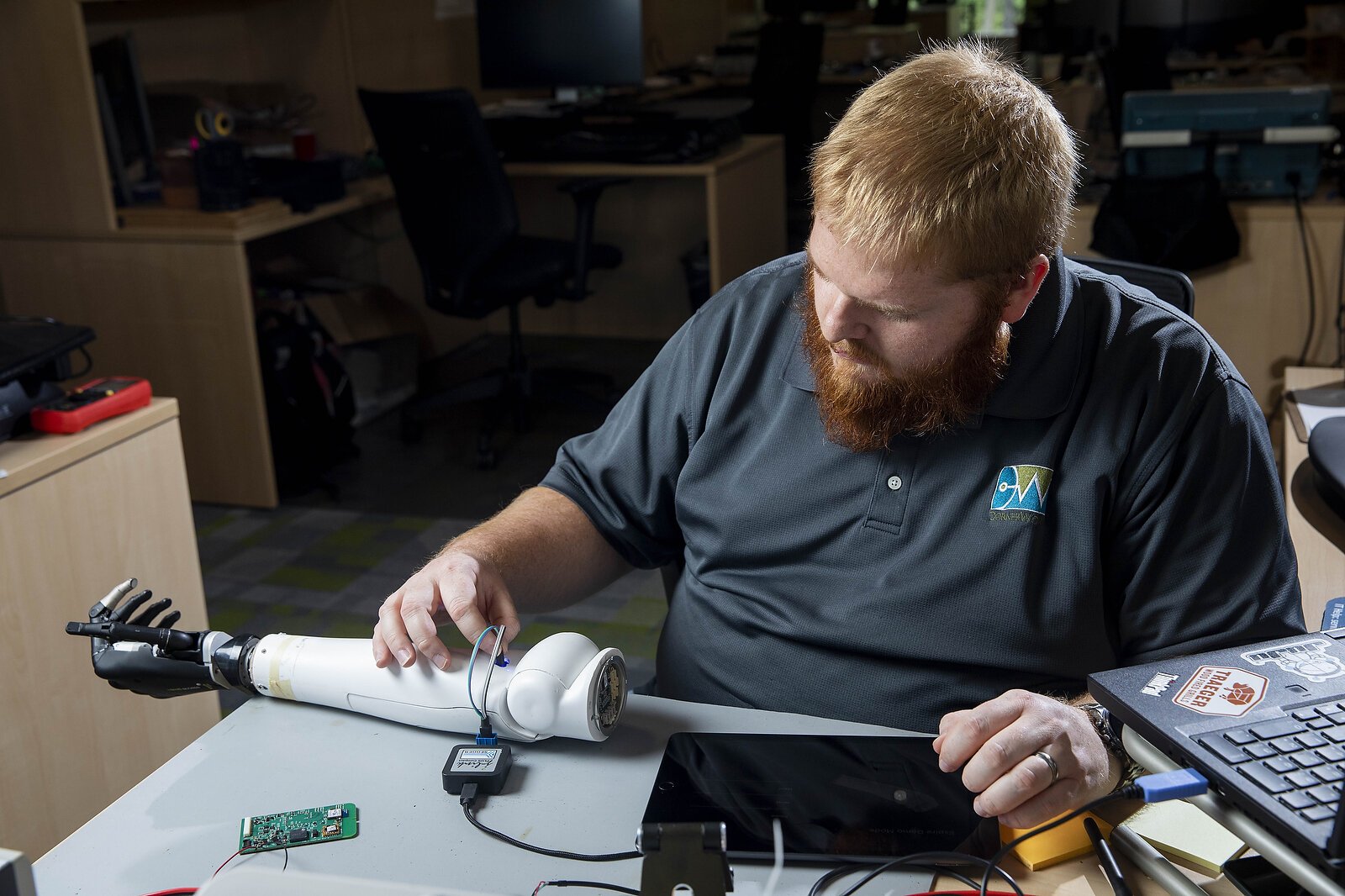
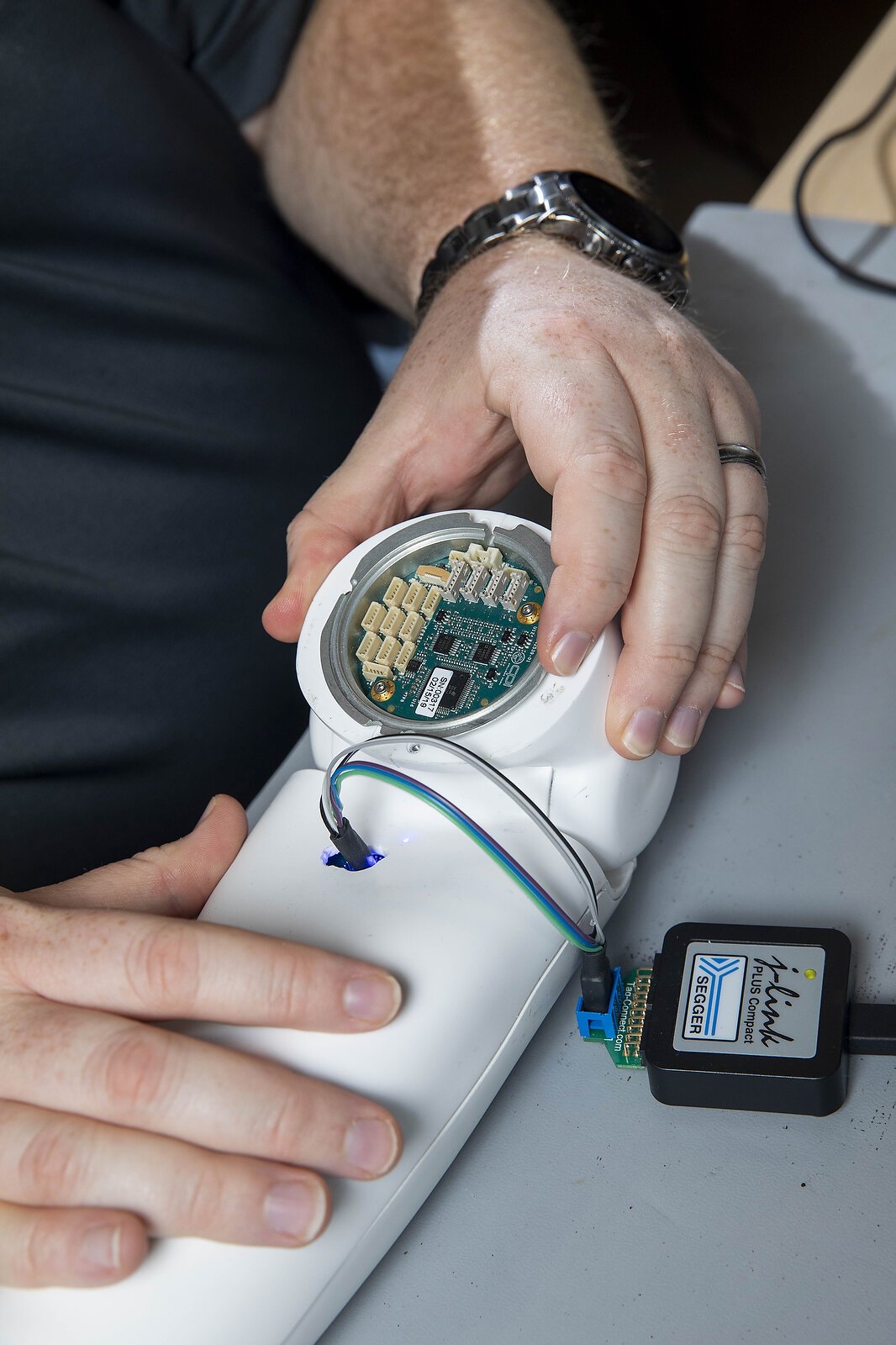
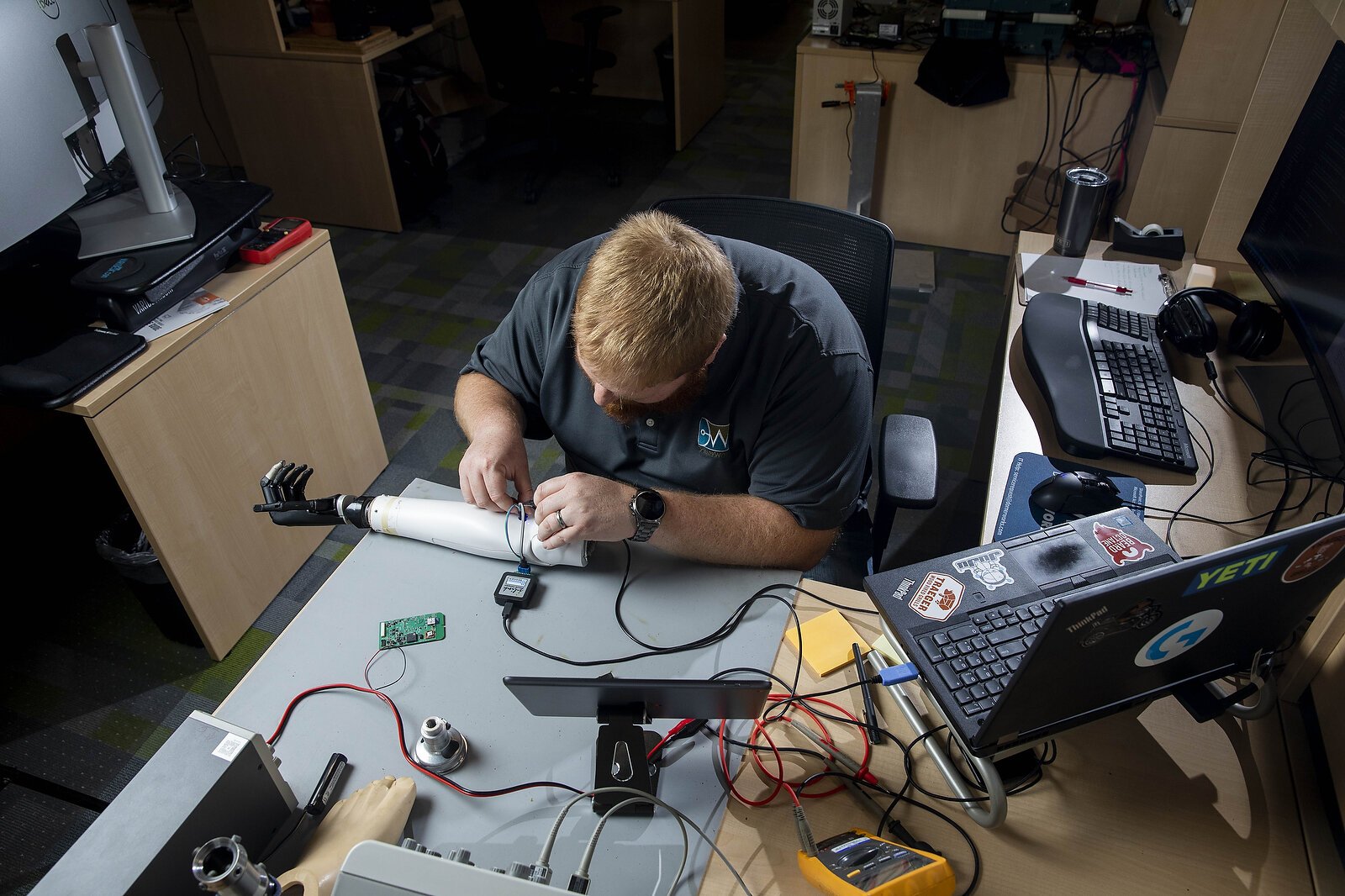
DornerWorks is a Grand Rapids-based embedded electronics engineering firm with over 20 years of experience developing products for companies in the aerospace and defense industry, consumer, industrial and medical markets. For the latter, DornerWorks Internet of Things (IoT) Strategy Leader Greg Nowak has worked on the embedded electronics in a prosthetic elbow, knee and foot for amputee patients.
While the knee and the foot are still in development, Nowak helped develop the elbow from the ground up. A company came to DornerWorks with the design for an existing prosthetic that had a complex configuration process and a short battery life.
Nowak engineered improvements to the design that would allow for a new type of battery, “one that you could hot swap throughout the day rather than having to plug the elbow back in midday when you needed to recharge it,” he says.
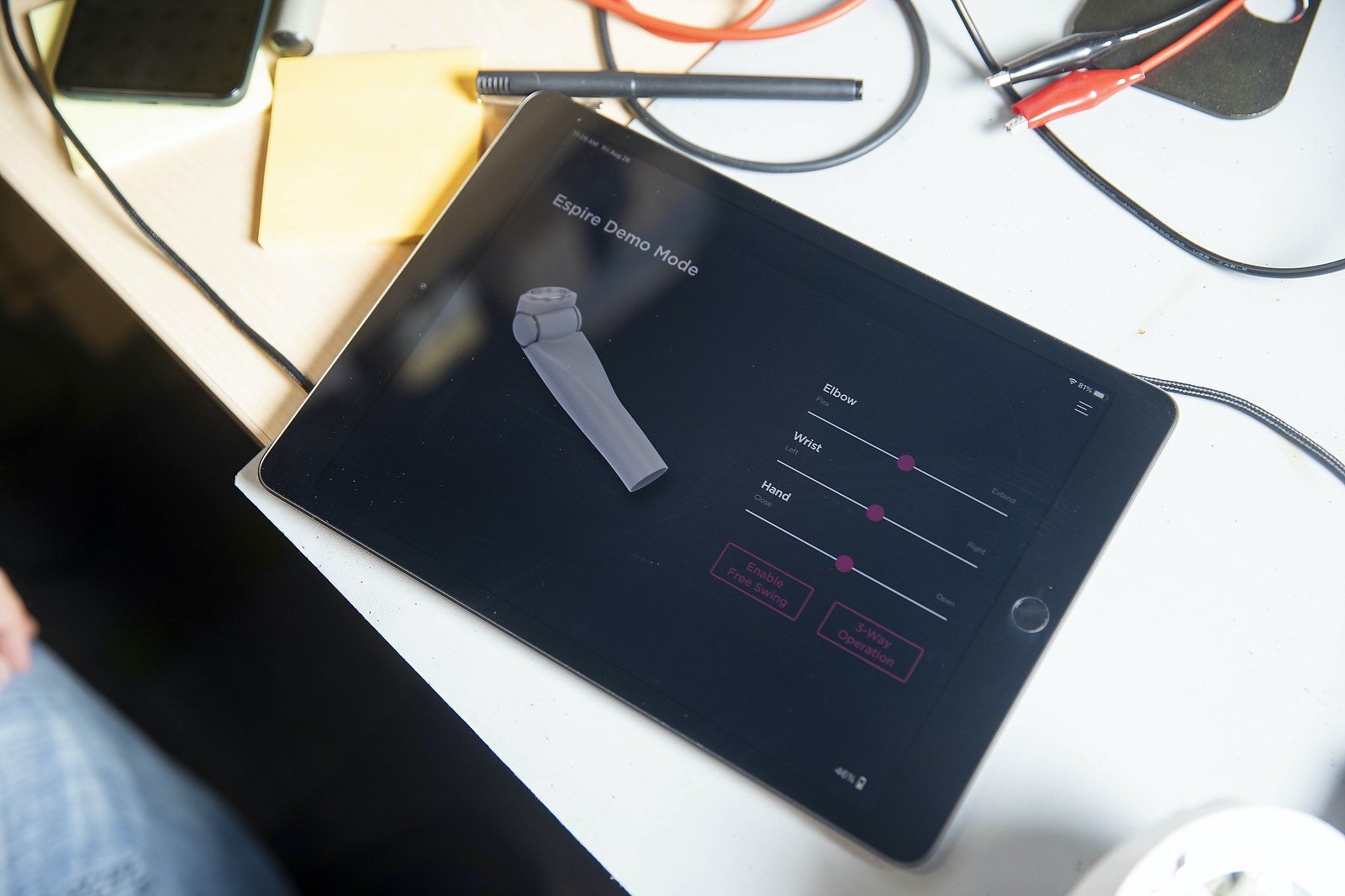
An iPad app makes the prosthetic easier to access and adjust from a doctor’s perspective as well as user’s perspective. No longer are restrictive cords and multiple software packages needed to configure the elbow to a patient. Setup, updates, bug fixes and feature enhancements can be pushed out to the device through a connection to the app, giving users much more than just freedom of movement.
“You’re no longer taking screwdrivers to adjust 500 different settings,” Nowak says.
With great technological advances come technological responsibility, however. The act of making a wireless connection between a prosthetic arm and an iPad, or your phone and any other device, also opens up those devices to potential cyberattack.
Nowak says security assurances like encryption and authentication are handled behind the scenes to minimize the potential of one of those attacks getting through.
“You minimize that by not connecting to everything and not constantly being connected,” he says, adding that patients still need to see their doctor in-person for an adjustment. “You have to be physically close. You have to push a button on the device, then the mobile app tries to connect. There’s a very personal aspect to the connectivity. It’s certainly not something that could just happen by accident.”
Improving old technologies with new is in many ways the heart of improving access for humans, and a great motivator for those with the talents to do so.
“Taking some of those old technologies, the mechanical technology, and improving them with electronics is certainly rewarding in that sense,” Nowak says. “It’s an opportunity where we can take our expertise as software engineers or hardware engineers and apply it to something that makes a real difference in somebody’s life.
“I really like to work on products that change people’s lives,” he adds. “It’s a good feeling to see somebody walk, who couldn’t previously when they [came] into the doctor’s office that morning. They’re able to now do things they couldn’t a couple hours ago.”
Improving access for all takes a collaborative effort between innovators, policymakers and people who simply want to change the world. That requires a lot of talent and is a credit to West Michigan where that talent can be found.
Photos courtesy Kristina Bird, Bird + Bird Studio
This series seeks to highlight tech organizations and employers throughout Greater Grand Rapids that are delivering innovative programs and addressing talent pipeline challenges and seeking to develop, attract and retain quality talent in West Michigan. This series is underwritten by The Right Place.
Matthew Russell is a writer and maker living in West Michigan. Matthew has over 25 years of experience as a journalist for newspapers and magazines in the Midwest, has been published in two books about Grand Rapids history, and is currently improving his skills as an amateur apiarist while building a sustainable microfarm in West Michigan.
Related Articles
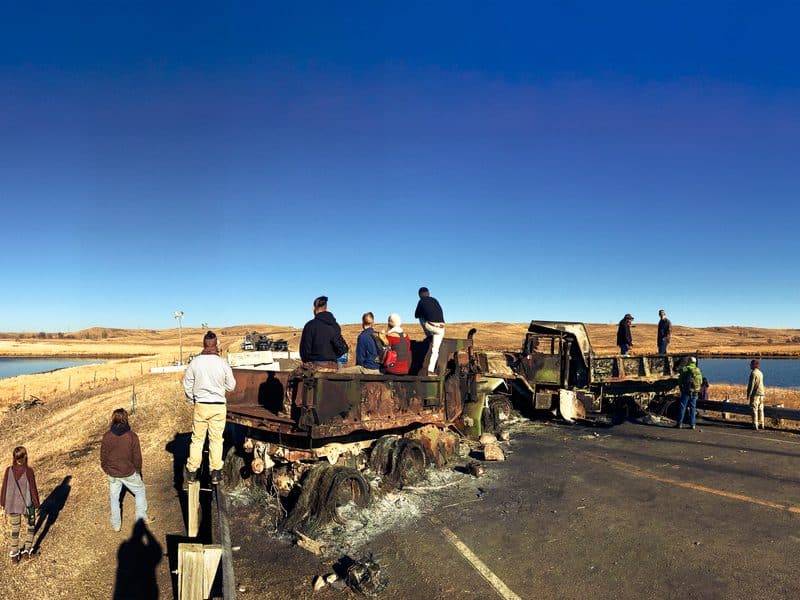
#RG20LookBack: Standing Rock and learning to listen to the land…and each other
In his 33rd #RG20LookBack column marking Rapid Growth’s 20th anniversary, publisher Tommy Allen connects lessons from Standing Rock with a reopened Grand Rapids exhibition, reminding readers that Indigenous history remains in the present tense.

Shark Tank stars kick off Tech Week Grand Rapids
Daymond John and Robert Herjavec open a week that celebrates innovation, entrepreneurship, and West Michigan’s growing technology community.

Trinity Health and Michigan community groups will make fresh, local food a Medicaid benefit
A new Trinity Health initiative will allow people in the Ann Arbor, Detroit, and Grand Rapids areas to access fresh, affordable produce from local organizations through their Medicaid health plans.


