
#RG20LookBack: When public art becomes a part of the place
In his 31st #RG20LookBack column marking Rapid Growth’s 20th anniversary, Publisher Tommy Allen revisits Grand Rapids’ relationship with public art, from Calder and Maya Lin to ArtPrize, and considers what the city might make room for next.
After a month away, we’re back with #RG20LookBack just as Grand Rapids enters its bonus fifth season: ArtPrize.
ArtPrize is different from the public art that stays with us year after year. It arrives, fills the city with discovery and conversation, then disappears. But I also believe its success grew from something Grand Rapids had already been practicing for decades: making room for art in our public life.
In June 2006, just months after Rapid Growth launched, we published “The Art of Building a City,” written by Brian Burch. The story explored how public art was doing more than changing the way Grand Rapids looked. It was changing how people experienced the city.
And this was three years before ArtPrize debuted.
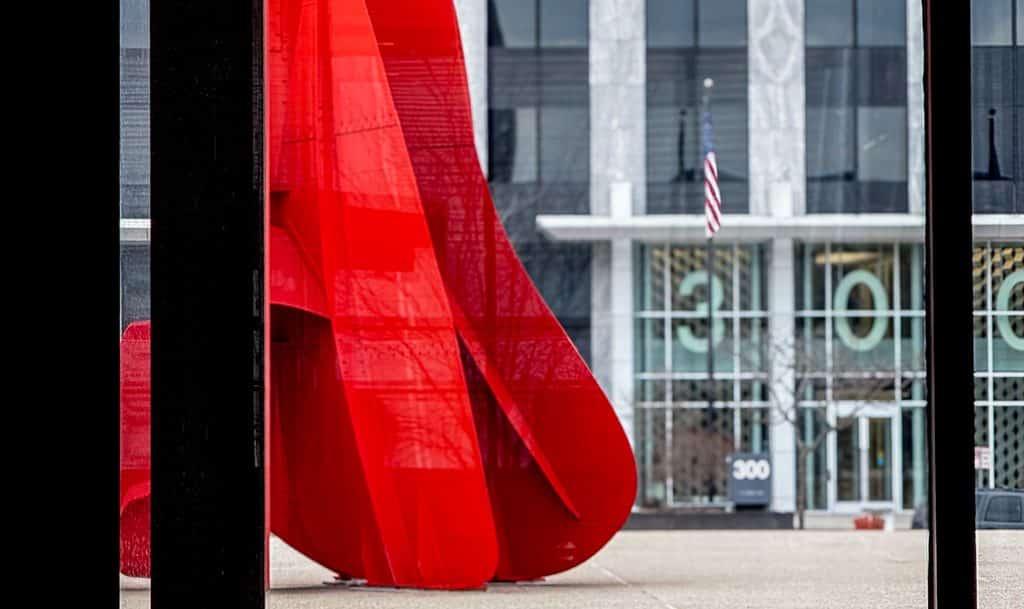
Long before I moved here, Grand Rapids had already taken a remarkable leap. In 1969, Alexander Calder’s “La Grande Vitesse” arrived downtown after the city became the first in the nation to receive a National Endowment for the Arts grant supporting a work of public art.
I can only imagine what it must have felt like to watch that enormous red sculpture rise from the concrete and realize something about the city had changed.
My own version of that experience came later with Maya Lin’s “Ecliptic” at Rosa Parks Circle.
It arrived as a work of art, but it never remained simply an object. We skated across it in winter, danced around it under the summer sun, protested and celebrated there year round. We met up here with friends for a lunch from a food truck. People gave the work a life beyond what any artist could completely script.
I understood that most clearly more than a decade ago when Lin returned to Grand Rapids. After a press conference at the Grand Rapids Art Museum, she stepped outside a side door to find Rosa Parks Circle overflowing with swing dancers.
“Was this planned?” I overhear her ask someone next to her all the while keeping her gaze on the hundreds of dancers that filled the circle as the sun was low in the sky.
“No,” I told her. “This happens here on a regular basis.”
I remember feeling proud, not only of what she had created, but of what Grand Rapids had done with it.
We had completed the work.
That is what brought me back to this nearly 20-year-old Rapid Growth story.
Calder helped introduce one generation to what public art could mean. Maya Lin gave another generation a place it could inhabit. Then ArtPrize arrived in 2009 and, for a few weeks each year, expanded inviting us to that conversation across the entire city.
And I don’t believe that story is finished.
Somewhere ahead of us is another work, another idea, or perhaps an entirely different form of public art we haven’t imagined yet. This is what excites me as I survey looking for the next pubic art work that will once again help shape our city.
Whatever it is, I do hope it is still a piece that encourages people to gather around it so naturally that they forget there was ever a time when it wasn’t here…or that we cannot imagine this world without each other.
Grand Rapids has a history of making room for those possibilities.
Looking to the future, I hope we always do.
The Art of Building a City
Throughout human history, public art typically has served to honor a special individual or commemorate a period of time. Think of the 9-foot bronze statue of political giant Arthur Vandenburg recently unveiled in downtown Grand Rapids. Or the Civil War monument standing near the intersection of Fulton and Division.
In recent decades, however, public art has quickly emerged as an effective way to establish places of distinction, enhance the urban identity, and spur economic prosperity. Sure cities need skyscrapers, good roads and mass transit, effective schools, and decent places to live. But what’s it matter if it’s all plain and indistinct? Thus public art increasingly is recognized as a key piece of infrastructure deserving of serious investment.
Indeed, some cities have harnessed the power of public art to combat poverty, crime, and even pollution in downtrodden areas. What happens is that the works themselves essentially become a magnet attracting individuals and groups to gather in particular places, which subtly reorganizes the social structure of communities and activates fresh conversations that often times lead to new growth and revitalization.
The Heart of a Space
In June 1969 a single event transformed the city of Grand Rapids in this way—the dedication of Alexander Calder’s La Grande Vitesse at Vandenberg Plaza. The project began in 1967 when the National Endowment for the Arts awarded the city its first grant for Art in Public Spaces. With no previous model to follow, Grand Rapids essentially wrote the book on funding public art through partnerships that united public agencies and private organizations. It became the case study for future installations after the NEA declared the project the most successful of its kind in the United States.
The installation served as the capstone of the city’s urban renewal program of the late 1960’s, which included a new city hall, a county administration building, and three new office buildings along Ottawa Avenue—Fifth/Third Bank Building (formerly Old Kent), Chase Bank (formerly Bank One), and 300 Ottawa Avenue.
Just as La Grande Vitesse has affectionately become the “heart” of Grand Rapids, public art in the nation’s cities continues to become a more prolific and integral piece of the urban fabric.
Public Art Moves People
Public art operates specifically at the intersection of art and culture, where artistic awareness and physical space combine. In June 2004, the City of Chicago opened Millennium Park, a nearly 25 acre, $475 million public space built above a downtown commuter rail yard. Public opinion leading up to the park’s opening was overwhelmingly pessimistic; the Chicago Tribune called it a “troubled showpiece.” But in two years the park has become one of the city’s leading tourism destinations, generating more than 5 million visitors annually.
The attraction? More than $220 million of public art “enhancement pieces” funded solely through private dollars—the interactive Crown Fountain, designed by Jaume Plensa, features two, 50-foot-tall glass block towers which displays a rotation of 1,000 larger-than-life faces of everyday Chicagoans; the colossal, 110-ton, stainless steel Cloud Gate sculpture by Anish Kapoor; and the visually striking Pritzker Pavilion, designed by architect Frank Gehry. These sculptural enhancements are so engaging, as any visitor quickly realizes, they are almost addicting.
One result is that people just can’t seem to stay away. Some $1.4 billion in new residential development alone can be attributed to presence of Millennium Park, according to a 2005 study commissioned by the City of Chicago. And a feature story in The New York Times recently predicted that “Millennium Park will define residential living in Chicago much like Central Park does in New York.”
“Good public art has the ability to increase the aesthetic of a public space and invite people into new social interactions,” says Lisa Van Arragon, professor of art history at Calvin College.
Art is much more than decorative, Van Arragon said, but integral to the conversation of the public space.
That conversation extends into the language of economic development. By inviting people to interact with a public space through art, community leaders effectively open the doors for new business opportunity.
Engaging a Community
Here in Grand Rapids, Maya Lin’s Ecliptic at Rosa Parks Circle is a local example of the sculptural aesthetic within a public park. It is Lin’s first piece to combine art and architecture and, like La Grand Vitesse, it represents a significant area of revitalization in the heart of the central city.
Echoing the city’s relationship to the Grand River, Ecliptic physically recreates the differing states of water as it is main theme: liquid, solid, and vapor. Its centerpiece is a 13,000 square-foot oval amphitheater that converts into an ice skating rink in the winter.
Ecliptic encourages interaction with and within the site during all seasons, whether it is ice skaters, evening concert-goers, or the lunchtime crowd. As the artist intended, the piece becomes the gathering place and the public becomes the art.
But the Ecliptic has not only dramatically improved the design aesthetic of Rosa Parks Circle and attracted more people to the area. The installation of the work also has helped to spur an increase in redevelopment along Monroe Center similar to what Chicago now experiences around Millennium Park, albeit on a much smaller scale. Consider the following sampling of projects that came as or immediately after Rosa Parks Circle opened to the public:
- The Grand Rapids Art Museum chose to build a new home adjacent to the park and is expected to open in spring 2007.
- Space Source, which manages a building directly across the street from the park, is giving the grey ho-hum exterior at 161 Monroe Avenue a modern face-lift to complement the architecture of the Maya Lin work and the new art museum.
- Small business in the area has flourished. Both Starbucks and Beaner’s Gourmet Coffee recently opened at the corner of Monroe and Pearl; Jimmy John’s sandwich shop and Olive Express now operate on Monroe Center; and the Little Bohemia shop recently expanded floor space and merchandise.
- The area, once known more as a lunchtime destination, has become more popular for fine dining establishments such as Tre Cugini, Leo’s, and Louis Benton Steakhouse.
The Ecliptic is not the only art-based project to spur revitalization in Grand Rapids. When the Urban Institute for Contemporary Art relocated to the Heartside neighborhood in 1999, the organization, which showcases the work of emerging artists, helped transform a section of town once known for prostitution, poverty, drugs, and violence into one of the city’s more popular downtown districts.
Art Opens The Eyes
Public art can also be ephemeral, but significant by engaging an existing space, even if for a short period of time. Tom Otterness in Grand Rapids: the Gardens to the Grand, a temporary exhibition of public art coordinated by Frederik Meijer Gardens & Sculpture Park, is encouraging people to take “art walks” downtown and stimulating the urban conversation by bringing what Van Arragon calls a “neo-pop, 3-D narrative” to the landscape.The 35 bronze sculptures in downtown Grand Rapids animate public spaces with humor, provocative thought, and frequently irony—consider Beavers, in front of Fifth/Third Bank, Death Figure, gazing at us from above, or Horse and Rider, positioned to acknowledge La Grande Vitesse.
All of these works call attention to their surroundings, helping people to see things that were already there, but oftentimes from an entirely new perspective. The sculptures directly involve the community by bringing individuals, couples, and families into the urban framework, animating the public spaces, and making people more comfortable in the city.
Taken together, all this public art – the Otterness statues, La Grand Vitesse, the Ecliptic, and other works – has generated an incredible force for progress in the city. They’ve helped to create places of distinction and spaces for residents and visitors to congregate and interact. By investing in public art, Grand Rapids provides its people and business community with a renewed sense of faith and civic spirit and an open invitation to actively participate in their city.
Photo by Tommy Allen
Related Articles
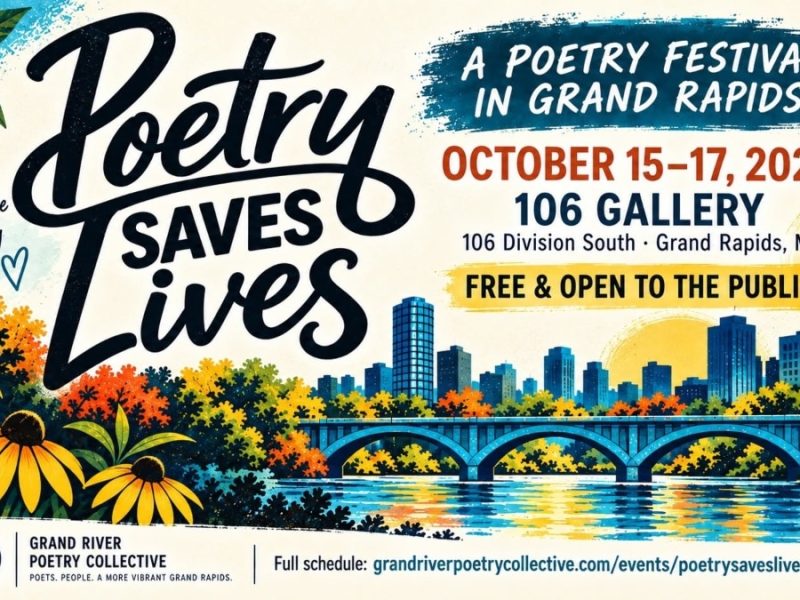
Can “Poetry Saves Lives?” Festival shares how poetry benefits mental health
Free three-day event includes panel of local mental health professionals.
Kent District Library lets neighbors borrow, discover and explore together
From birdwatching kits to local music, KDL helps people try new things, save money, and share experiences.
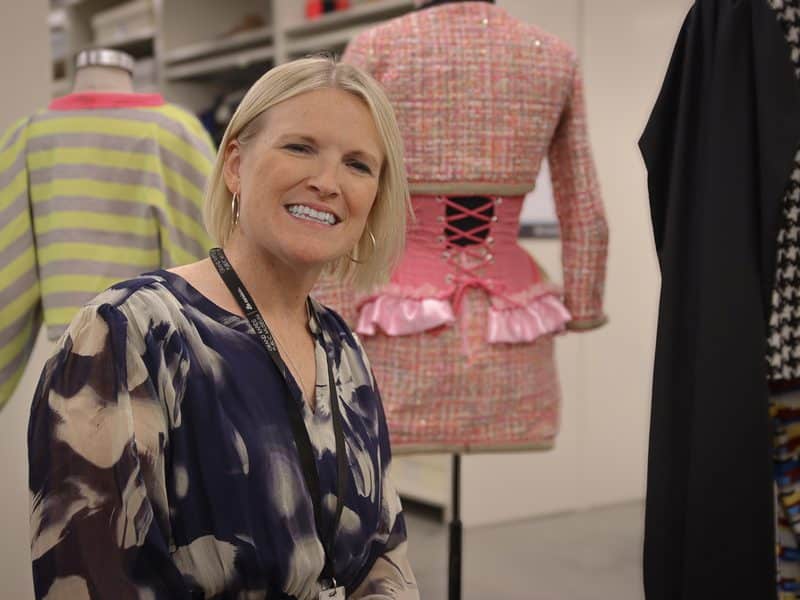
Something for every season: Fashion, curiosity, and community at the GRPM’s new archive center
Inside the Grand Rapids Public Museum’s new Archives Center, Kendall College of Art and Design students are turning decades-old garments into inspiration for their next designs.


